Written By | International News Agencies
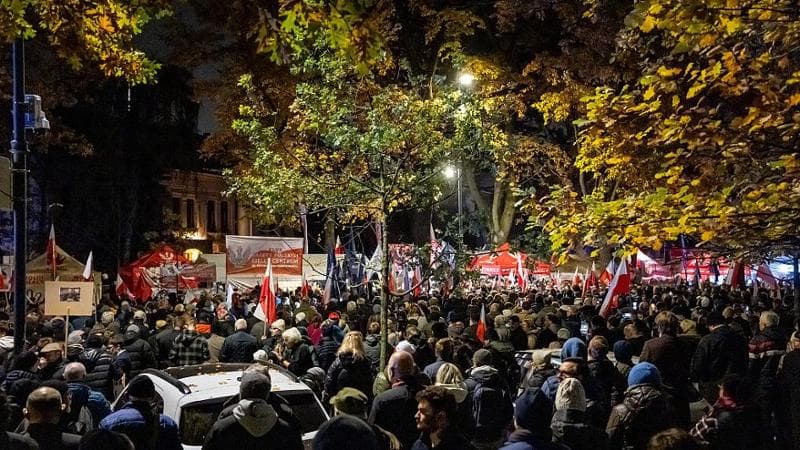
A years-long fight over who controls Poland's highest court erupted into street confrontation on Friday, with both sides calling the other's actions a coup.
World Politics
Overview
On the evening of Friday, October 30, 2026, a long-simmering struggle over the control of Poland's Constitutional Tribunal turned physical. Government-backed judges announced that the court's president, Bogdan Święczkowski, had been suspended; riot police surrounded the Warsaw building; a group of newly elected judges was escorted inside by State Protection Service officers; and protesters, including supporters of the opposition Law and Justice (PiS) party, gathered outside, where police said some in the crowd threw objects at officers and three people were detained. Meanwhile, President Karol Nawrocki, a PiS ally, ordered his plane to turn back to Warsaw while he was returning from a visit to Senegal, writing on X that the president must be in Poland at such a moment.
Both camps used the same word for what had happened, but in opposite directions. Święczkowski, the tribunal's own official account and opposition leaders called it a coup d'état. Prime Minister Donald Tusk, for his part, framed the move as the overdue restoration of the rule of law, writing that the process is painful and requires decisive action. Because accounts differ on who legally issued the suspension and on what authority, much of the story turns on a question that Polish lawyers themselves are sharply divided over: who, in the current constitutional order, is the legitimate leadership of the country's highest constitutional court.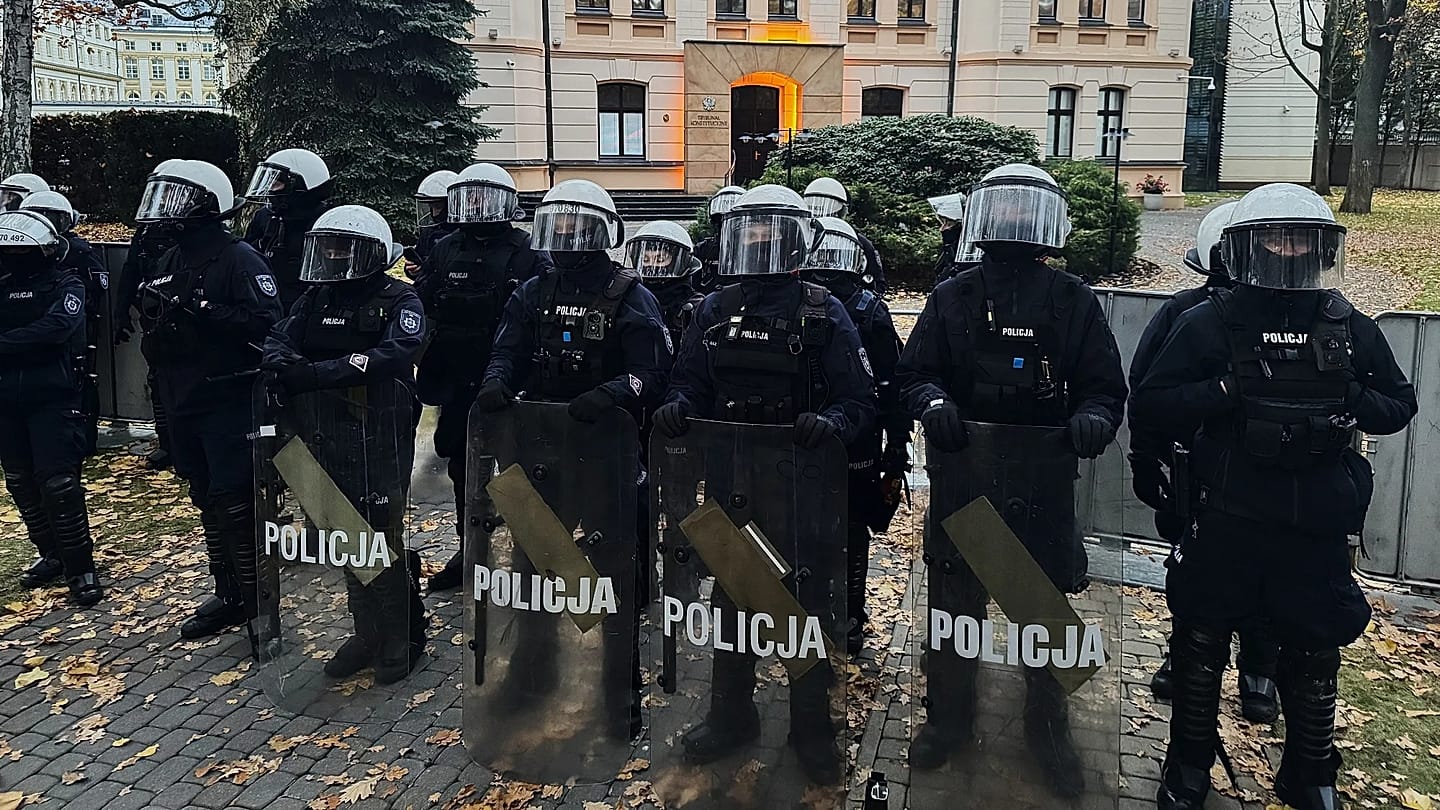
Background: A Court at the Center of Poland's Rule-of-Law Fight
The roots of Friday's confrontation go back to 2015, when the Law and Justice party took power and embarked on sweeping judicial changes. Critics at home and abroad said the reforms amounted to a political takeover of the courts, and the Court of Justice of the European Union ruled that the changes violated EU law. The Constitutional Tribunal, in particular, came to be seen by opponents as a body packed with judges friendly to the governing party.
After the October 2023 elections PiS remained the largest party but lost its parliamentary majority, and Tusk formed a pro-European coalition that won a confidence vote on a promise to reverse the changes. In practice the coalition has argued that three of the tribunal's judges were unlawfully appointed under the previous government, and it has therefore not recognised the body's legitimacy. According to reporting by Notes from Poland, the government ignored tribunal rulings and refused to nominate judges to fill vacancies until March 2026, when it began filling them.
Since then, parliament has chosen eight new judges this year. The mechanism for them to take office runs through the president, and here the cohabitation of a Tusk government with PiS-aligned presidents has proved decisive. Nawrocki, who won the presidency in mid-2025, has refused to swear in several of the judges nominated by parliament, citing how they were chosen and their qualifications. Accounts differ slightly on the number: Al Jazeera reports that he has refused three of six nominees, while Notes from Poland says he has refused five of eight chosen this year. Those judges took their oaths in parliament instead and submitted them to the president's office. Two earlier attempts by the government to legislate a repair of the judiciary were vetoed by PiS-aligned presidents, including Nawrocki.
Święczkowski, who was appointed under the PiS government and leads the court, refused to accept the parliament-sworn judges or let them take up their posts. Al Jazeera reports that for about six months he used his powers as court head to block judges elected by the current parliamentary majority from working, effectively paralysing the tribunal. Notes from Poland adds that he also disregarded an order from the European Court of Human Rights that the judges be allowed to take up their posts, arguing that the Strasbourg court lacked authority to issue it.
Key Developments on Friday
The sequence of events, as reported by Al Jazeera, Notes from Poland and Ynet, began with a statement on the tribunal's website announcing that Święczkowski had been suspended. Judge Anna Korwin-Piotrowska told the public broadcaster TVP that she had issued the order, accusing him of blocking judges from taking their posts and of irregularities in how cases were assigned. She is one of the judges Nawrocki declined to swear in, and she has now been placed in charge of the tribunal, according to Al Jazeera.
The website statement cited article 130 of the law on common courts, a provision that allows a court president or the justice minister to order a break in a judge's duties. That choice of legal basis is already contested. The legal scholar Marcin Matczak argued, as reported by Notes from Poland, that the justice minister has no such power over the Constitutional Tribunal. The tribunal's official X account went further, calling the takeover of its website unlawful, saying Korwin-Piotrowska is not a tribunal judge, and describing the whole operation as a coup.
Justice Minister and Prosecutor General Waldemar Żurek separately submitted motions to lift the immunity of Święczkowski and his deputy, Bartłomiej Sochański. Żurek argued that the two had failed in their duties by preventing judges from working. Such immunity motions are a prelude to possible criminal proceedings, though the reports available so far do not say what charges, if any, are contemplated.
At the building itself, riot police surrounded the court. Supporters of Święczkowski reportedly cut through the fence with a power tool, and Ynet carried footage of him trying to re-enter the grounds, where police blocked him. Notes from Poland reports that seven newly elected judges were escorted into the building by State Protection Service officers through a gate from the prime minister's chancellery, and that court spokeswoman Weronika Ścibor said Sochański was not admitted. Police later entered the premises after incidents in which objects were thrown at officers, and said they detained three people after some in the crowd launched what they called dangerous projectiles. Former Justice Minister Zbigniew Ziobro, a PiS figure, urged demonstrators to mount loud, firm, united and fearless resistance and called the suspension a blatant, criminal attack on the constitutional order.
Reactions
The political reaction split along the familiar line. Tusk posted on X that restoring the rule of law is the government's duty, that the process is difficult and sometimes painful, and that there was no alternative to decisive action. PiS leader Jarosław Kaczyński said Poland had become a police state and called on Nawrocki to return and defend the court. Zbigniew Kapiński, who heads the Supreme Court, said he was appalled and called the events undoubtedly a coup d'état, a notable intervention from the head of a separate judicial body.
Nawrocki's decision to abort his trip was the most visible sign that the presidency intends to be a party to the dispute rather than a bystander. Ynet noted that the move against Święczkowski came while the president was in the air on his way to Senegal, a timing that opponents will likely cast as opportunistic and that supporters of the government will likely describe as the only moment the operation could be carried out without a presidential veto. Reports so far do not say what Nawrocki intends to do on his return.
Outside Poland, there was little immediate formal reaction in the sources reviewed for this article. That silence may change quickly, given that the European Commission and the European Court of Human Rights have both been involved in Poland's judicial dispute for years.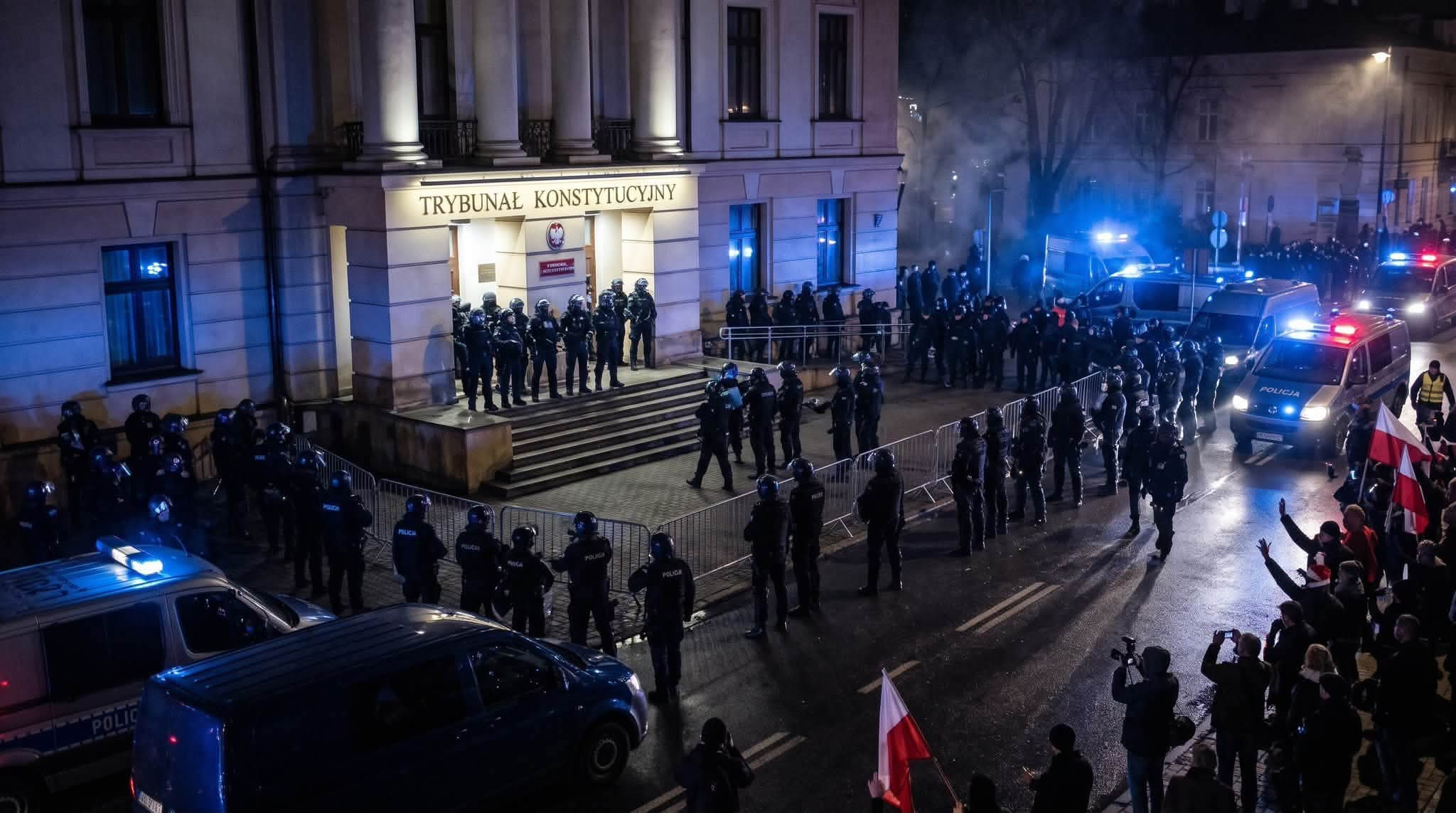
Analysis: Two Competing Legalities
The deeper difficulty is that each side can point to a legal narrative in which it is the defender of the constitution. The government's position is that the tribunal as constituted under PiS was tainted by unlawful appointments, that its leader has defied both parliament and an international court, and that the usual remedies were blocked by presidential vetoes and refusals to administer oaths. On this view, extraordinary steps are justified to unfreeze a body that cannot function. The opposition's position is that the constitution gives the president a role in swearing in judges, that the government has long disregarded the tribunal's rulings, and that suspending a sitting president of the court by means of a statute governing ordinary courts, with police and the prosecutor's office in support, is exactly the kind of executive interference that Poland's reformers once condemned.
Both arguments have weaknesses. The reliance on article 130 of the law on common courts to suspend the head of a constitutional court is vulnerable to the objection, voiced by Matczak, that the justice minister has no such authority over the tribunal. And the refusal of the court's leadership to admit judges sworn in by a parliamentary majority, along with its reported dismissal of a Strasbourg order, gives the government a basis for arguing that the tribunal's present leadership is itself acting outside the law. Which of these arguments prevails will not be decided by commentators; it will depend on whether the new leadership can in fact operate the building, whether the tribunal's staff and other judges follow it, and whether the courts and prosecutors treat its decisions as valid.
What Comes Next
Several things bear watching in the coming days. The first is whether the police presence and the new leadership hold, or whether Święczkowski's camp finds a way to reassert control of the premises, the website and the docket. The second is the fate of the immunity motions against Święczkowski and Sochański, which will test the willingness of parliament and the prosecutor's office to take the confrontation into criminal territory. The third is what Nawrocki does with the powers he retains, including the refusal to swear in judges, the use of vetoes and the possibility of challenging the legality of the new leadership before other bodies.
The fourth is the street. Friday's protests involved supporters of PiS and ended with police entering the premises and three detentions; if the opposition succeeds in mobilising larger crowds, the government's decision to use police to secure a contested court could become as politically costly as the paralysis it was intended to end. Finally, there is the European dimension. A government that came to power promising to restore EU-compliant judicial standards now finds itself accused by its critics of resorting to methods that Brussels would once have scrutinised closely. How the European institutions respond may determine whether the government's framing of Friday as a restoration of the rule of law gains traction outside Poland.
For now, the facts available are provisional. This was a fast-moving, breaking story, the reports differ on certain details such as the number of judges Nawrocki has refused to swear in, and Al Jazeera did not name who ordered the suspension while Notes from Poland attributes the order to Korwin-Piotrowska. What is clear is that Poland ended October with two rival claimants to the leadership of its highest constitutional court, and a president rushing home to contest the outcome.



