Written By | Political Desk
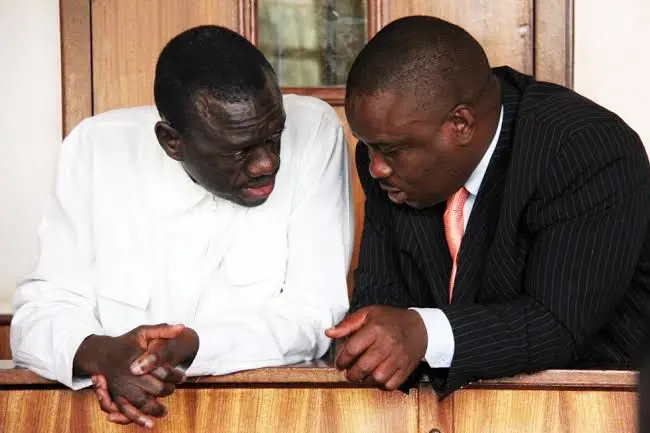
Justice Minister Norbert Mao says a government-backed reconciliation track is running alongside the courts, even as Erias Lukwago is moved to hospital and the opposition denies it is negotiating.
POLITICS
Uganda's government says it is pursuing a political settlement for two of the country's most prominent detained opposition figures, Dr Kizza Besigye and former Kampala Lord Mayor Erias Lukwago, with General Salim Saleh named as the person leading the effort. The announcement, made by Justice and Constitutional Affairs Minister Norbert Mao at a press conference at the Democratic Party offices in Kampala, came as Lukwago was taken to Mulago National Referral Hospital after his health reportedly worsened.
Mao said the initiative follows the direction of President Yoweri Museveni and is aimed at national reconciliation. He stressed that it is separate from the court cases and from the men's medical treatment. Beyond that, he offered few specifics: he did not name participants, describe the terms under discussion, or give a timeline, and he cautioned that the talks are not meant to bypass the courts and do not guarantee that either man will be released.
What was said
Mao described what he called "three theatres" of activity: the courts, medical care, and political engagement. The third, he said, is the most difficult, because it involves consulting people and institutions outside government, including the detained men's families and political parties. He said the government's immediate priority is the men's health, putting it bluntly: "Because if you die, even if you are released, what is the point?"
The minister also said the government does not want the law to appear selectively applied, with some people exempted from trial. That framing suggests that any political settlement would have to be reconciled with the ongoing prosecutions rather than simply replace them. He urged the public not to politicise the process and said he would share more information soon.
Unconfirmed reports say a committee of eminent persons has been formed to support the talks, and that opposition representatives are expected to engage Saleh's group. Those reports have not been verified, and Mao did not address them directly in the account of his remarks available to this briefing.
The two detainees
Dr Kizza Besigye, a longtime opposition leader, has been in detention since November 2024. He faces treason charges alongside his aide, Obeid Lutale, and UPDF officer Captain Denis Oyaa Oola. His case is before the High Court in Kampala, and proceedings have previously been interrupted over health concerns. According to the Peoples Front for Freedom (PFF), senior party officials have not been able to access him since he collapsed in court.
Erias Lukwago, a leader of the PFF, has been detained since June 2026 and is charged with misprision of treason, an offence that concerns knowing about a treasonable act and failing to report it. His lawyers are renewing bail efforts, arguing that he needs specialised medical treatment. He was moved to Mulago on Monday, 19 October.
The opposition's response
The PFF has denied that it is negotiating with Saleh over Besigye's release. That denial sits uneasily beside Mao's description of a process that involves consulting political parties and families, and it may reflect the party's reluctance to be seen as accepting a deal outside the judicial process, or simply that no formal talks have reached the party. The available reporting does not settle which. What is clear is that the two sides are describing the situation differently: the government as an active reconciliation effort, the opposition as one it has not joined.
Why it matters
The Besigye case has been one of the most politically charged legal matters in the country for nearly two years, and Lukwago's detention since June has added a second high-profile name. Both men are held on charges that carry heavy political weight, and the health of detained figures can quickly become a flashpoint domestically and with international observers. A hospitalisation raises the stakes: a serious medical event in custody would complicate any settlement and could harden positions on both sides.
The choice of General Salim Saleh as the lead figure is itself notable. Mao presented him as acting on the President's direction, which signals that the initiative has backing at the highest level of government, and positions it as an executive-driven track rather than a parliamentary or judicial one. At the same time, Mao's insistence that courts, medicine and politics are separate theatres reflects a legal reality: treason and misprision of treason charges are matters for the courts, and a prosecution of this kind would ordinarily end through a judicial decision or through the prosecuting authorities' own steps.
There is also a credibility question. Reconciliation efforts tend to succeed when both sides acknowledge them. With the PFF publicly denying negotiations and Mao declining to name participants, outside observers have little to judge the initiative by. The unconfirmed committee of eminent persons, if it exists, may become the clearest sign of whether the process has substance.
What to watch next
Several developments will indicate where this is heading. The first is Lukwago's medical condition and the outcome of his renewed bail application, since a court decision on bail would be the most concrete near-term change. The second is whether Mao delivers on his promise of further information, and whether that information includes names, terms or a schedule. The third is the PFF's posture: any shift from denial to engagement would suggest that contacts are real. The fourth is the Besigye trial itself, including whether hearings resume on schedule or are again interrupted by health concerns.
Finally, observers will look for how the political track interacts with the legal one. If the government's position that the law must not look selectively applied holds, a settlement would need a legal mechanism. If the political track produces releases without one, critics are likely to say the courts were sidelined. Mao has said the process is not meant to bypass them. No public agreement on conditions or timing for either man's release has been announced, and, as of 21 October 2026, the talks remain an assertion by the government that the opposition has not endorsed.
This account relies on press reporting by Nile Post, republished by AllAfrica on 20 October 2026. Details such as the unconfirmed committee and the content of any talks could not be independently verified.



