ABUJA, Nigeria
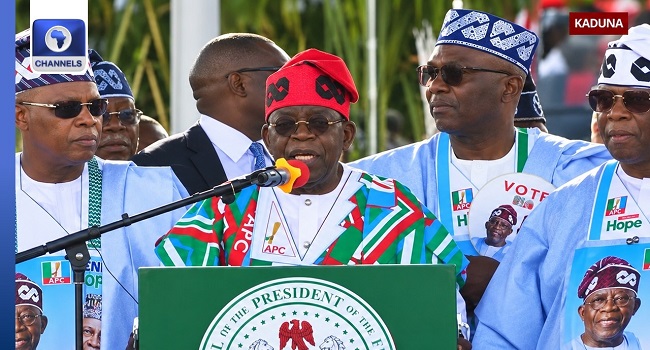
Seventy-eight days before Nigerians vote, the contest to lead Africa's most populous country has settled into a pattern that favors the man already in office. President Bola Tinubu formally opened his All Progressives Congress (APC) campaign for a second term on Saturday, October 24, at Ranchers Bees Stadium in Kaduna, and used the occasion to turn the cost-of-living crisis, the central grievance of the election, back on his opponents. "They created hunger and poverty. We are trying to eradicate them," he told the crowd, according to Arise TV's account of the rally. His main challengers, who have been unable to unify, answered within hours.
The exchange matters because Nigeria's opposition is running as three separate forces rather than one. Former Vice President Atiku Abubakar carries the African Democratic Congress (ADC), former Anambra governor Peter Obi leads the Nigeria Democratic Congress (NDC) ticket, and Oyo State Governor Seyi Makinde is running under the APM banner. Meanwhile, the president is travelling to Saudi Arabia for an Umrah pilgrimage, which his office describes as a religious trip, with his media aide denying it is for medical checks, according to allAfrica.

The calendar and the rules
Voting for president and the National Assembly is set for January 16, 2027, with governorship and state assembly elections following on February 6. Those dates were brought forward after Tinubu signed the Electoral Act 2026 on February 18; the presidential vote had previously been scheduled for February 20, 2027, and the governorship polls for March 6, according to the summary of the timetable on Wikipedia and reporting by Rio Times. Presidential campaigning formally opened on August 19 and closes on January 15, 2027.
The Independent National Electoral Commission (INEC) published its final list of presidential candidates on September 12. Eighteen parties each fielded one candidate, BusinessDay reported. Tinubu runs with Vice President Kashim Shettima. Atiku's running mate is Rotimi Amaechi, the former transport minister who finished second to him in the ADC primary. Obi's is Rabiu Kwankwaso, the former Kano governor. Sixteen of the 18 candidates are men.
Winning the presidency requires more than a plurality. Under Nigeria's rules, as summarized by Wikipedia, a candidate must lead the poll and secure at least 25 percent of the vote in two-thirds of the 36 states and the Federal Capital Territory. A modified runoff mechanism applies if no one meets the threshold. That geographic requirement is why the choice of Kaduna for the campaign launch carries weight beyond symbolism.
Why Kaduna
The APC has not publicly explained its choice, but the arithmetic is suggestive. In 2023 Kaduna State had 4,335,208 registered voters, and the seven North-West states together had 22,255,562, about 24 percent of the national register of 93,469,008, according to Rio Times. In that election Atiku, then running for the Peoples Democratic Party, won Kaduna with 554,360 votes against Tinubu's 399,293 and Obi's 294,494, taking 14 of the state's 23 local government areas. Governor Uba Sani of the APC won the governorship that year by just 10,806 votes, a result upheld by the Supreme Court in January 2024.
Put simply, the president opened his campaign in a state he lost in 2023 and in the region where Atiku remains strongest. Analyst Haruna Ibrahim described Kaduna to Rio Times as "more or less the centre of northern Nigeria." The timing is also notable. The rally came 84 days before polling, about 66 days after campaigning opened; in 2022 the APC launched 102 days before the vote. Campaign director Abdulaziz Yari announced the date on October 9. The party's schedule lists 37 stops, one in each state and the capital territory, with Calabar next on November 2, then Gombe on November 3, and a finale in Lagos on January 9.
What was said in Kaduna
According to Arise TV, Tinubu promised "prosperity, continuity, growth, recovery, and opportunity," said his government pays salaries regularly, and declared that the fuel subsidy "belongs to the past." He pledged an end to corruption, invoice falsification and smuggling, and told supporters their opponents "have nothing to offer you but heckling." Shettima sought to reassure northern voters, asserting that Tinubu had consistently supported northern political interests, including backing Atiku's 2007 presidential run, Nuhu Ribadu's in 2011, and Muhammadu Buhari's in 2015 and 2019.
Governor Sani used his remarks to showcase a road project. He said the 123-kilometer Kaduna–Birnin Gwari road, abandoned for over 40 years, is being rebuilt with N117 billion released to the contractor, and claimed that "today you can travel to Birnin Gwari with your eyes closed without a single police escort." Those are the governor's claims and were not independently verified in the sources reviewed.
The opposition replies
Atiku's response came through a statement from Phrank Shaibu of the ADC presidential campaign council. "Mr President, blaming the opposition for hunger is either delusion or a staggering case of political amnesia," it said, noting that the APC governed for eight years before Tinubu took office and that he has now added three and a half years. The statement also mocked the commissioning of an unfinished Abuja–Kaduna expressway from a stadium: "A road cannot be completed with a speech or a ribbon-cutting ceremony."
The ADC's campaign council, through Kola Ologbondiyan, went further, alleging that attendees were paid between N50,000 and N100,000 and that the 5,000-capacity stadium was sparsely filled. Those allegations are unproven, and the APC has not been shown to have responded to them specifically. What the APC did say, before the rally, was that Atiku and the ADC were plotting to discredit the event with fake news and deepfakes. Presidential campaign spokesman Dele Alake dismissed a purported letter about N2.3 trillion (about $1.73 billion) for the rally as "a senseless and utterly baseless lie," Rio Times reported. Attendance was not independently established in the reporting reviewed.
Another group, identified as MDPCO, alleged that at least 20,000 people have been killed in northern Nigeria since 2023 and millions displaced, saying "no part of the country should be an electoral warehouse to be raided every four years and abandoned after victory." The group did not provide verification for those figures.
How the opposition got here
The split is the product of a coalition that did not hold. In July 2025 the ADC leadership was reconstituted, with former Senate President David Mark as interim chairman, and the party was chosen as the vehicle for a unified opposition rather than registering a new one. Atiku, Obi, Amaechi and others pledged in September 2025 to back whoever won the ADC primary, according to Wikipedia.
That pledge did not survive the primary. Atiku won the ADC nomination on May 27, 2026, with 1,846,370 votes to Amaechi's 504,117; Amaechi and third-placed Mohammed Hayatu-Deen rejected the result, Rio Times reported, though Amaechi has since joined the ticket as running mate. Obi left the ADC for the NDC and named Kwankwaso as his deputy. Makinde declared on May 14 and was picked by the APM at a May 30 primary in Ibadan. He was elected governor in 2019 on the Peoples Democratic Party platform. The PDP itself has nominated Sandy Onor.
Markets, the economy and the naira
No reliable public polling was found for this briefing, and the sources reviewed do not cite any. Prediction markets offer a rough, imperfect read. As of October 24, Rio Times reported Polymarket pricing Tinubu at 68.5 percent and Obi at 24.0 percent to win, on about $135,959 in volume, while Kalshi priced Tinubu at 71 percent, Obi at 17 percent and Atiku at 3 percent. These are market prices, not polls, and thinly traded markets can be skewed by a handful of bettors.
The economic backdrop is harsh. The naira traded around 1,329.80 to the dollar on October 24 after a 2.1 percent one-day fall, according to the same report. Tinubu himself said in Kaduna that the fuel subsidy "belongs to the past"; the cost-of-living pressure that followed is why hunger has become the campaign's dominant theme and why his claim that opponents "created" it is such a contested line.
Analysis: three ways the race could move
First, fragmentation helps the incumbent, but only if the vote splits along regional and religious lines in a way that keeps the opposition from clearing the 25 percent threshold in enough states to force a contest. The two-thirds-of-states rule cuts both ways: it rewards national reach, which the APC machine has, but it also means Tinubu cannot win on his Southwest base alone. Atiku's strength in the North-West and Obi's in the South-East and parts of the North-Central region could deny him the geographic spread in a multi-way race, even if he leads the national count. Whether a runoff then becomes possible is a question INEC and the courts, not campaign managers, will settle.
Second, the question of who is blamed for hardship is not yet decided. Tinubu's strategy is to cast his challengers as the authors of the hardship and to ask voters to stay the course for recovery. Atiku's retort, that the APC has now governed for eleven and a half years, is equally pointed. The president has the advantage of incumbency's resources; the opposition has the advantage of a daily-bread issue that no stadium rally can erase.
Third, trust in the process is itself a campaign issue. Allegations of paid crowds, deepfakes and fake letters, from both sides, suggest a contest in which information is as contested as votes. INEC's handling of results transmission, and the credibility of the rules under the new Electoral Act, will matter more than any rally.
What to watch
The next stops on Tinubu's tour are Calabar on November 2 and Gombe on November 3, which will test the APC's ability to stage large events away from its strongholds. Watch also for any move by Obi, Atiku or Makinde toward a withdrawal or an informal alliance as the weeks pass, any court challenges over candidate eligibility or party leadership, and the Saudi trip: the presidency calls it a religious journey and denies it is for medical checks. Independent polling, when it appears, will be the first real test of the markets' confident prediction.
Published By | News Editor