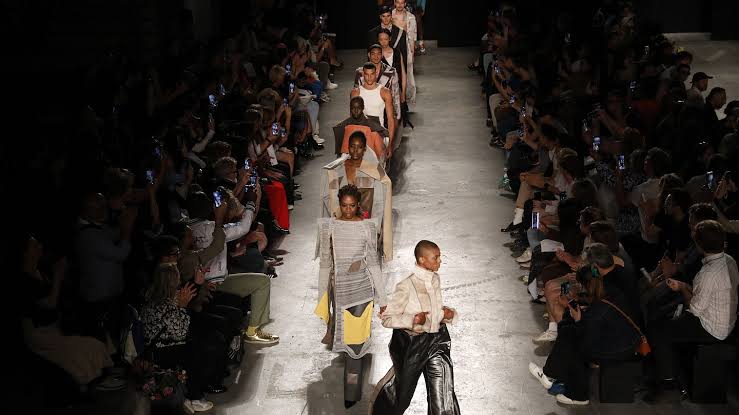
Marks & Spencer joins the official LFW schedule for the first time in its 100-year fashion history — with a shoppable collection, a live stream and a CEO who wants the clothes in your basket before the models are out of their shoes.
LONDON
London Fashion Week opened this morning the way it usually does: Paul Costelloe at 10 a.m., a schedule thickening through the day towards Harris Reed and H&M, five days of shows stretching to Monday. What is not usual arrives tomorrow at midday, when a high street retailer better known for Percy Pigs and school shirts takes a place on the official runway calendar for the first time.
Marks & Spencer is showing at London Fashion Week, and the clothes will be available to buy immediately. It is either the most democratic thing to happen to the British fashion calendar in years or a sign that the calendar has run out of designers — and both positions are being argued in Mayfair this week with some heat.

One hundred years of getting dressed
The occasion is a centenary. M&S has been in the fashion business for a hundred years — a longer continuous run than most of the houses it will share a schedule with — and has been unsubtle about wanting credit for it. The show draws on Collection, Per Una and Autograph, three sub-brands that between them have clothed a remarkable share of the British population, and promises to reimagine some of the retailer's most recognisable fashion moments for a contemporary audience.
The format is the point. This is a "see now, buy now" collection of womenswear and menswear, available online and in flagship M&S stores across the UK and key international markets essentially as the show ends, streamed live on the retailer's Instagram and YouTube channels with behind-the-scenes footage alongside.
"I'd like to thank the British Fashion Council for supporting us in joining the LFW schedule," M&S chief executive Stuart Machin said when the show was announced in July. "This is a special moment; for 100 years M&S fashion has been part of everyday life and now we will showcase our designs on fashion's global stage."
He then said the part that will irritate some of his new neighbours on the schedule. "At M&S we focus on designing clothes with style, quality and value, and making fashion accessible to all. That's why we will stream our show, bringing one of the world's leading fashion weeks to everybody."
Laura Weir's rebuilt calendar
None of this happens without the British Fashion Council, whose chief executive Laura Weir has spent her tenure trying to get brands back onto a London schedule that had been leaking them for years. McQueen, Stella McCartney and Victoria Beckham all decamped to Paris. This September, Alexander McQueen returns to London and Christopher Kane makes his Mulberry debut. M&S is the third pillar of the same recovery.
Weir's framing of the M&S booking is careful and revealing. "As one of the great icons of the British high street, and a valued patron of the British Fashion Council, M&S has played an important role in the nation's retail and cultural story for generations," she said. "Its debut shoppable collection at London Fashion Week is a significant moment, demonstrating how heritage, innovation and accessibility can come together to connect exceptional British design with consumers in new and relevant ways. It is a powerful example of how fashion can inspire, engage and reach audiences far beyond the runway."
Read that last sentence again and you find the strategy. London has never been able to out-spend Paris or out-heritage Milan. What it can do is out-reach both — and a retailer with a store on almost every British high street and a live stream pointed at everyone is a more efficient reach machine than any luxury house in Europe.

A retailer with something to prove
There is a harder commercial context behind the centenary bunting. M&S's full-year results, for the 52 weeks to 28 March 2026, were badly disrupted by the cyberattack that took its online operations offline: sales in the affected division fell 7.7% to £3.9 billion, adjusted operating profit dropped 55.4% to £213.4 million, and the margin landed at 5.5%. Second-half sales grew a bare 0.2% as online trading was restored, still constrained by availability and the clearance of excess seasonal stock.
Womenswear took the worst of it. But the underlying fashion story has been improving, and the numbers the company prefers are about category leadership rather than totals: it is the UK's biggest retailer of women's denim, with an 18.2% market share, and growing share in men's denim. It has been editing rather than expanding, removing 9% of options in store for Spring/Summer.
A London Fashion Week show, in that light, is not a vanity project. It is a bid to convert grudging respect — the quiet acknowledgement that M&S basics are good and its prices sane — into the thing the retailer has never quite had, which is desire. And it follows a pattern: the M&S Summer show, and a genuinely strange world-first catwalk staged in the pit lane at the British Grand Prix.
What this means for the person who actually buys clothes
For anyone who has watched a runway show, loved a coat, and discovered it will arrive in stores in seven months at a price resembling a mortgage payment, tomorrow is a small revenge. See-now-buy-now collapses that gap to nothing: the clothes on the runway at midday are purchasable at 12.30.
The format has been tried before — Burberry and Tommy Hilfiger both attempted it a decade ago and both retreated, because luxury supply chains are built around the long lead time and the anticipation is part of what is sold. A mass retailer has neither problem. M&S already manufactures at scale, already stocks nationally, and gains nothing from making customers wait.
The open question will be litigated in reviews tomorrow afternoon: whether a shoppable high street collection can be judged as fashion rather than merchandising. Expect a split, expect the clothes to sell regardless, and expect at least one critic to note that the most-watched show of London Fashion Week may be the one with the lowest average price point.
The high street at the top of the schedule
London Fashion Week has always been the scrappiest of the four, trading in discovery rather than dominance. Putting M&S on the official calendar bets that the scrappiness now lies in reach — that a live-streamed show selling an affordable coat to a hundred thousand people is a more radical act in 2026 than another beautifully lit collection nobody can buy.
It is also, unavoidably, a hundredth birthday party. For a century, M&S has dressed Britain without once being asked to defend the results in front of a seated row of critics. Tomorrow at midday, it will be.
Published By | Features Editor