DAR ES SALAAM, Tanzania
Ten months after Tanzania's October 2025 general election set off the deadliest unrest in the country's recent history, President Samia Suluhu Hassan this past week inaugurated a new criminal commission — staffed in part by judges from Namibia and Uganda — with a mandate to identify who planned and financed the violence that a previous inquiry found killed approximately 518 people. The commission's launch on Aug. 7 came even as opposition leader Tundu Lissu remained in pretrial detention on treason charges, his trial dogged by more than a year of procedural delays, and as international bodies including the Commonwealth apply mounting, still-unresolved pressure on Dar es Salaam to release him and open talks with the opposition.
Background
Hassan, who took office in 2021 following the death of President John Magufuli, was declared the winner of the Oct. 29, 2025, presidential election with a reported 98% of the vote, according to Tanzania's electoral commission — a landslide margin achieved after the country's main opposition party, CHADEMA, was disqualified from both the presidential and parliamentary races for refusing to sign an official code of conduct. CHADEMA's chairman, Tundu Lissu, who had campaigned for the disqualified party under the slogan "No Reforms, No Election," was arrested that April and charged with treason over a speech prosecutors said called on the public to rebel and disrupt the vote. His lawyers have said the charge is politically motivated.
The election itself triggered nationwide protests that security forces met with tear gas and, protesters and rights groups say, live ammunition; government buildings were set ablaze in several cities, and authorities imposed a near-total internet blackout as the unrest spread. In the crisis's aftermath, retired Chief Justice Mohamed Chande Othman led a 153-day fact-finding inquiry — interviewing 1,323 victims in person and collecting 953 written affidavits, alongside forensic and geographic analysis of images and video — that concluded in April 2026. The Chande Commission's report found that approximately 518 people were killed during the October unrest and that 245 people remained missing out of 758 reported disappearances recorded between 2023 and 2025. Investigators identified what they termed "criminal indicators requiring accountability" but, drawing criticism from civil society, stopped short of naming individual perpetrators, saying that task fell outside its fact-finding mandate.

Key developments
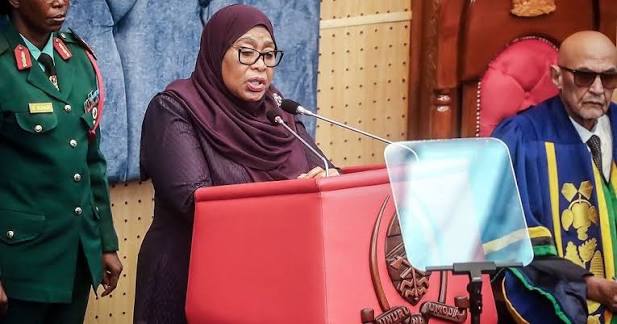
The commission inaugurated at State House in Dar es Salaam on Aug. 7 is explicitly designed to close that gap. Chaired by Justice Shaban Ali Lila, a retired justice of Tanzania's Court of Appeal, the six-member panel also includes three retired Tanzanian High Court justices — Gad John Mjemmas, Awadh Mohamed Bawazir and Aishieli Nelson Sumari — alongside two judicial figures from elsewhere in Africa: Justice Petrus Tilainge Damaseb, deputy chief justice of Namibia's High Court, who has also served in the appellate courts of Lesotho and Botswana, and Justice Barishaki Cheborioni of Uganda's Court of Appeal, who has led inquiries into human rights violations in his own country, including the burning of the Kasubi Tombs. A six-person secretariat led by Paul Kadushi will support the panel's work.
"We decided to include our colleagues [from the region] in order to obtain a broader perspective," President Hassan said at the launch. "This commission will delve deeper to find out exactly who instigated, who was involved, and who provided funds for those things to happen in our country." She gave the commission 150 days — roughly five months — to complete its work, though she indicated the government would consider extending the deadline if requested. "I recognise the weight of this responsibility," she said, adding: "I strongly urge all Tanzanians to provide the necessary cooperation to the commission in carrying out their duties... and not to disturb it in carrying out its work." Chief Secretary Ambassador Dr. Moses Kusiluka said the new panel would conduct "a more in-depth investigation into specific matters identified by Justice Othman's commission and other new matters as they may arise," including looting, the deaths of children, and unresolved claims of missing bodies and abductions.
The commission's formation follows months of criticism. A coalition of 14 civil society organizations had faulted the Chande Commission for collecting more than 1,300 victim testimonies without naming a single perpetrator, arguing the approach appeared designed to avoid accountability rather than deliver it. Former Prime Minister Joseph Sinde Warioba has separately questioned the government's decision to keep the full Chande report confidential, noting that past inquiries of similar significance were made public to support national healing. When the criminal commission was first announced in May, opposition leaders and rights groups voiced similar skepticism about whether it would function independently of the government whose security forces stand accused of much of the violence under investigation.
Lissu's own case has moved in fits and starts through Tanzania's courts. His treason trial, which opened in May 2025, was effectively halted on Feb. 24, 2026, after the High Court struck down a prosecution bid to introduce additional evidence from a witness who had already testified; the Director of Public Prosecutions then sought a revision of that ruling at the Court of Appeal. That revision bid was dismissed on July 30 by a three-justice appellate panel — Augustine Mwarija, Zainabu Goronya Muruke and Amour Said Khami — who found the prosecution's application "devoid of merit," a ruling defense lawyers characterized as a significant setback for the state's case. As of July 22, CHADEMA said Lissu had spent 468 days in pretrial detention on charges that carry a potential death sentence.

International pressure and opposition response
The Commonwealth has emerged as the most active international body pressing Dar es Salaam toward a resolution. Its Ministerial Action Group issued a statement after its 73rd meeting on July 10 setting a series of deadlines: 30 days for the government to resolve Lissu's detention through a political or legal pathway and to release others held solely for the peaceful exercise of their rights; 60 days to restore full access to digital platforms and end intimidation of media and free-expression advocates; and 90 days to convene a credible, inclusive inter-party forum, with neutral facilitation, covering electoral reform, political competition, detainees and accountability. Government spokesperson Gerson Msigwa said on July 22 that Dar es Salaam was "assessing" the statement. "Tanzania is a sovereign country, a country that decides its own affairs," he told reporters in Dodoma. "But it is also a country governed on constitutional and legal foundations. We will carry out an assessment... and provide the Government's response." A Commonwealth extraordinary session is scheduled for September, with a formal response meeting set for November.
CHADEMA, for its part, has ruled out entering any talks without Lissu's prior release and without an independent mediator. "There will be no talks led by anyone unless the chairperson himself is out," CHADEMA deputy chairperson John Heche told reporters on July 22 outside the party's Kinondoni offices. "There are no talks we will enter into without a mediator. We will not go into talks of any kind with a gun held to us and while being blackmailed... going into talks on our knees." Washington has separately escalated pressure: the U.S. sanctioned Tanzania's police chief in May over alleged human rights violations tied to the crackdown, barring the official from entering the United States, while Senators Jeanne Shaheen and Ted Cruz introduced a bipartisan bill requiring a comprehensive review of the U.S.-Tanzania relationship in light of the October violence.
Analysis and outlook
The Lila Commission's launch gives Hassan's government a mechanism to demonstrate accountability without releasing Lissu or reversing CHADEMA's disqualification — the core demands of both the opposition and the Commonwealth. Whether the new panel can function independently, given that any credible investigation into "who provided funds" for the unrest will inevitably touch the security services that answer to Hassan's own government, is likely to be the central test of its credibility over its five-month mandate. The involvement of Namibian and Ugandan jurists is intended to lend the process external legitimacy, though rights groups that criticized the Chande Commission's confidentiality are likely to scrutinize whether the Lila Commission's findings — and any resulting prosecutions — are made public in a way the earlier report was not.
In the near term, the more consequential date may be the Commonwealth's September deadline for Tanzania to report progress against CMAG's 30-, 60- and 90-day benchmarks. With Lissu still detained and CHADEMA refusing talks on any other terms, Tanzania appears headed toward that deadline out of compliance on its most politically sensitive demand, setting up a fresh diplomatic confrontation just as the criminal commission's work is getting under way. How Dar es Salaam navigates that overlapping pressure — from a skeptical domestic civil society, an increasingly impatient Commonwealth, and a U.S. Congress weighing further sanctions — will shape whether Tanzania's political crisis begins to ease before its first anniversary in October, or hardens further.
Published By | News Editor