Health Desk
For half a century, pancreatic cancer has been the diagnosis oncologists dread delivering most. It is the cancer that hides. It is the cancer that spreads before it whispers. And it is the cancer that, for the overwhelming majority of patients who reach the point where chemotherapy stops working, has offered nothing at all except a calendar with very few pages left in it.
That calendar has just been rewritten.
The US Food and Drug Administration has approved Rasonque — generic name daraxonrasib — the first medicine ever cleared that goes straight for RAS, the mutated master switch that drives around nine in ten pancreatic tumours. It is a tablet. You swallow it once a day. And in the pivotal trial that got it over the line, patients taking it lived a median of 13.2 months compared with 6.7 months for those on standard chemotherapy.
Read that again. Not 13.2 weeks. Months. In a disease where crossing the one-year mark after second-line treatment has essentially never happened in a randomised phase 3 trial, in any line of therapy.
"This drug showed unprecedented results in an area of high unmet need," said Dr Angelo de Claro, director of the FDA's Oncology Center of Excellence, in the agency's approval announcement.

THE PROTEIN THEY SAID COULD NOT BE TOUCHED
To understand why cancer researchers have spent the past fortnight sounding faintly giddy, you need to understand RAS.
RAS is a family of proteins that sits inside your cells acting as an on-off switch for growth signals. When it works properly, it flicks on, tells the cell to divide, and flicks off again. When a mutation jams it in the ON position, the cell is handed a permanent instruction to multiply. It is one of the most common faults in all of human cancer — and in pancreatic adenocarcinoma, the form that accounts for roughly 90 to 95 per cent of the 67,000 new US pancreatic cancer cases each year, it is very nearly universal.
The problem was the shape of the thing. RAS is a small, smooth, almost featureless protein. Drug molecules work by wedging into pockets and grooves; RAS barely has any. Generations of medicinal chemists tried, failed, and gave the protein a grim nickname that stuck for four decades: undruggable.
"For many years, researchers believed that successfully targeting RAS had the potential to transform the treatment of pancreatic cancer, but therapeutically blocking RAS signalling proved extraordinarily challenging," said Dr Brian Wolpin, director of the Hale Family Center for Pancreatic Cancer Research at Dana-Farber Cancer Institute, who led the trial behind the approval.
Recent years brought partial victories — drugs that hit one specific RAS mutation, in the switched-off state, useful mainly in lung and colorectal cancer. Daraxonrasib is a different animal. It is what chemists call a multi-selective RAS(ON) inhibitor: it binds the protein in its active, switched-on configuration, and it hits multiple RAS variants at once rather than a single mutation. That breadth is precisely why it works in a cancer whose mutations are messy and varied.
WHY THIS CANCER IS DIFFERENT
It is worth pausing on why a six-and-a-half-month gain counts as a landmark rather than a footnote, because in most cancers it would not.
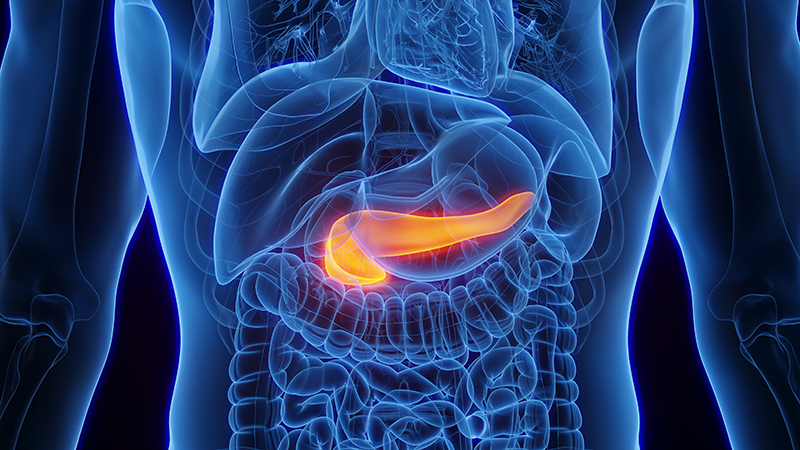
Pancreatic adenocarcinoma accounts for roughly 3.2 per cent of all cancer diagnoses in the United States. It accounts for a wildly disproportionate share of cancer deaths. The reasons are brutally simple. The pancreas sits deep in the abdomen behind the stomach, so tumours grow without pressing on anything that hurts. There is no screening test for the general population. By the time symptoms appear — jaundice, back pain, sudden unexplained weight loss, a new diabetes diagnosis in someone over 50 — the disease has very often already spread to the liver or the lining of the abdomen.
That means the majority of patients are diagnosed at a stage where surgery is off the table and chemotherapy is the only lever available. When that chemotherapy stops working, which it usually does within months, the second-line options have historically been thin, toxic and only marginally effective. Oncologists have spent decades in that second-line consultation with essentially nothing new to offer.
This is the gap Rasonque has walked into.
WHAT THE TRIAL ACTUALLY SHOWED
The study is called RASolute 302. It was a randomised, open-label, multicentre phase 3 trial enrolling 500 patients with metastatic pancreatic adenocarcinoma across North America, Europe and Asia — people whose disease had already progressed after one previous line of systemic treatment. Half got the daily tablet. Half got the chemotherapy that has been the standard fallback for years.
The headline result: median overall survival of 13.2 months on daraxonrasib versus 6.7 months on chemotherapy. That is a 60 per cent reduction in the risk of death — a hazard ratio of 0.40 — with a p-value under 0.0001, statistical language for "this is not a fluke."
Progression-free survival, the time before the tumour starts growing again, was 7.2 months versus 3.6 months across the whole trial population, and 7.3 versus 3.5 months among patients with the common RAS G12 mutations.
Tumours actually shrank measurably in 31.6 per cent of patients on the tablet, against 11.2 per cent on chemotherapy — and in the RAS G12 group the response rate was 33.2 per cent versus 11.8 per cent, close to a threefold difference.
The results were presented at a plenary session of the 2026 American Society of Clinical Oncology annual meeting — the slot ASCO reserves for the handful of studies it believes change practice — and published in the New England Journal of Medicine.
SIX AND A HALF MONTHS EARLY
Here is the part that surprised even the analysts. The FDA did not take its time.
The agency signed off on 26 August 2026 — a full 6.5 months before the user-fee deadline it had set itself. Rasonque had already collected Breakthrough Therapy designation, Orphan Drug designation and Priority Review, and it was pushed through the Commissioner's National Priority Voucher pilot programme, a scheme designed to fast-track therapies the agency deems national public health priorities. Back in May, the FDA had issued a "safe to proceed" letter allowing an expanded access protocol so that dying patients could get the drug before it was formally approved.
"Today's approval provides a critical new option for patients facing an extraordinarily difficult and historically hard-to-treat cancer. It is our fundamental duty to deliver more cures and meaningful treatments to patients as quickly as possible," said Acting FDA Commissioner Kyle Diamantas.
The licence covers adults with metastatic pancreatic adenocarcinoma who have had at least one prior systemic therapy, or who are not candidates for multi-drug chemotherapy in the first place — a group that includes many older and frailer patients who could never have tolerated the standard regimens anyway.

THE SIDE EFFECTS NOBODY SHOULD SKIM PAST
This is not a gentle drug, and the label does not pretend otherwise.
The most common adverse effects are rash, diarrhoea, stomatitis (painful inflammation of the lining of the mouth), nausea, fatigue, vomiting, abdominal pain, swelling, loss of appetite and bleeding. The rash in particular is close to universal: at the 300mg dose, rash of some grade occurred in around 90 per cent of patients, with severe grade 3 or higher rash in about 7 per cent.
And yet — and this is the number oncologists keep pointing at — only 1.2 per cent of patients stopped daraxonrasib because of side effects. On chemotherapy, 11.2 per cent quit. Severe grade 3-or-worse adverse events were actually slightly less common on the tablet (61.8 per cent) than on chemotherapy (69.6 per cent).
Put bluntly: it makes you itch, it makes your mouth sore, and almost nobody wants to stop taking it. That tells you something about what the alternative looks like.
THE NUMBER THAT SPOILS THE PARTY
Revolution Medicines, the California biotech behind the drug, has set the wholesale acquisition cost at 39,800 dollars for a 30-day supply. Over a year, that is roughly 477,000 dollars.
The company says eligible commercially insured patients may pay as little as zero at the pharmacy counter through co-pay assistance, and its chief financial officer has projected gross-to-net discounts of 20 to 30 per cent, meaning insurers and government programmes will pay less than the sticker. None of that changes the fact that a drug extending median life by about six and a half months has been priced at close to half a million dollars a year — or that the people most likely to be caught in the gap are the uninsured and the underinsured.
Wall Street, for its part, saw this coming. Revolution Medicines shares surged 41 per cent in a single day when the phase 3 results first landed in April, hitting an all-time high of 136 dollars.
WHAT THIS MEANS FOR YOU
If you or someone you love has metastatic pancreatic adenocarcinoma and has already been through one line of chemotherapy, this drug is available now, by prescription, in the United States. The single most useful thing you can do is ask your oncologist two questions: has my tumour been tested for RAS mutations, and am I eligible for Rasonque?
If you are newly diagnosed and have not yet started treatment, ask about tumour genomic testing early. The approval is for second line and for people unfit for combination chemotherapy — but knowing your RAS status now saves time later, and trials in earlier settings are already running.
If you are a caregiver, start the insurance conversation on day one, not on day thirty. Prior authorisation for a drug at this price point is not a formality.
And if you have a family history of pancreatic cancer, none of this changes the basics. This is still a disease best caught early, and it still gives almost no early warning. Unexplained weight loss, new-onset diabetes after 50, painless jaundice, persistent pain radiating to the back — these are not things to sit on.
WHAT HAPPENS NEXT
The obvious question is whether daraxonrasib works better earlier. Trials testing it in first-line metastatic disease, and in combination with chemotherapy, are already under way. And because RAS mutations are not confined to the pancreas — they are central to large slices of lung and colorectal cancer too — a drug that hits RAS broadly, rather than one mutation at a time, has implications well beyond this one approval.
There is a sober coda. Median survival of 13.2 months is a landmark in pancreatic cancer precisely because the bar was so appallingly low. It is not a cure. Half the patients in the trial still died within roughly thirteen months. The disease remains one of the deadliest in oncology, killing far out of proportion to the 3.2 per cent of cancer diagnoses it represents.
But for the first time in forty years, the switch that drives it has been flipped off in a randomised trial, in real patients, with a pill. Everything else is now a question of how much better it can get — and who will be allowed to afford it.
Published By | Features Editor