Kinshasa/Kigali
More than 15 months after the Democratic Republic of Congo and Rwanda first signed a U.S.-brokered peace framework, negotiators from both governments met in Geneva on September 16 and 17 for the seventh round of talks under the deal's Joint Security Coordination Mechanism — and the fundamental dispute that has stalled implementation from the start remains unresolved: Rwanda wants the FDLR militia neutralized before it will fully withdraw its forces from eastern Congo, while Congo insists Rwandan troops must leave regardless, and refuses to accept its sovereignty being conditioned on a security guarantee. With M23 rebels still controlling large swaths of North and South Kivu and a parallel Qatar-mediated track with the rebel group barely moving, the Geneva meeting underscored how far the celebrated Washington agreement remains from translating into peace on the ground.
Background: A War That Predates the Peace Deal
The roots of the conflict reach back to the 1994 Rwandan genocide, after which Hutu militia members who had participated in the killings fled across the border into what is now the Democratic Republic of Congo, eventually coalescing into the Democratic Forces for the Liberation of Rwanda, known by its French acronym FDLR. Rwanda has cited the FDLR's continued presence in eastern Congo as a persistent security threat ever since, and has repeatedly intervened militarily in the region, both overtly and through proxy forces, over the past three decades.
The current phase of the crisis accelerated with the resurgence of the M23 armed group, which first emerged in 2012, went dormant, and then relaunched a major offensive in 2022. M23 — which operates under the political umbrella of the Congo River Alliance, or AFC — seized the provincial capital of Goma in January 2025 and went on to capture South Kivu's capital, Bukavu, later that year, before taking the city of Uvira in December 2025. Congo has long accused Rwanda of arming, training and directing M23, a charge Kigali denies, insisting its military posture is purely defensive against the FDLR threat on its border.
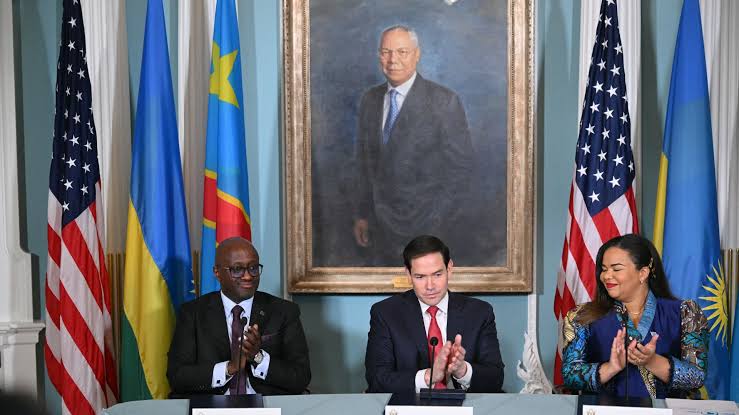
Under international pressure, the two countries' foreign ministers signed an initial peace agreement in Washington on June 27, 2025, and their heads of state — Congolese President Félix Tshisekedi and Rwandan President Paul Kagame — reaffirmed it at a signing ceremony on December 4, 2025, under the banner of the Washington Accords for Peace and Prosperity. The deal, mediated with support from the United States, Qatar, Togo and the African Union Commission, commits Rwanda to disengaging its forces and lifting defensive measures along the border, commits Congo to neutralizing the FDLR through a process of disarmament, demobilization and conditional reintegration of non-state armed groups, and establishes a regional economic integration framework built around trade in critical minerals — a nod to the economic incentives Washington has attached to the diplomacy.

Nine Rounds of Meetings, Limited Results
Since the deal's signing, the two sides have met repeatedly under the Joint Security Coordination Mechanism, or JSCM, a body co-chaired with U.S. participation and established within 30 days of the original agreement. Meetings in the second half of 2025 produced incremental steps — a security mechanism review in September, a finalized set of security arrangements in October, and agreement on the economic integration framework in November — but by March 2026, independent monitors reported that fighting continued largely unabated despite the diplomatic process, that M23 retained its territorial gains, and that Rwandan troops remained inside Congolese territory. The United States responded on March 2, 2026, by imposing sanctions on elements of the Rwandan military, a sign of Washington's frustration with the pace of implementation even as it continued to sponsor the talks.
The process has continued through 2026 nonetheless. On July 28, Congo and the FDLR-focused disarmament track saw a bilateral protocol signed; on August 7, the two sides carried out a limited prisoner exchange, releasing 15 detainees. At the sixth JSCM meeting, held August 12-13 at the U.S. mission in Geneva, Congo presented a formal Disarmament, Demobilization and Reintegration plan for FDLR combatants, with the United Nations mission in Congo, MONUSCO, joining a virtual session to share its own operational experience with past DDR efforts. The two governments agreed to advance a pair of new initiatives aimed at strengthening monitoring and verification of the accords and scheduled a trilateral planning conference with the United States for October 2026 to produce a revised military "operations order" — technical-sounding language for what would amount to a concrete, verifiable roadmap for troop movements and disengagement.
The September Geneva Round
That set the stage for the seventh JSCM meeting on September 16-17 in Geneva, which Al Jazeera and other outlets framed as a critical test of whether the peace deal can survive its second year. Congolese government spokesperson Patrick Muyaya represented Kinshasa's position publicly in the run-up to the talks, while Rwandan President Kagame has been notably blunt in his public assessments of the process, calling the arrangements around FDLR neutralization "insufficient" — a striking statement from a head of state whose government is a co-signatory to the framework meant to resolve exactly that dispute. On the Congolese side, sentiment among civil society has grown similarly skeptical; one pro-democracy activist quoted in Al Jazeera's coverage captured the mood bluntly: "People are still waiting for the real benefits of peace that have been trumpeted for over a year."
Complicating the picture further, M23 itself is not a signatory to the Washington agreement and has no formal seat at the Geneva table. The group, whose spokesperson Lawrence Kanyuka speaks for the AFC-M23 coalition, instead participates in a separate, Qatar-led dialogue directly with the Congolese government — a parallel process that has moved even more slowly than the Rwanda-focused track. According to the U.N. Security Council's September 2026 monthly forecast on the Congo situation, that Doha process has produced signed protocols on only two of eight planned agreement areas — a ceasefire oversight and verification mechanism, and a mechanism for the liberation of detainees — leaving the substantive issues of territorial control, governance and long-term security arrangements with M23 essentially untouched. Representatives from that track were also in Geneva during the same period, the Security Council report noted, working to address "outstanding issues which have hampered progress."
Adding to the tension, AFC-M23 reported on August 27 that a humanitarian aircraft operating in the conflict zone had been shot down, an incident that has not been independently resolved but that highlights how fragile conditions remain for civilians and aid operations in areas under the group's control, even as diplomats meet in Geneva conference rooms thousands of miles away.

Stakes on the Ground
The consequences of the process's slow pace fall overwhelmingly on civilians in North and South Kivu, where fighting between the Congolese army, known as FARDC, and M23 has continued in what the Security Council's September forecast described as a situation that "continues to deteriorate, despite various ceasefire agreements." The same report noted that ongoing displacement, weakened public institutions and the sheer complexity of the regional conflict have left civilians "vulnerable and unprotected," even as a concurrent Ebola outbreak in the country — with thousands of confirmed cases and well over 2,000 deaths reported by U.N. agencies this year — has stretched the same public health and humanitarian infrastructure already strained by conflict displacement.
The diplomatic stakes are equally significant for the broader region. The Washington framework represented a rare instance of sustained, high-level American engagement in a Central African conflict, paired explicitly with economic incentives around critical minerals — cobalt, tantalum and other resources concentrated in the eastern Congo that have drawn global commercial interest even as they fuel the conflict economy that arms militias on both sides of the border. Critics, including regional analysts cited in earlier coverage of the agreement, have argued the deal primarily serves U.S. geopolitical and economic interests rather than addressing M23's underlying territorial ambitions or the unresolved political grievances of communities in the east — an assessment the persistent fighting since the deal's signing has done little to dispel.
What to Watch Next
The most concrete near-term marker is the trilateral planning conference with the United States scheduled for October 2026, meant to produce the revised military operations order that both sides agreed to pursue at the August JSCM meeting. Whether that conference actually narrows the gap between Rwanda's demand for verified FDLR neutralization and Congo's demand for unconditional troop withdrawal will be the clearest signal yet of whether the Washington-Geneva process can move from statements of principle to enforceable steps on the ground.
Equally important will be whether the parallel Doha track with M23 itself makes any movement beyond its current two of eight signed protocols; without direct progress with the group that actually controls the contested territory, the state-to-state diplomacy between Kinshasa and Kigali risks addressing only part of the conflict. And with James Swan, the head of the U.N. mission MONUSCO, expected to brief the Security Council on the situation this month, international attention on the gap between diplomatic process and battlefield reality is unlikely to fade — even as, fifteen months after Washington, the guns in eastern Congo have yet to fall silent.
Published By | News Editor