Daily World Politics
Overview
With nine days until the November 3 midterm elections, the Trump administration has quietly loosened part of its tariff wall against Canada, a move that political observers see as aimed squarely at protecting Republicans in tight races. On Friday, October 23, the White House announced it was removing several Canadian products, among them plywood sheets, some paper products, certain machinery and refrigeration equipment, and packing crates and boxes, from 50 percent tariffs. At the same time it added new Canadian goods to the 50 percent levy, effective October 30.
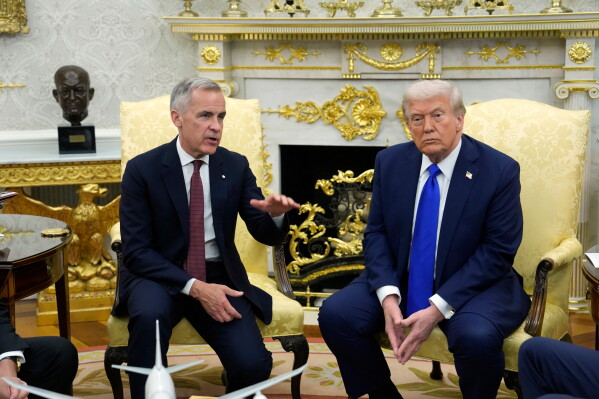
The change comes in the middle of one of the sharpest diplomatic disputes between the two allies in decades. Trade talks collapsed in August, Ottawa has retaliated and is now spending billions to shield its steel and auto industries, and the US Embassy in Ottawa has accused Canadian politicians of trying to influence American elections, an allegation that Prime Minister Mark Carney and Ontario Premier Doug Ford reject and independent experts have called implausible.
Background: A Trade Relationship Under Strain
Roughly 70 percent of Canadian exports go to the United States, which makes the relationship the backbone of the Canadian economy. Years of US duties on autos, steel, aluminum and lumber have cost jobs and slowed growth, and Canada entered a technical recession this year after two consecutive quarters of contraction, according to reporting on the latest announcement.
The most recent escalation followed the breakdown of negotiations that had appeared close to a deal. Trump then imposed 50 percent tariffs on roughly $20 billion in Canadian goods, about 5.5 percent of Canada's exports to the United States, covering items from hockey sticks to cement. Sources describe the timing and legal basis differently: one account says the tariffs were imposed after talks broke down in August, while another says the White House imposed the 50 percent levies in July under Section 338, which it described as a response to discriminatory treatment of American products. This article treats both as reports of the same measure and notes that the discrepancy has not been resolved.
Trump has also said he wants automakers to relocate production from Canada to the United States. Carney said last week that Canadian auto exports to the US have fallen by more than 10 percent and US exports to Canada by more than 20 percent, and that the integrated North American auto industry may no longer be a priority for Washington.

Key Developments: The October 23 Adjustments
According to the White House, the exemptions cover plywood sheets, some paper products, certain machinery and refrigeration equipment, and certain packing crates and boxes. Simultaneously, the administration is extending the 50 percent tariff to new categories, including certain valves, carpets, waste products and residual products of the chemical and allied industries. The new duties take effect October 30.
The most visible political beneficiary is Senator Susan Collins of Maine, a Republican seeking a sixth term in a state hit hard by the trade war. Collins publicly welcomed the changes and said she had "secured" exemptions for products important to Maine agriculture, including blueberry, potato, apple and seaweed producers, adding that many farmers depend on Canadian equipment and packaging that US suppliers cannot easily replace. A Fox News poll released Thursday showed her tied with Democrat Troy Jackson at 49 percent each, and Democrats are aggressively targeting the seat.
The shifts do not all point in one direction. In Michigan, where Republican Mike Rogers trails Democrat Abdul El-Sayed by about three points in the MSNOW polling tracker as of October 24, both candidates have criticized the tariffs. Rogers said he has called for an end to the tariff war but praised the new duties on Canadian "trash trucks," arguing that Canadian trucks have used Michigan landfills for decades. Headlines in outlets including the Washington Post, the Detroit News and International Business Times framed the package as a rollback that helps GOP candidates, with the latter calling it a likely last-ditch attempt; the White House has offered no political rationale beyond its list of products.
Canada's Response
Dominic LeBlanc, the minister responsible for Canada-US trade, said Ottawa "takes note" of the new measures and is ready to work constructively and in good faith while it evaluates them. That restrained reaction contrasts with the tone Carney struck days earlier. Speaking on October 21, he said US tariffs had "upended a trade bargain that's existed for decades" and warned that "tariffs make both our industries weaker and reduce choice for our families." Of the changed American approach, he said: "Their approach has changed. So must ours."
With Ford, Carney announced an aid package on October 21 to protect Canadian steel and auto jobs. Reports give the total as about C$8.7 billion, or roughly US$6.2 billion by the headline figure, though the component amounts reported, C$5.2 billion over five years for steelmakers and C$2.5 billion for automakers of which C$1.5 billion comes from Ottawa, add up to somewhat less, and the discrepancy is not explained in the coverage. Carney has set a goal of doubling Canada's exports to markets other than the United States within a decade. He spoke with Trump at length the same day on trade, Iran and the Middle East, reported no breakthrough, and said Canada remains ready to negotiate.
Ford was blunter. He said the relationship with the United States had changed permanently, regardless of the midterm result or who occupies the White House: "We're not going back to the way things were." Meanwhile, the US-owned steelmaker Cleveland-Cliffs confirmed layoffs at its plant in Hamilton, Ontario, underlining the human cost.

The Interference Accusation
Layered over the trade fight is a sharp political quarrel. On October 14, US Ambassador Pete Hoekstra warned Canadian politicians to keep their noses out of American politics. On October 21 the US Embassy released a fact sheet listing quotes from Canadian politicians that it said showed plans to influence American politics. As described in coverage of the document, it named Industry Minister Mélanie Joly for discussing retaliatory tariffs aimed at Republican states, and Ford for airing a television advertisement featuring former President Ronald Reagan criticizing tariffs. It also cited eleven Canadians charged with illegally voting in US elections between 2012 and 2026, without linking those cases to the Canadian government.
Carney and Ford rejected the claims. A former Canadian diplomat told CP24 on October 15 that Canada had not interfered in the midterms, and McGill political scientist Daniel Béland called the notion that Canada could significantly change the outcome "absurd." Canadian officials point out that targeted retaliation is a normal tool of trade policy and that criticizing a foreign government's policies in public is not the same as covert interference. The ad at the center of the dispute, they note, is also the one that reportedly prompted Trump to walk away from talks a year earlier.
Analysis: Why It Matters
The adjustments illustrate a tension at the heart of the administration's trade strategy. Tariffs are central to the president's economic message, yet in a year when fuel prices are elevated by the Iran war and his approval has fallen to record lows in several surveys, they also impose costs on exactly the swing states and border communities where Republicans are most vulnerable. Carve-outs targeted at Maine's farmers show how the political and economic logic can diverge, and new duties on items such as Canadian garbage trucks show that the administration is not abandoning the tool.
For Canada, the picture is of a partner that has stopped assuming the relationship will return to normal. Carney's export-diversification target, the provincial and federal aid package and Ford's declaration that things will not go back to the old way all suggest that Ottawa is planning for a long period of trade friction whichever party controls Congress. At the same time, the embassy's accusation raises the diplomatic temperature in a way that could complicate any eventual negotiation, since it frames normal Canadian lobbying as foreign meddling.
What's Next
The immediate dates are October 30, when the new tariffs take effect, and November 3, when voters decide control of Congress. Canada has said it is evaluating the measures and will respond in good faith, which leaves open whether it adjusts its own retaliation. Markets and manufacturers on both sides of the border will watch for any sign that talks resume after the election.
If Democrats win the Senate or House, tariff authority and oversight could become a new battleground in Washington. If Republicans hold on, the White House may feel freer to harden its stance. Either way, the past week suggests that the trade war is now inseparable from the campaign calendar, and that Canadians have concluded the old continental bargain is not coming back soon.
Published By | News Editor