Written By | International News Agencies
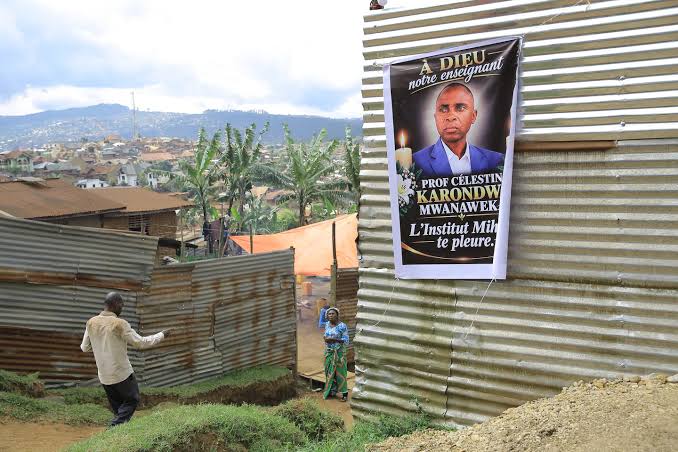
He was beaten at his home on Sunday and died of his injuries at a local hospital after using a radio program to urge neighbors to follow health guidance.
KINSHASA
Mourners buried Marie-Célestin Karondwa, a local official of Congo's ruling party, on Wednesday in Butembo, the North Kivu city at the center of the country's worst Ebola epidemic. He was beaten at his home on Sunday and died of his injuries at a local hospital after using a radio program to urge neighbors to follow health guidance. His death is the starkest sign yet that the outbreak, which has now sickened more than 8,000 people, is as much a political and social emergency as a medical one.
Why it matters now
The outbreak, declared on May 15, 2026, is the 17th in the Democratic Republic of Congo's history and the deadliest. As of Sept. 28 it had recorded 8,067 cases and 3,901 deaths, a fatality rate of 48.4 percent, according to Al Jazeera. The World Health Organization has warned that it is on track to exceed the deadliest Ebola epidemic on record, the 2014-2016 outbreak in West Africa, which killed more than 11,000 people. Responders say the greatest obstacle is no longer only the lack of a licensed vaccine, but the refusal of some communities to believe the disease is real. When defenders of the response are attacked, the work of tracing contacts, isolating the sick and burying the dead safely becomes harder still.
The killing in Butembo
Karondwa belonged to the Union for Democracy and Social Progress (UDPS), the party of President Félix Tshisekedi. According to the Associated Press, he had been using a radio program to advocate for public compliance with response measures, notably social distancing and handwashing. "They beat him up and then set the house on fire," his granddaughter, Sagesse Kavira, said. Jean-Baptiste Katsongo Lwatswa, the UDPS first federal vice president in Butembo, said the advocacy "is believed to have provoked the anger of certain young people." The party described Karondwa as "an innocent victim for having defended the party's position on the existence of the Ebola virus disease."
It remains unclear who carried out the attack, how many people were involved, or what their motive was, according to Al Jazeera's report on the funeral. The date of the attack is given as Sunday in Al Jazeera's Oct. 1 report and in the AP; a separate Al Jazeera article from Sept. 28 gave it as Sept. 23. Because the AP and the later Al Jazeera report both say Sunday, that is the account used here, but the discrepancy underlines how thin the verified detail remains.
An outbreak with no approved weapons
The epidemic is caused by the Bundibugyo strain of the virus. Bundibugyo has no approved vaccine or treatment, though several vaccines and treatments are being trialed. Clinical trials are continuing in Ituri province, the epicenter, according to the AP.
The spread is wide. Al Jazeera's reporting describes cases across several provinces in the northeast, including North Kivu, Ituri and Tshopo, with spread to areas near the borders with South Sudan, Uganda and Rwanda; a second Al Jazeera article counts seven affected provinces. Local authorities have reported "low capacity" at Ituri health centers and a "complete shortage" of experimental vaccine stocks in Tshopo province.
On funding, Al Jazeera reported that the United States has pledged $267 million, with efforts under way to reach a $2 billion target. The WHO's position is that the outbreak is "far from over." Its director-general, Tedros Adhanom Ghebreyesus, described the situation as "a catastrophic collision of disease and conflict," according to Al Jazeera's account.
Why people do not believe
The AP reported that many residents dismiss Ebola as a hoax and that mistrust of the government is deep, rooted in "how it's managed past Ebola outbreaks to chronic corruption." Al Jazeera added that some view the outbreak as a pretext for corruption, that stigma discourages people from reporting symptoms, and that authority is resisted in rebel-held areas. A Butembo resident, Enoch Muhindo Balimatangi, told the AP: "Some say that the illness exists, while others refuse to accept that it does."
This is a political legacy as much as a public health one. Eastern Congo has endured decades of armed conflict, and its residents have repeatedly seen aid money and official promises fail to translate into safety or services. In that setting, a health message delivered by a ruling-party official is not received as neutral. The killing of Karondwa, a member of the president's own party, suggests that the party label itself may have made him a target, although no motive has been established. The fact that he was speaking on radio, one of the few channels that reach rural and urban audiences alike, adds to the concern: if local voices are silenced, the response loses its most credible messengers.
The weight of the numbers
The scale of the epidemic gives the political questions their urgency. A fatality rate of 48.4 percent, as calculated in Al Jazeera's Sept. 28 report from 3,901 deaths among 8,067 cases, means that nearly one in two confirmed patients has died. Those figures are for confirmed cases only, and the reporting reviewed here does not say how many suspected cases remain untested, so the true burden may differ. What the figures do show is that the outbreak has already passed the 8,000-case mark in under five months since its May 15 declaration, a pace that explains why the WHO now speaks of the outbreak tracking toward the West African record.
Responders face a shortage of nearly everything at once: vaccine stocks in Tshopo, staff and equipment in Ituri, and, perhaps most important, a willingness among communities to come forward. The AP noted that the combination of stigma and disbelief leads some residents to refuse to report symptoms. Every undetected case is a potential chain of transmission, which is why a killing connected to the response reverberates far beyond one household in Butembo.
Analysis: security and legitimacy as public health tools
Three points emerge from the evidence. First, the outbreak's trajectory depends on political legitimacy. Contact tracing and community burials work only if people cooperate, and cooperation requires trust in the institutions asking for it. Second, the lack of a licensed vaccine means behavioral measures matter more than in outbreaks where a vaccine could be used to ring-fence cases. The handwashing and distancing guidance Karondwa promoted was, in effect, the primary tool available. Third, the eastern conflict zones complicate everything. The AP and Al Jazeera both point to areas outside government control, where response teams cannot operate on the same terms.
For the government in Kinshasa, the episode presents a test. It can treat the killing as an isolated crime, or as evidence that protecting health workers and local advocates must become a security priority. The government's statements in response to the killing were not available in the reporting reviewed for this story, so it is not yet clear how the authorities will frame it or whether arrests will follow. Readers should also note that the reporting on motive rests on the party's account and the statement of a party official, and that independent investigation has not been described.
The funding gap is the other front. A $267 million U.S. pledge against a $2 billion target leaves a large shortfall if, as the WHO's warnings suggest, the outbreak continues to grow. The comparison with West Africa, where a slow early response allowed a regional epidemic to become a global emergency, is the one that officials most want to avoid.
What to watch
The first marker is whether Congolese authorities identify and charge those responsible for Karondwa's death, and whether security for health communicators in Butembo is strengthened. A visible response would signal that the state intends to defend the outbreak's local advocates; silence would risk emboldening those who reject the response.
The second is the weekly case and death count. With 8,067 cases and 3,901 deaths as of Sept. 28, the WHO's projection that the outbreak could pass 11,000 deaths will be tested by whether weekly numbers accelerate or flatten. The third is the vaccine and treatment trials in Ituri, which could change the epidemic's course if any candidate proves effective, and the fourth is the funding drive toward $2 billion. Finally, watch the borders. The reported spread to areas near South Sudan, Uganda and Rwanda means that a failure in Butembo could become a regional problem.



