Written By | International News Agencies
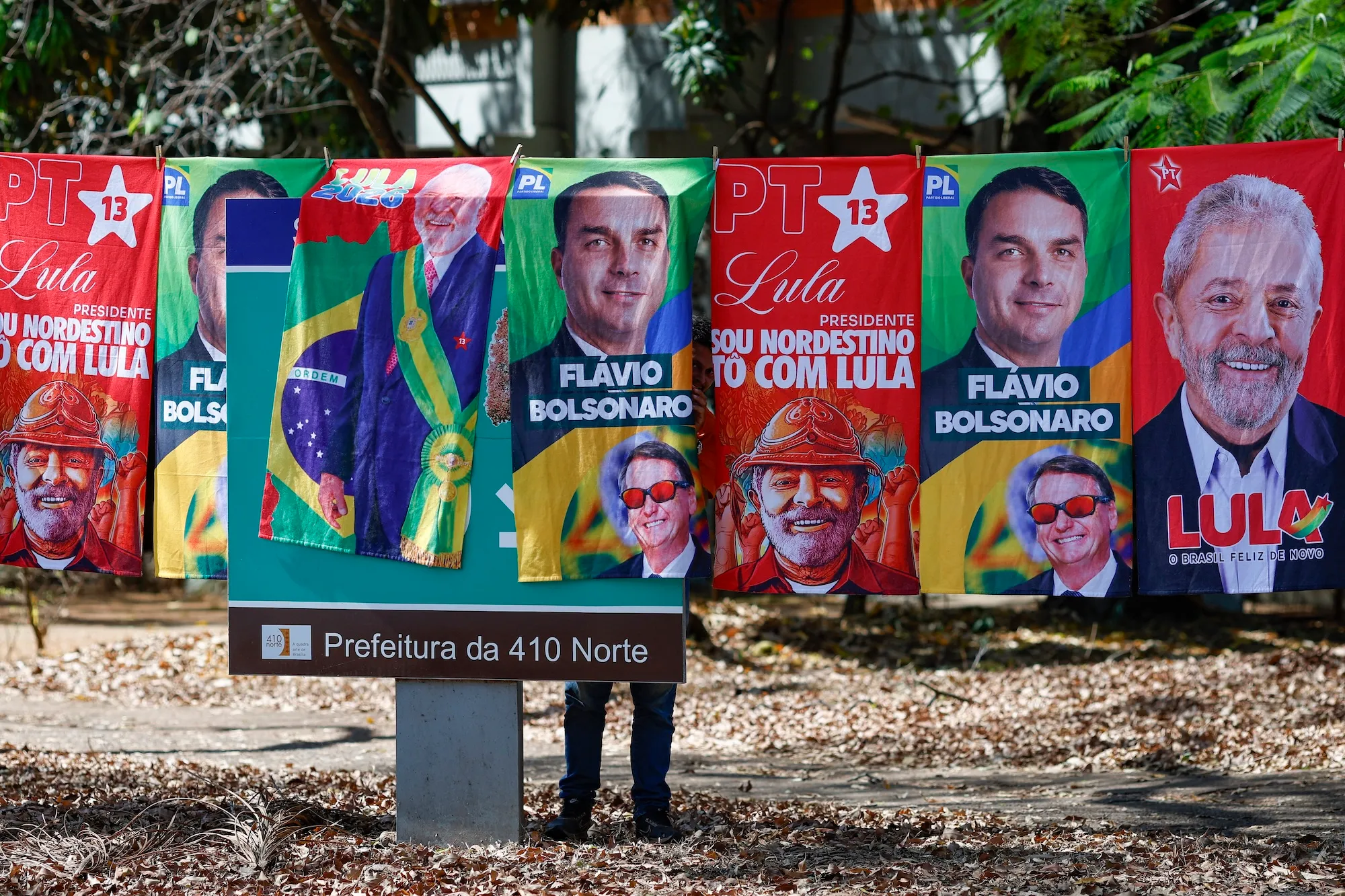
The race enters its final hours as close to a coin flip as Brazilian presidential politics has produced in years.
Overview
On Sunday, October 25, more than 158 million registered Brazilians will choose between two men who embody the country's deepest political divide: Luiz Inácio Lula da Silva, the 80-year-old Workers' Party (PT) president seeking a fourth term, and Senator Flávio Bolsonaro, the 45-year-old Liberal Party (PL) candidate and son of the jailed former president Jair Bolsonaro. Polls open at 8 a.m. Brasília time and close at 5 p.m., when the Superior Electoral Court (TSE) begins publishing results. The winner will take office on January 5, 2027.
The race enters its final hours as close to a coin flip as Brazilian presidential politics has produced in years. Datafolha's latest survey, taken October 20 to 22, put the two candidates at a dead heat of 50 percent each among valid votes. Aggregations of about twenty pollsters show Bolsonaro with a slender edge, roughly 51 to 49 percent. Yet betting markets treat him as the clear favorite, with Polymarket and Kalshi pricing his chances near 80 percent, a gap between the polls and the wagers that itself reflects how badly pollsters misjudged the first round.
Background: A First Round That Upended Expectations
The first round, held October 4, delivered a shock. Flávio Bolsonaro won 47.03 percent of valid votes, or about 56.1 million ballots, against 45.16 percent for Lula, about 53.9 million, a margin of roughly 2.2 million votes. The centrist Augusto Cury took 2.89 percent, and ten other candidates were eliminated. Datafolha's final pre-election survey had shown Lula ahead 45 to 42, and several other major pollsters, including Quaest, PoderData and CNT/MDA, also had him in front. The miss has made many Brazilians, and many investors, wary of trusting the numbers this time.
Abstention reached 21.08 percent, the highest rate in a first round since 1998, even though voting is compulsory for literate citizens between 18 and 70. How many of those absent voters return on Sunday, and for whom, is one of the central unknowns of the runoff. Markets reacted enthusiastically to the first-round result: the Ibovespa stock index jumped 7.7 percent to a record, and the real strengthened sharply, signaling that investors saw a Bolsonaro presidency as friendlier to business. Michelle Bolsonaro, the former first lady, also won a Senate seat for the Federal District with 29.05 percent and is campaigning for her stepson.
The shadow of Jair Bolsonaro hangs over the contest. The former president, who governed from 2019 to 2022, is serving a sentence of 27 years and three months, currently under house arrest, after the Supreme Court convicted him over a plot to overturn the 2022 election. He denies the charges. He endorsed Flávio in December 2025, and Flávio has promised to pardon his father; legal experts cited in coverage say a pardon would not restore Jair Bolsonaro's eligibility to run for office.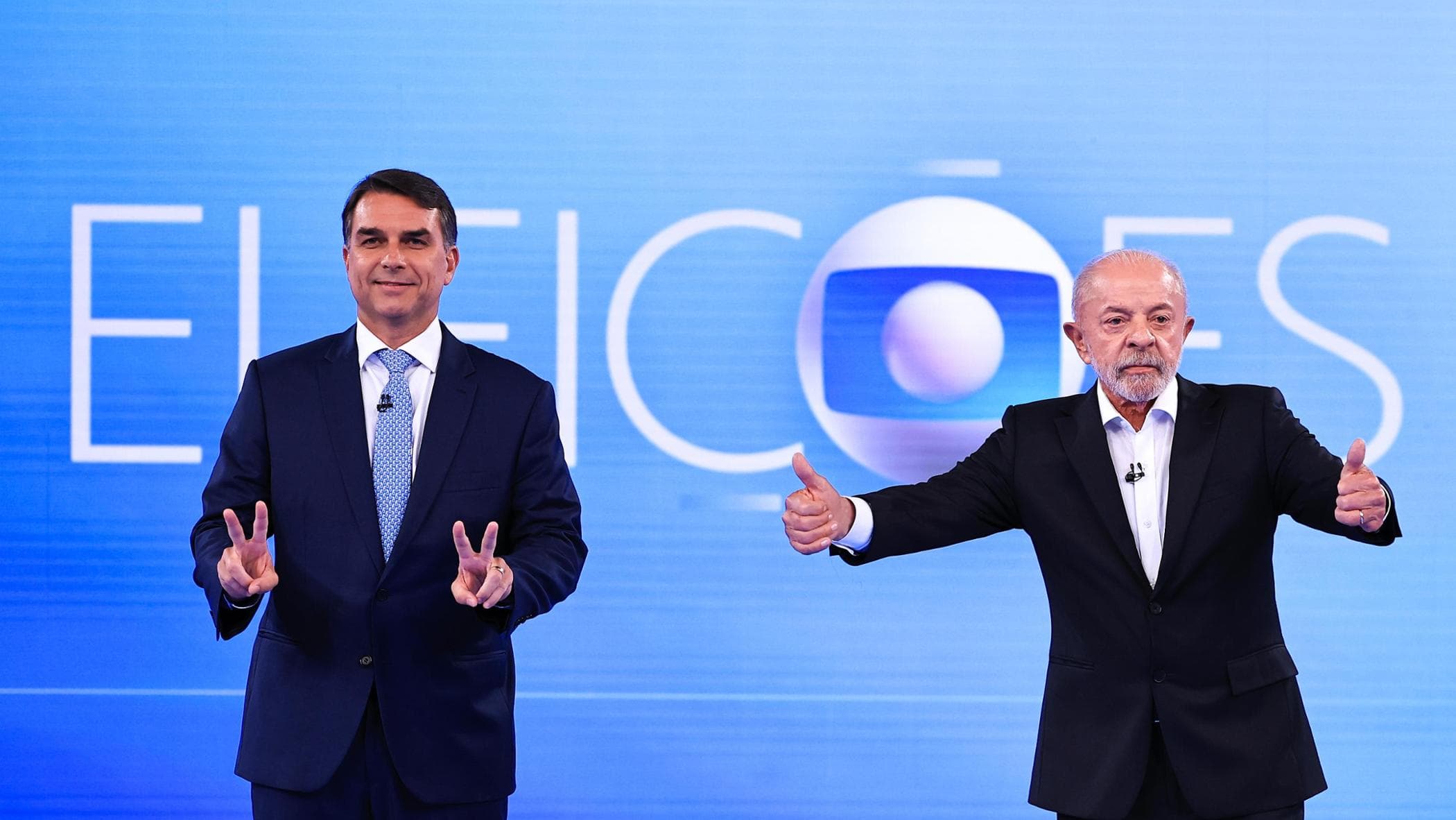
The Candidates and Their Programs
Lula, who governed from 2003 to 2010 and again since January 2023, is running with Vice President Geraldo Alckmin of the PSB. His platform stresses continuity of the current fiscal framework, interest-rate cuts once inflation allows, and an income-tax exemption for monthly salaries up to 5,000 reais, financed by higher taxes on the wealthiest. He backs ending the six-days-on, one-day-off work schedule and shortening the legal work week to 40 hours, and he promises a dedicated Public Security Ministry and 10 billion reais for states and cities to fight crime. On the environment, he pledges zero deforestation by 2030 while expanding oil and gas production. The monthly minimum under the Bolsa Família cash-transfer program has risen from 600 to 691 reais under his government, and his approval is split almost evenly: Datafolha found 49 percent approving and 48 percent disapproving.
Flávio Bolsonaro, running with Alfredo Gaspar, has presented himself as a more conventional conservative than his father, though he campaigns on the family's legacy. He promises to cut at least ten ministries, run budget surpluses, cap discretionary spending, revise the tax reform due to start in 2027, and return to privatization, with a target of 900 billion reais in infrastructure investment. On crime, he would lower the age of criminal responsibility to 16, and to 14 for serious offenses, designate gangs such as the PCC and Comando Vermelho as narco-terrorist organizations, and build five federal maximum-security prisons. A Datafolha poll found 80 percent of Brazilians support lowering the criminal age to 16. He would keep social programs but tie recipients to training and jobs, and he has said he would now vote in the Senate to end the six-day work week, a notable concession to a popular cause. He also proposes limiting single-justice rulings at the Supreme Court and ending presidential re-election.
Foreign policy offers perhaps the sharpest contrast. Lula stresses sovereignty and diversified trade, and says he will use Brazil's reciprocity law against American tariffs if necessary. Bolsonaro promises to repair relations with Washington and join the US-led Shield of the Americas. President Donald Trump called Bolsonaro's first-round lead "a big victory." Lula's campaign has tried to tie Bolsonaro to the new US tariffs because of his family's closeness to Trump's circle, and Datafolha reporting says Bolsonaro asked US officials to delay a tariff decision until after the vote. Both candidates treat China as Brazil's top export market.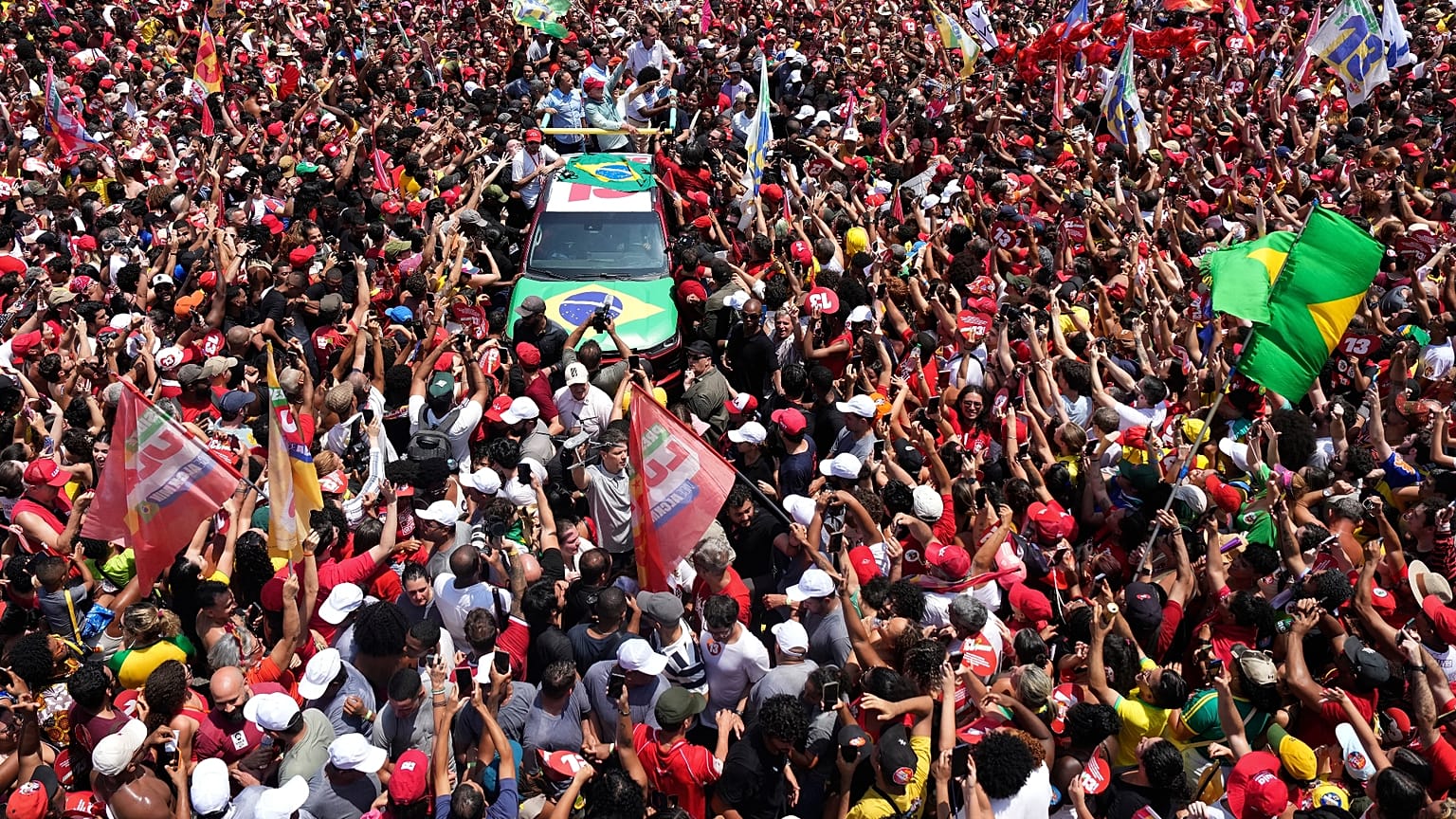
The Final Stretch: Polls, Maps and Mood
The movement of the polls since October 5 tells a story of narrowing. Bolsonaro led several surveys by four to ten points in the days after the first round, but his advantage has shrunk. Datafolha went from a four-point Bolsonaro lead on October 8 to a tie on October 22. AtlasIntel moved from 5.6 points to 2.2, and Ipespe/Abrapel from 5.4 to 1. Even so, Bolsonaro leads in the great majority of the roughly forty runoff polls tracked, and four surveys, including Vox Brasil and Data Ranking, show Lula ahead. Datafolha's margin of error is two points, so a tie and a narrow lead in either direction are statistically indistinguishable.
The electorate's geography is stark. Datafolha's early-October survey showed Bolsonaro ahead 58 to 35 in the South and 50 to 42 in the populous Southeast, which holds about 42 percent of voters, while Lula led 61 to 35 in the Northeast. Evangelical Christians, some 28 percent of the electorate, favored Bolsonaro 69 to 25, while Lula led among the poorest 47 percent of voters, 52 to 41. Voters who backed eliminated candidates lean to Bolsonaro, 46 percent to 32 percent, with 15 percent planning blank or spoiled ballots. Rejection is nearly symmetrical: 46 percent say they would never vote for Bolsonaro and 45 percent never for Lula, which leaves a thin sliver of persuadable voters, and both camps are fighting over them.
The campaign has also been unusually short on direct confrontation. Neither candidate took part in first-round debates, and Globo, Band and Record all saw planned debates scrapped or boycotted at various points, with court rulings over the format adding to the confusion. A final runoff debate on TV Globo was scheduled for October 23, and Lula has said the network is "under suspicion" of his campaign; this report could not independently confirm how that event unfolded, and readers should consult Brazilian outlets for the latest.
Reactions and Stakes
Markets are the most visible audience. The Ibovespa closed up 0.47 percent on October 23 near 205,000, and the real traded around 4.99 per dollar. Goldman Sachs has flagged a possible 50 percent diesel price increase from Petrobras after the runoff, and the central bank meets on November 4 to set interest rates. First market reaction in São Paulo and New York comes Monday, October 26.
For the left, a Lula defeat would mark the loss of the flagship government in Latin America just as the region's politics swing right, and a blow to the party Lula co-founded and has led for decades. For the right, a Bolsonaro victory would amount to the political rehabilitation of a family whose patriarch was convicted of attempting to subvert the democratic order. Prediction markets have become a talking point in their own right; coverage notes they are bets, not pollsand should be read with caution after the first-round polling miss.
Institutional questions loom as well. Parties backing Bolsonaro hold 259 of the 513 seats in the Chamber of Deputies, and the newly elected Congress is seated on February 1, 2027. Senate President Davi Alcolumbre pulled a public-security constitutional amendment on October 15 with no new date. In Rio de Janeiro, a gubernatorial dispute is unresolved after the TSE voided votes for Anthony Garotinho and declared Douglas Ruas of the PL the winner with 50.88 percent; the PSD has asked the Supreme Court to order a runoff.
What to Watch on Sunday and After
Results should begin arriving from 5 p.m. Brasília time (4 p.m. Eastern), and Brazil's electronic voting system typically produces a near-final count within hours. Because the margin may be a point or two, the key questions are turnout in the Northeast, where Lula's strength lies, against the South and Southeast, and whether abstention falls from its first-round record. A result within a percentage point would test the willingness of both sides to accept the outcome, particularly given the history of the 2022 election and the criminal case against Jair Bolsonaro.
If Lula wins, he would face a Congress dominated by the right and a fractured economy, with an uncertain trade relationship with Washington. If Flávio Bolsonaro wins, expect early moves on a pardon for his father, the privatization agenda and a reset with the Trump administration, along with fierce resistance from the Supreme Court and the left over any attempt to curb judicial power. Either way, a polarized country will have to live with a razor-thin mandate.



