Written By | Health News Agencies
No vaccine. No approved cure. A record-breaking Bundibugyo epidemic has now sent a dying patient through an international airport — and health chiefs are racing to find everyone he touched.
NAIROBI / GOMA
A man stepped off a budget flight at Nairobi's main airport on a Saturday afternoon, walked through the health screening, and climbed into a car with a relative and a friend. Forty-eight hours later he was dead — killed by one of the most feared viruses on Earth.
That man, a Kenyan who had spent seven years living in the Democratic Republic of Congo, is now the first confirmed imported case of Bundibugyo Ebola in Kenya. And he arrived from the heart of what the World Health Organization calls the largest Ebola outbreak ever recorded in Congo — an epidemic that, according to the latest European figures, has now passed 9,100 confirmed cases and more than 4,400 deaths.
There is no licensed vaccine for this strain. There is no approved treatment. And with nearly half of everyone who catches it dying, officials across East and Central Africa are in a race against time.
The Flight That Changed Everything
According to Kenya's Health Cabinet Secretary, Aden Duale, the patient fell ill roughly a month before he came home. He was treated at several health facilities in Congo, then travelled by road to Kampala, Uganda, and boarded a Jambojet flight to Nairobi, landing at Jomo Kenyatta International Airport at about 1:10pm on Saturday 3 October.
He passed the routine public-health screening at the airport. A relative and a friend collected him and took him to Nairobi Hospital, where staff isolated him. He was later moved to the East Wing Isolation Facility, a site used during the COVID-19 pandemic with intensive and high-dependency care capacity.
His symptoms were textbook and terrifying: fever, chills, crushing fatigue, muscle pain, a painful sore throat, and bleeding under the skin at the site of an injection. Despite supportive treatment he died at about 11:30pm on Monday 5 October. Tests confirmed Bundibugyo virus, and Kenya announced the case on Tuesday 6 October.
"The Ministry of Health wishes to inform members of the public that it has confirmed the first imported case of Ebola Bundibugyo virus disease," Duale said in the announcement. He added: "I wish to assure the public not to panic, as all systems are in place to mitigate the spread of the disease."
The Great Contact Hunt
The moment a case is confirmed, a second, quieter battle begins: finding everyone who might have been exposed. Kenya initially listed 28 contacts, including family members and the health workers who cared for the man. Investigators are also tracing 23 passengers and four crew members who shared his flight.
By 11 October, according to figures cited by the European Centre for Disease Prevention and Control (ECDC), Kenya's Health Cabinet Secretary said 108 of the patient's 122 listed contacts were in quarantine and none had developed symptoms. Duale said only one test had come back positive — the patient's own.
Kenya says it has screened 652,584 travellers since enhanced surveillance began, tested 267 samples across five laboratories, and trained 4,971 health workers. Border points are on heightened alert, though no general travel restriction has been announced. A suspected case in Wajir County was reported negative in preliminary tests on 8 October, according to the county governor.
The WHO's own assessment of how the man was infected is sobering. The agency presumes he caught the virus in a health facility or in the community while seeking care for a different illness — a reminder that Ebola often spreads where people go to get better.
A Record-Breaking Epidemic
The Congo outbreak was first detected in May 2026, and the WHO declared a Public Health Emergency of International Concern on 17 May. It is only the second documented Bundibugyo outbreak in Congo, and the numbers have since dwarfed anything the country has seen. The WHO describes it as "the largest Ebola disease outbreak ever recorded in the Democratic Republic of the Congo irrespective of virus species."
For comparison, Congo's 2018–2020 Ebola epidemic, caused by a different virus species, killed nearly 2,300 people. This one has already killed roughly twice that many.
The WHO's 8 October update put the toll at 8,728 confirmed cases, 4,205 deaths and 2,269 recoveries as of 6 October — a crude case fatality ratio of 48.2 per cent. ECDC's update of 15 October, with data to 12 October, raised that to 9,144 confirmed cases and 4,410 deaths, with 79 new cases and 11 deaths reported in a single day. Some 899 patients are in isolation.
The virus has now reached 65 of Congo's 167 health zones across seven provinces, according to ECDC. Ituri remains the epicentre, with more than 6,700 cases and over 3,100 deaths. But the picture is shifting.
North Kivu: The New Danger Zone
Médecins Sans Frontières (MSF) says North Kivu accounted for nearly 40 per cent of newly confirmed cases in its 5 October update, up from 24 per cent at the end of August. The province has the highest death rate of any in the outbreak, at 57.7 per cent, according to the WHO. A health zone called Alimbongo reported its first cases in early October — four confirmed, two of them fatal.
North Kivu is a region scarred by armed conflict, and responders say insecurity and rumours are making the job harder. A community leader in Beni, Alberto Lusenge, warned that the failure to stop early transmission in Ituri, together with attacks on response workers, has deepened public worry. He cautioned that North Kivu could become an even bigger focus if community cooperation is not secured.
Daniel Makasi Levergénois of Watoto Radio said misinformation is undermining containment, with rumours in Beni and Butembo making some residents reluctant to cooperate.
Meanwhile, hospitals are buckling. "For weeks, treatment capacity has stretched to its limit," said Stephanie Hoffmann, coordinator of MSF's Ebola treatment centre in Butembo. Patients are sometimes sent elsewhere because beds run out. MSF said that as of 28 September, 34 per cent of confirmed patients were being treated in non-specialised facilities.
Dying at Home: A Warning Sign
One statistic in the WHO's latest briefing stands out. Of 372 deaths recorded since its previous update, 264 happened in communities and only 108 in treatment centres. The WHO says this "continues to point to delays in identifying illness and reaching appropriate care."
In plain English: too many people are falling sick, staying hidden, and dying before anyone can help them — or stop them infecting others.
Contact tracing is also falling short. As of 4 October, teams were following 23,741 of 29,535 identified contacts, or 80.4 per cent, below the 85 per cent target. ECDC's latest figure is 77.6 per cent — moving in the wrong direction. Africa CDC's director-general, Jean Kaseya, put it bluntly: "We will only bring this outbreak under control once the last chain of transmission has been broken."
What Is Bundibugyo — and Why Is It So Dangerous?
Bundibugyo virus is one of several viruses in the Ebola family. Like its better-known cousin Zaire ebolavirus, it causes a severe haemorrhagic illness that begins with fever, headache and exhaustion and can progress to vomiting, diarrhoea and internal and external bleeding. It spreads through direct contact with the blood or body fluids of infected people, or with contaminated surfaces and bodies.
The cruel twist is the lack of defences. The WHO states plainly that "no approved vaccines or specific treatments currently exist" for Bundibugyo virus disease. The WHO's earlier-licensed Ebola vaccines were developed against the Zaire species and are not approved for this one. A WHO vaccine-candidate prioritisation report was published in July 2026, and a treatment trial began enrolling patients on 2 July, but no results have been reported in the sources reviewed for this article.
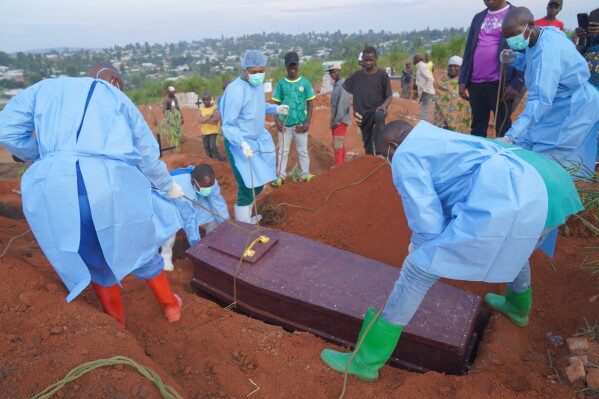
That leaves responders relying on the old playbook: find the sick, isolate them, trace every contact, give supportive care, and bury the dead safely. It works — but only when communities trust the people doing it.
Is the World at Risk?
For most people outside the region, the answer from official bodies is reassuring — with caveats. The WHO assesses the risk as very high in Congo, high for neighbouring countries that share a land border with it, and low for the rest of the African region and the world. ECDC says the risk of importation to the EU and European Economic Area remains very low.
But the virus is clearly travelling. Uganda reported 20 confirmed cases and two deaths between May and June before being declared outbreak-free on 25 August, after 42 days without a new case. Kenya now has its first imported case. And several health workers who were infected or exposed while helping in Congo have been flown to Europe for treatment: an aid worker in France in June, a US citizen evacuated to Germany in May and another in July, a UK resident isolated in London in July, and a healthcare worker admitted to Leiden University Medical Center in the Netherlands on 1 October. The WHO says the Dutch patient will not be counted as a local case.
The WHO advises against restricting travel or trade with affected countries, arguing such measures push people toward informal border crossings and hurt the response. Its temporary recommendations, issued on 24 August, call for coordinated control, cross-border cooperation and stronger surveillance. A detailed WHO risk assessment for Kenya is still under way.
The Expert View
Public-health specialists point to a common pattern in the data: delays. Delays in recognising symptoms, delays in reaching care, and delays in finding contacts. The Kenya case illustrates all three. The patient was ill for around a month, was treated at several facilities, and crossed two borders by road and air before he was properly isolated.
The WHO also flags "critical funding gaps" in the response, even as it scales up surveillance, laboratory testing, infection prevention and control, clinical care and community engagement. Africa CDC has called for a community-centred response built around active case finding, systematic contact tracing and daily follow-up of exposed people.
What This Means for You
The Bottom Line
A dying man's journey from a Congolese clinic to a Nairobi isolation ward has put a spotlight on an epidemic that has been growing for five months. The world now has record-high case numbers, no vaccine, hospitals pushed to their limits, and a new hotspot in a conflict-hit province.
The good news is that Kenya's quick isolation of the patient and rapid tracing of his contacts — with more than 100 quarantined and no symptoms reported so far — shows the response system can work. The bad news is that it has to work every single time, on every border, for as long as the virus keeps moving.
For now, the verdict from the experts is simple: the danger is real, it is concentrated in Congo, and the fastest way to protect everyone is to stop it where it started.



