TAIPEI / LONDON
It is one of the most quietly ubiquitous prescriptions in modern men's health. A small tablet, taken every single day, not for a romantic evening but for something far more mundane: the miserable, sleep-wrecking business of getting up four times a night to urinate.
Tadalafil. Better known by its brand name, Cialis. Millions of men take it. Many have taken it daily for years.
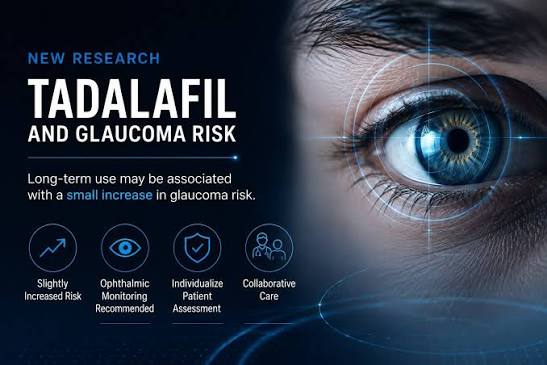
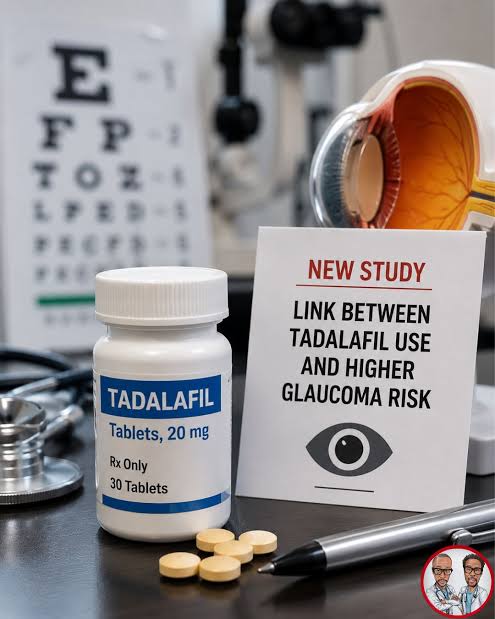
And now a large new study, published in the British Journal of Ophthalmology and pushed into wide circulation by the BMJ Group on Monday, has found something that has urologists and eye doctors sitting up: men prescribed the drug for enlarged-prostate symptoms were 22 per cent more likely to be diagnosed with glaucoma over five years than closely matched men who were not.
Glaucoma is not a condition that announces itself. It is the leading cause of irreversible blindness in the world. It destroys peripheral vision so gradually that most people do not notice until a substantial and permanent chunk of their visual field is already gone. There is no getting it back.
So the finding matters. But so does the fine print — and the fine print is where this story gets genuinely interesting.
WHAT THE RESEARCHERS ACTUALLY DID
The study was led by Yun Hsia, with senior author Chien-Chih Chou of National Taiwan University Hospital in Taipei, and colleagues including researchers from Taichung Veterans General Hospital and collaborators internationally. It was published online in the British Journal of Ophthalmology on August 4, 2026 (DOI: 10.1136/bjo-2026-329957), and reached mainstream attention when BMJ Group issued its press release this week.
The team went to the TriNetX Analytics Network — a federated global health-records network that pools de-identified electronic health data from health systems across multiple countries — and pulled records for men aged 40 and over who had lower urinary tract symptoms, or LUTS, between January 2012 and December 2022.
LUTS is the clinical shorthand for the constellation of problems caused by benign prostatic hyperplasia, or BPH: the non-cancerous enlargement of the prostate that afflicts roughly half of men over 50 and more than 80 per cent by the eighth decade of life. Weak stream. Hesitancy. Urgency. Getting up at 2am. And again at 4am.
Crucially, the researchers EXCLUDED anyone who already had a glaucoma diagnosis. They wanted new cases only.
They then performed 1:1 propensity-score matching — a statistical technique that pairs each drug user with a non-user who looks as similar as possible on paper. The matching covered age, race, smoking history, alcohol-related disorders, prescribed medications, kidney function as measured by glomerular filtration rate, and a battery of underlying conditions including cardiovascular disease, diabetes, cancer, high cholesterol, obesity and chronic obstructive pulmonary disease.
The result was two groups of exactly 36,927 men each — 73,854 in total — followed for up to five years.
THE NUMBERS
Over the follow-up period, tadalafil use was associated with a significantly higher risk of being diagnosed with any glaucoma: a hazard ratio of 1.22, with a 95 per cent confidence interval of 1.12 to 1.33.
In absolute terms — the number that actually tells you what is happening to real people — 3.93 per cent of tadalafil users developed glaucoma within five years, compared with 3.16 per cent of non-users. The difference is statistically robust (P less than .001) but small in everyday terms: well under one percentage point over half a decade.
When the researchers broke the finding down by glaucoma subtype, the signal was not spread evenly. It clustered in two specific categories:
PRIMARY OPEN-ANGLE GLAUCOMA — the most common form of the disease, the slow-burning kind that quietly erodes peripheral vision — hazard ratio 1.33 (95% CI, 1.05 to 1.67).
OCULAR HYPERTENSION — raised pressure inside the eye, the principal risk factor for glaucoma and often its precursor — hazard ratio 1.32 (95% CI, 1.06 to 1.65).
Meanwhile, no significant association emerged for normal-tension glaucoma or for primary angle-closure glaucoma. The signal was specific, not smeared.
There was one more finding, and arguably the most persuasive of the lot. Tadalafil users were 33 per cent more likely to be STARTED on glaucoma treatment during follow-up (HR 1.33; 95% CI, 1.20 to 1.47). The researchers used this deliberately as a proxy for clinically meaningful disease — because a doctor writing a prescription for pressure-lowering eye drops has made a real judgement, not merely entered a diagnostic code.
The associations survived sensitivity analyses in which lag times of one, three and six months were built in — a technique designed to weed out cases where the glaucoma was probably already brewing before the tadalafil was ever prescribed. And the pattern held consistently among men over 50, among White participants, and across a range of comorbidity burdens.
WHY THE EYE? THE BIOLOGY IS NOT AS STRANGE AS IT SOUNDS
At first glance a prostate drug and an eye disease seem to belong to different medical universes. They do not.
Tadalafil belongs to a class called phosphodiesterase type 5 inhibitors — PDE5 inhibitors — the same family that includes sildenafil, sold as Viagra. It was approved by the FDA for erectile dysfunction in 2003, and then in 2011 for the signs and symptoms of benign prostatic hyperplasia, both on its own and in men who have both conditions.
The mechanism is elegantly simple. PDE5 is the enzyme that breaks down cyclic guanosine monophosphate, or cGMP. Block the enzyme, and cGMP accumulates. cGMP relaxes smooth muscle. Relaxed smooth muscle in the prostate and bladder neck means better urinary flow.
But the nitric oxide–cGMP signalling pathway does not stop at the prostate. It is also a recognised regulator of pressure inside the eye.
Here is how that works. Nitric oxide stimulates guanylate cyclase, which generates cGMP, which relaxes cells in the trabecular meshwork — the spongy drainage tissue at the front of the eye — widening the intercellular spaces that govern how fluid leaves the eye through the meshwork and Schlemm's canal. It is, in effect, the eye's plumbing valve.
So sensitive is this pathway that it is the deliberate target of a newer generation of glaucoma drugs: nitric-oxide-donating and guanylate-cyclase-directed treatments designed to lower eye pressure by exactly this route.
Which raises an uncomfortable question the study cannot answer. Could chronic, sustained, daily PDE5 inhibition over years paradoxically disrupt that balance — altering ocular blood flow, or shifting outflow regulation in a way that raises pressure over the long term, rather than lowering it?
The authors do not claim to know. They note pointedly that they did not have intraocular pressure data at all. What they write is this: "These findings suggest that chronic PDE5 inhibition may influence ocular physiology, warranting further mechanistic investigation."
THIS IS NOT THE OTHER PDE5 EYE PROBLEM — AND THE DIFFERENCE MATTERS
There is a real risk of confusion here, and it is worth heading off.
PDE5 inhibitors already carry a distinct, long-established ophthalmic safety signal: non-arteritic anterior ischaemic optic neuropathy, or NAION. That is a sudden, usually painless event in which blood supply to the optic nerve head is compromised, often producing abrupt vision loss in one eye on waking. It has nothing to do with eye pressure. It has been most often reported with short-term, on-demand dosing for erectile dysfunction, and it is more concerning in men with vascular risk factors such as diabetes.
A systematic review and meta-analysis, along with case-series data summarised by the American Academy of Ophthalmology, have reinforced that association, and some specialists advise stopping the drug after a first NAION event in one eye to protect the other.
The new glaucoma finding is a separate phenomenon, with a separate mechanism, on a separate timescale. But taken together the two build a broader picture: PDE5 inhibitors are a drug class with measurable, if modest, effects on the physiology of the eye.
THE CAVEATS — AND THEY ARE SUBSTANTIAL
The researchers are emphatic that their work does not prove tadalafil causes glaucoma. This is an observational study built on routinely collected health records, and it carries every limitation that implies.
It relies on diagnostic and prescription codes rather than validated eye-pressure readings or optic-nerve imaging. Glaucoma subtypes may be misclassified in the coding. There is no information on tadalafil dose or on whether patients actually took what they were prescribed. The researchers could not track changes in medication over time, nor fully capture new health conditions that developed during follow-up.
And there is a subtler problem, one that haunts all database pharmacoepidemiology: detection bias. Men on a daily long-term prescription see doctors more often. Men who see doctors more often get more eye examinations. More eye examinations means more incidentally discovered glaucoma. Some of that 22 per cent may not be extra disease at all — it may be extra looking.
Most participants were White, so the findings may not generalise to men of other ethnic backgrounds — a serious limitation given that people of African and Caribbean ancestry carry a substantially higher baseline risk of open-angle glaucoma.
And because the cohort was restricted specifically to men prescribed tadalafil for urinary symptoms — the daily, long-term, cumulative-exposure scenario — the results should not be assumed to apply to men taking a PDE5 inhibitor occasionally for erectile dysfunction.
THE EXPERT VIEW: AWARENESS, NOT ALARM
Specialist commentary since publication has landed firmly on the side of proportion. As Ophthalmology Times noted in its analysis, a hazard ratio in the region of 1.2 to 1.3 translates into a five-year absolute risk difference of well under one percentage point — and residual confounding cannot be ruled out in a retrospective, claims-based design.
The authors themselves frame the results as supporting consideration of eye monitoring rather than any change to prescribing practice.
Their own words are unambiguous: "These findings do not contraindicate tadalafil use but highlight the importance of baseline ophthalmic assessment and regular follow-up, particularly in patients with pre-existing glaucoma, ocular hypertension, a family history of glaucoma, high myopia, or those requiring long-term therapy."
In other words: nobody is being asked to throw the pills away. Everybody is being asked to book an eye test.
The scale of the population involved is what gives even a modest signal weight. An estimated 4.22 million people in the United States were living with glaucoma as of 2022, a figure projected to reach around 6.3 million by 2050 as the population ages. More than 2.7 million Americans aged 40 and over are affected. Overlay that on a drug taken daily, for years, by a large slice of the same ageing male demographic, and small relative risks translate into real numbers of real people.
WHAT THIS MEANS FOR YOU
If you or someone you love takes tadalafil daily for prostate symptoms, here is the practical shortlist.
1. DO NOT STOP TAKING IT ON YOUR OWN. This point cannot be overstated. The researchers explicitly did not advise stopping. Untreated BPH symptoms carry their own consequences — sleep destruction, urinary retention, infections, and in severe cases kidney damage. Any change is a conversation with the prescriber, not a solo decision after reading a news story.
2. BOOK AN EYE EXAMINATION — a proper one. Not a high-street glasses fitting. A comprehensive eye exam that includes intraocular pressure measurement and an assessment of the optic nerve. If you have been on daily tadalafil for years and have never had one, that is the gap this study is pointing at.
3. KNOW WHETHER YOU ARE HIGH-RISK. The authors flag specific groups for closer follow-up: men with pre-existing glaucoma or ocular hypertension, a family history of glaucoma, high myopia (strong short-sightedness), and anyone on long-term therapy. Add to that the established risk factors — being over 60, African or Caribbean ancestry, diabetes, and previous eye injury.
4. TELL YOUR EYE DOCTOR WHAT YOU TAKE. Ophthalmologists and optometrists do not automatically see your urology prescriptions. Say the word "tadalafil" out loud at your next appointment.
5. AND TELL YOUR UROLOGIST ABOUT YOUR EYES. The traffic runs both ways. If glaucoma runs in your family, the doctor prescribing your prostate medication deserves to know before, not after.
6. KNOW THE WARNING SIGNS — AND THE FACT THAT THERE MOSTLY AREN'T ANY. Open-angle glaucoma is famously symptomless until late. That is precisely why screening, rather than symptom-watching, is the entire strategy. Do not wait to notice something.
THE BOTTOM LINE
A study of 73,854 men has found a consistent, mechanistically plausible, statistically solid association between long-term daily tadalafil for prostate symptoms and a modestly increased risk of open-angle glaucoma and raised eye pressure.
It is not proof. It is a signal — and one that the biology of the nitric oxide–cGMP pathway makes uncomfortably credible.
The absolute risk increase is under one percentage point over five years. Weighed against the genuine quality-of-life benefit of a drug that lets a man sleep through the night, that is a trade many will still make without hesitation, and reasonably so.
But glaucoma takes what it takes and never gives it back. And the intervention here is not a difficult one. It is an eye appointment. Make it.
Published By | Features Editor