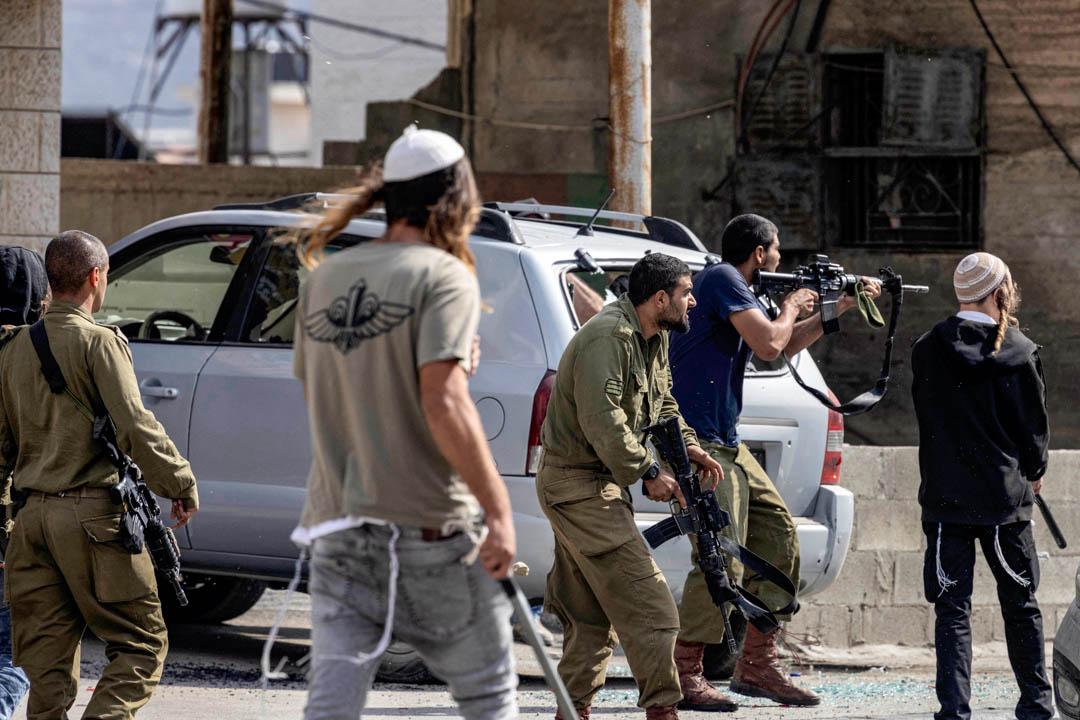
A riot by more than 100 settlers that blocked a court-ordered homecoming for a Palestinian family has drawn rare condemnation from Israel's president and prime minister, and it landed one day after Britain's foreign secretary promised to ban settlement goods.
World Politics
Overview
In the early hours of Tuesday, September 29, more than one hundred Israeli settlers converged on the village of Jalud, south of Nablus in the occupied West Bank, and stopped a Palestinian family from returning to the house it had been driven out of two months earlier. The settlers blocked roads, burned tires, threw stones at the soldiers and Border Police escorting the family, and set fire to Palestinian property, including the family's home and vehicle. Security forces withdrew before the operation could be completed. The family, named Tubasi in Israeli reports and Toubasi in others, was again unable to go home.
The episode would have been one more entry in a long ledger of settler violence, but for two things. The return had been ordered by an Israeli court, so the mob was defying the state's own judiciary and the army sent to carry out its ruling. And the riot came within a day of a sharp speech in Liverpool by British Foreign Secretary Ed Miliband, who told the Labour Party conference that Israeli actions in Gaza and the West Bank are "a stain on the conscience of the world" and announced steps aimed at the settlement economy. The reaction from Israel's own leadership was unusually pointed. This article sets out what happened at Jalud, how Israeli officials and others responded, what the wider data on settler violence show, and what may follow.
Background: An Eviction, a Court Order, and a Village Under Pressure
Jalud is a Palestinian village in the northern West Bank, in an area where settler outposts have multiplied in recent years. According to the accounts published by Israeli and Palestinian outlets, the Tubasi family fled its home in July after what the Israeli military later described as harassment and violence by local settlers. Middle East Eye, citing the family's account, says they were forcibly evicted. The i24NEWS report describes the departure as the result of nationalist crimes against them. The two descriptions differ in emphasis, but both agree that the family left under pressure from settlers rather than by choice.
The family then went to court. An Israeli court ordered the army to secure their return, and the military organized a night-time operation in which soldiers and Border Police would escort them back to the house. Israel's High Court is named in the Times of Israel account as the source of the ruling, while other reports refer more generally to "a court". Either way, the operation was an enforcement of an order, not a discretionary act of goodwill. That is what makes the events of Monday night and Tuesday morning legally and politically weighty: the people who blocked it were resisting a judicial decision that the executive branch was implementing.

Key Developments: The Night at Jalud
Reports agree on the broad outline. Over a hundred settlers, described by the military and the president as extremists, gathered as the escorted return began. They closed roads, set tires alight, hurled rocks, and attacked the security personnel. Three Border Police officers were lightly injured, according to i24NEWS and the Times of Israel, although one account describes the injured as soldiers; a security vehicle was also damaged. The settlers set fire to Palestinian homes and cars. Homeowner Mahmoud Tubasi told reporters his house was burned to the ground along with the family's vehicle, and Middle East Eye reports that two homes belonging to the family were set alight, forcing them to flee once more. The Israeli military said only that the return "was not completed".
The violence did not stay in Jalud. Middle East Eye reports similar attacks in al-Mughayyir and other villages, with vehicles set on fire and cars pelted with stones. Separately, in occupied East Jerusalem, a mob attacked Arab men near Damascus Gate during Sukkot celebrations, and eleven people were arrested there. The Jalud arrests were far fewer. The Times of Israel says three suspects were detained, while i24NEWS reports two were taken into custody and passed to police for questioning. That is a discrepancy in the available reporting that later official statements should resolve. In either case, the number is small compared with the size of the crowd described.
The Israeli military's statement was notable for its framing. It said it "strongly condemns any harm to security personnel while carrying out their duties, as well as acts of vandalism and damage to property", and added that such incidents "divert attention, undermine stability, and hinder the security forces' defensive and counterterrorism activities." The language centers on the harm to soldiers and to the army's mission rather than on the fate of the Palestinian family, a pattern that critics of Israeli policy have long pointed out.
Reactions in Israel
President Isaac Herzog, whose office is largely ceremonial but who carries considerable moral weight, called the riot "a moral stain and an affront to the rule of law" and "an extremely grave act that must be dealt with to the full extent of the law." He said the violence stands in profound contradiction to Jewish values, and he stressed that it took place during the festival of Sukkot, which he said the rioters had dishonored. Middle East Eye notes that Herzog's statement did not address the Palestinian victims.
Foreign Minister Gideon Sa'ar called the riot "serious and abhorrent" and said the perpetrators "are criminals who must be dealt with to the full severity of the law." Opposition leader Benny Gantz described the rioters as "a small, radical element that has lost its way" who do not represent the broader settler population, and called for stricter governance in the area. Prime Minister Benjamin Netanyahu condemned what he called violent riots and, in the wording reported by the Times of Israel, blamed a "small number" of rioters. Yahoo News, in a headline, described him as condemning riots by radical settlers.
The common thread in these statements is the claim that the perpetrators are a fringe. That claim is central to how Israeli officials manage the issue, because it allows condemnation without acknowledging a broader pattern or changing policy. Critics, including the United Nations, reject the premise, as the next section shows.
The Wider Picture: Numbers and the UN's Charge
Middle East Eye, citing United Nations data, reports that settler violence has surged dramatically since October 2023, with more than 1,600 attacks recorded between January and September 2026 alone, an average of roughly 6.7 attacks a day. The same report says over 1,300 Palestinians have been killed in the West Bank since 2023, though that figure covers all causes and not settler attacks alone. A UN commission has said that "violence by settlers is the direct outcome of Israeli policies that support, enable and protect their actions."
If those figures are right, the Jalud riot is not an outlier but one visible instance of a daily phenomenon. The distinguishing features here are the target, a family whose return had been sanctioned by a court, and the fact that the perpetrators fought the security forces directly. Israeli officials have generally been most willing to condemn settler violence when it is directed at Israeli soldiers or police, and the president's and military's statements fit that pattern, since both refer to attacks on the security forces alongside the arson.
London's New Line
The timing intensified the diplomatic dimension. On Sunday, September 27 or Monday, September 28, depending on the outlet's reporting date, Miliband addressed the Labour conference in Liverpool, where the party is led by Prime Minister Andy Burnham according to Al Jazeera. He said the government would take a tougher stance on Israeli actions in Gaza and the West Bank, calling them "a stain on the conscience of the world." He said: "We call out ethnic cleansing... We call out the evidence of war crimes... and we match word with action." According to Al Jazeera, the measures include a ban on imports of goods from illegal Israeli settlements and steps to disrupt the flow of British finance, construction and services to the settlements, building on the earlier recognition of Palestinian statehood. The Times of Israel's headline on his full speech says he described the entire occupation as unlawful and attacked "settler terrorists" and an Israeli government that indulges them, and it separately reports Miliband saying UK sanctions on settlers have mobilized other countries.
The speech was not without domestic friction. Al Jazeera reports that dozens of people were arrested outside the Liverpool venue in protests over the ban on Palestine Action, a reminder that the government faces pressure from pro-Palestinian activists who regard its steps as insufficient. In Israel, the speech is likely to be read together with the Jalud riot as evidence for those who argue that unchecked settler violence carries a diplomatic price.
What Comes Next
Several questions will determine whether Jalud proves a turning point or a passing controversy. The first is accountability. With only two or three arrests reported among a crowd of more than a hundred, the test is whether prosecutors bring serious charges and whether those charges result in convictions. Herzog and Sa'ar have both said the law must be enforced to its fullest, and their words will be measured against the outcome.
The second is whether the Tubasi family is able to go home. The court order stands, and the military has said only that the return was not completed. If the army does not try again, or tries and is again turned back, the episode will show that a determined mob can nullify an Israeli court ruling. If it succeeds, with a larger force, it will show the reverse. Either result will be closely watched by Palestinian residents of other threatened villages and by the Israeli legal system.
The third is international. The British ban on settlement imports and the move against financial and construction links are announcements of intent, and the detailed measures, timing and legal mechanisms have yet to be seen in the reporting reviewed here. Other governments may weigh similar steps, particularly if the violence continues at the pace the UN describes. Israel's government can be expected to reject the British characterization, while Herzog's and Gantz's language suggests that even within Israel's establishment there is pressure to be seen acting against the perpetrators.
The final variable is the political calendar within Israel, where the leadership's own condemnation of settler violence may collide with the interests of coalition partners who support the settlement movement. Reports reviewed for this article did not detail those partners' reactions, so that dimension remains to be reported. What is clear is that a single night in one village has, in the space of a day, become a test of the rule of law in the West Bank, of Israeli political unity, and of how far Western governments are willing to go.
Published By | News Editor