Written By | Health News Agencies
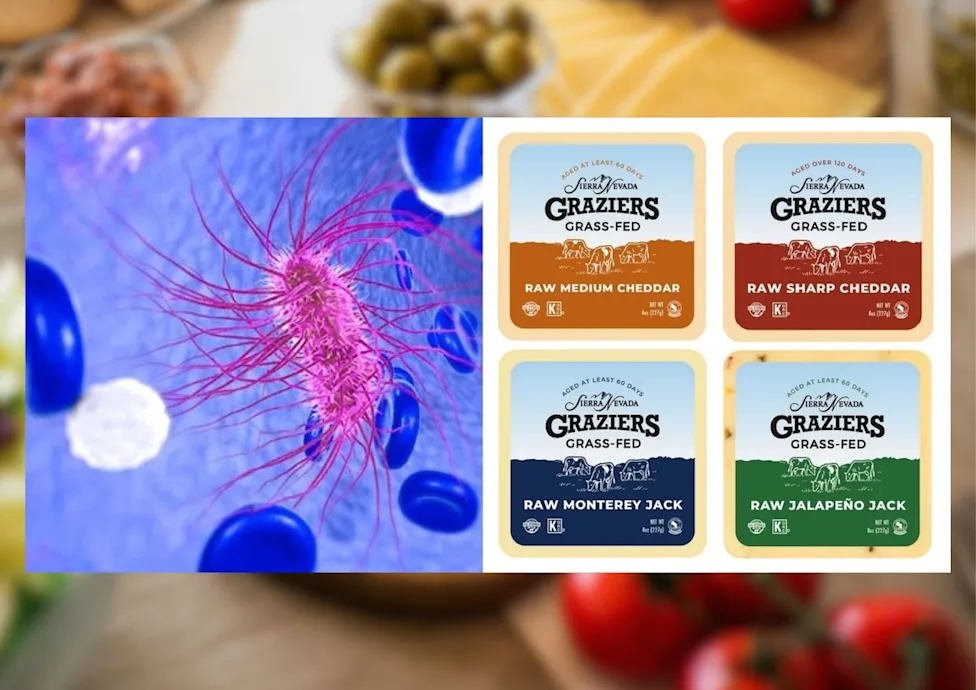
Thirteen people in nine states have fallen ill, eight have been hospitalised and three have developed a dangerous kidney complication
ATLANTA
A warning aimed at parents
It looks like any other block of farmhouse cheddar: a tidy label, a promise of "grass-fed" goodness, and a note that it has been aged for months. But federal health officials say this cheese has been making small children seriously ill.
On Friday, 25 September, the Centers for Disease Control and Prevention (CDC) and the Food and Drug Administration (FDA) announced a multistate outbreak of E. coli O26:H11 linked to Graziers grass-fed raw milk cheeses made by Sierra Nevada Cheese Company of Willows, California.
The numbers are small but alarming:
In San Diego County, officials say two of California's three cases are local children under five.
Every one of the nine sick people investigators have been able to interview, 100%, said they had eaten Graziers raw milk cheese. For comparison, a national CDC food survey found that only 4.9% of people normally report eating unpasteurised cheese in a given week. Genetic fingerprinting through the CDC's PulseNet system showed the bacteria from the patients were closely related, pointing to a single source.
What has been recalled
On 24 September, the FDA contacted Sierra Nevada Cheese Company to tell it about the outbreak and recommend a recall. The company agreed the same day to recall all of its Graziers raw milk cheeses. The recalled products are:
They were sold in 8-ounce and 16-ounce retail packs, and in 5-pound loaves for restaurants, delis and wholesalers. Distribution was nationwide, both in shops and online.
The recall covers every Graziers raw milk cheese, not specific batches, because investigators have not yet narrowed the problem to a single lot or production date.
The CDC's key warning is one many shoppers will miss: these cheeses have a long shelf life. A block bought in July could still be sitting in a fridge or freezer today.
Why the toddlers are the ones in hospital
E. coli O26 is one of the "Shiga toxin-producing" strains of E. coli, known as STEC. They are close cousins of the infamous O157:H7 strain behind the 1993 Jack in the Box burger disaster. These bacteria release a poison that attacks the lining of the gut and can then travel through the bloodstream.
Symptoms usually start between a few days and nine days after eating contaminated food. They include severe stomach cramps, diarrhoea that is often bloody, vomiting and sometimes a fever. Most people recover within about a week.
But roughly 5 to 10% of people diagnosed with STEC infections develop HUS. In HUS, the toxin damages tiny blood vessels, especially in the kidneys. Red blood cells are destroyed, platelets drop and the kidneys can shut down. Some patients need dialysis. Survivors can be left with high blood pressure, chronic kidney disease or brain and nerve damage. Some die.
Children under five are the most vulnerable, because their immune systems are still developing. That is exactly the age group dominating this outbreak. Three of the 13 known patients already have HUS, a far higher share than the usual 5 to 10%. With numbers this small, that could be partly chance, but it fits a pattern of very young victims.
"Aged 60 days": a rule, not a guarantee
Here is the twist that has food safety campaigners furious. This cheese appears to have followed the law.
For decades, US rules have allowed cheese made from raw, unpasteurised milk to be sold only if it has been aged for at least 60 days. The theory was that time, salt and acidity would kill dangerous germs. The Graziers labels say the cheese was "aged at least 60 days", and the sharp cheddar "aged over 120 days".
But scientists have doubted that rule for years. The FDA announced in 2013 that it would re-evaluate the 60-day standard. Starting in 2014, it tested 1,606 aged raw milk cheeses and found Salmonella, Listeria and Shiga toxin-producing E. coli in samples. The review has never been finished.
Meanwhile, outbreaks keep coming. Seattle food safety lawyer Bill Marler, who has represented victims of nearly every major US food poisoning outbreak since Jack in the Box, has tallied four outbreaks in 31 months traced to raw milk cheese that met the 60-day rule:
That is 43 people sick, 17 hospitalised and at least six with HUS, all from cheese that followed federal law.
Not the company's first scare
This is not Sierra Nevada Cheese Company's first raw milk problem. In August 2025, California's State Veterinarian ordered a statewide recall and quarantine of the firm's Bella Capra raw goat milk cheddar after state testing found Listeria monocytogenes, according to the California Department of Food and Agriculture.
79 days: the timeline that troubles experts
The first known illness began on 7 July. The most recent began on 26 August. The recall came on 24 September.
That is 79 days after the first person fell ill and almost a month after the last reported case. In his Saturday column, Marler summed up the problem bluntly: "The recalls are arriving. The outbreaks are already over."
Delays like this are partly built into the system. The CDC says it usually takes three to four weeks just to confirm that a sick person belongs to an outbreak: a doctor has to order the right stool test, a lab has to grow the bacteria, a state lab has to sequence it and upload it, and then investigators have to interview the patient or a parent about everything they ate. Each link takes time.
But the lag matters most for foods that keep. Leafy greens are usually eaten or thrown away within days. A vacuum-packed block of aged cheddar can sit in a fridge for months, which is why officials are urging households to check now.
Expert perspective
Health officials stress that the 13 confirmed cases are almost certainly an undercount. The CDC notes that many people recover without seeing a doctor and are never tested for E. coli, and that the outbreak "may not be limited to the states with known illnesses." Food Safety News, citing CDC estimates, reports that for every confirmed patient in an E. coli outbreak, around 26 more go undetected.
Marler says he is preparing a citizen petition asking the FDA to require a warning statement on cheese made from unpasteurised milk, and to finish the long-stalled review of the 60-day rule. He argues the labels shoppers see today say nothing about the risk to young children, pregnant women and older people.
Supporters of raw milk cheese point out that it is a centuries-old tradition, prized for its flavour, and that many European countries allow it widely. Most raw milk cheese eaten in the US causes no illness. But the FDA's position is that raw milk and products made from it carry a higher risk of dangerous germs, and that young children are among the people most at risk.
The outbreak also lands at a sensitive moment for the FDA. At a Senate confirmation hearing on Thursday for the agency's nominee for commissioner, Dr Heidi Overton, senators raised concerns about staffing. Senator Tim Kaine said the agency had lost about 4,500 people, roughly a fifth of its workforce, according to an account of the hearing by Marler.
What this means for you
Check your fridge and freezer today. Look for Graziers grass-fed raw milk cheese from Sierra Nevada Cheese Company, in medium cheddar, sharp cheddar, jalapeño jack or Monterey jack.
Watch for symptoms. If anyone in your home ate the cheese and develops severe stomach cramps or diarrhoea, especially bloody diarrhoea, call a doctor and mention the cheese. Specific tests are needed to diagnose STEC.
Know the HUS danger signs. Seek emergency care straight away if someone, particularly a young child, has:
HUS often appears about a week after diarrhoea starts, sometimes just as the person seems to be getting better.
Do not treat E. coli with anti-diarrhoea medicine or antibiotics unless a doctor tells you to. Some can make STEC infections worse.
Think twice about raw milk products for high-risk family members. Health authorities advise that children under five, pregnant women, adults over 65 and people with weakened immune systems choose pasteurised cheese and milk. Pasteurisation kills E. coli, Listeria and Salmonella; aging alone does not reliably do so.
The bottom line
No one has died in this outbreak, and the recall is now in place. But three people have developed a kidney complication that can leave lifelong damage, and investigators say more cases are likely to surface.
The bigger question will not go away with this recall. The 60-day aging rule, written decades ago and questioned by the FDA's own tests, is still the only safety standard stopping raw milk cheese from reaching supermarket shelves. Until regulators finish the review they began in 2013, the best protection is simple: check your fridge, and think carefully before serving raw milk cheese to little ones.



