Economic & Social Transformation
This week, Kigali is hosting the first African Medicines Agency (AMA) Week, a gathering of regulators, manufacturers and the World Health Organization that runs from 25 to 30 October and ends with the 11th African Medicines Regulators Conference. The timing is apt. For five years, Africa's ambition to make its own vaccines has been told mainly as a story about buildings: modular cleanrooms shipped to Rwanda, filling lines installed in Senegal, financing ceremonies in Cape Town. In 2026 the story is changing. Construction is giving way to the harder questions of who will buy what these plants make, at what price, and whether regulators can certify products fast enough for factories to stay solvent.
The stakes are economic as much as medical. Gavi, the Vaccine Alliance, notes that Africa is home to about 20% of the world's population but accounts for only around 0.1% of global vaccine production. Figures cited in Nigeria this year put the continent's import dependence at roughly 99% of the vaccines and more than 95% of the medicines it uses. The African Union and Africa CDC have set a target of producing 60% of the continent's vaccine needs locally by 2040. Meeting it would mean building a new high-skill manufacturing sector almost from scratch, at a time when Western health aid is shrinking.

Why 2026 is the hinge year
The central instrument is Gavi's African Vaccine Manufacturing Accelerator (AVMA), launched in 2024 with about US$1 billion in incentives over ten years (some reporting puts the total envelope at US$1.2 billion). AVMA does not build plants. It pays manufacturers once they clear specific hurdles. A milestone grant, reported at between US$10 million and US$25 million, follows WHO prequalification of a priority vaccine, and per-dose "accelerator payments" are paid on top of the market price after that. The logic is to offset the cost premium that new, sub-scale African producers face against established Indian and Chinese suppliers.
In a 15 May 2026 statement, Gavi said AVMA was expected to make its first cash disbursement to an African manufacturer in the second half of 2026. That would be the programme's first payment for actual output rather than for promises. Gavi chief executive Sania Nishtar said AVMA had helped secure 13 technology-transfer agreements leading to commercial-scale facilities in six African countries, and that about US$3 billion in additional financing had been mobilised since 2024. The first AVMA-supported, African-made vaccines could be deployed as early as 2027.
Gavi also proposed a US$189 million top-up called AVMA+, presented to its Board at its 1 to 2 July 2026 meeting and reported as approved. About US$139 million is earmarked for directly purchasing up to 70 million doses of African-manufactured vaccines through competitive tenders. The remaining US$50 million goes to "ecosystem" bottlenecks, especially regulatory capacity and market entry. The shift in emphasis matters: guaranteed demand, not capital expenditure, is now seen as the binding constraint.
The plants: what is being built, and when
Several flagship projects show both the momentum and the long lead times.
- Senegal: The Institut Pasteur de Dakar's MADIBA facility in Diamniadio is designed for live viral, mRNA and protein-subunit vaccines, with a stated long-term capacity of more than 300 million doses. It has drawn a €75 million European Investment Bank financing agreement and a US$45 million package from the African Development Bank, IFC and the US DFC for its subsidiary VaxSen. The Institute is also CEPI's preferred African manufacturer for a Lassa fever vaccine candidate from 2026/27, which positions Dakar for outbreak vaccines that global suppliers often neglect.
- South Africa: In April 2026, Biovac secured a €75 million quasi-equity investment from the EIB Group, backed by an EU guarantee, and a US$20 million IFC-led senior loan for what is billed as Africa's first end-to-end, multi-vaccine plant in Cape Town. The facility, which Biovac's chief executive valued at about US$180 million, will make vaccines from drug substance to finished doses. It is due for completion in 2028, starting with oral cholera vaccine and later adding polio (IPV), pneumococcal and meningitis vaccines, for 30 to 40 million doses a year at full capacity. About 340 skilled jobs and 7,000 indirect jobs are projected.
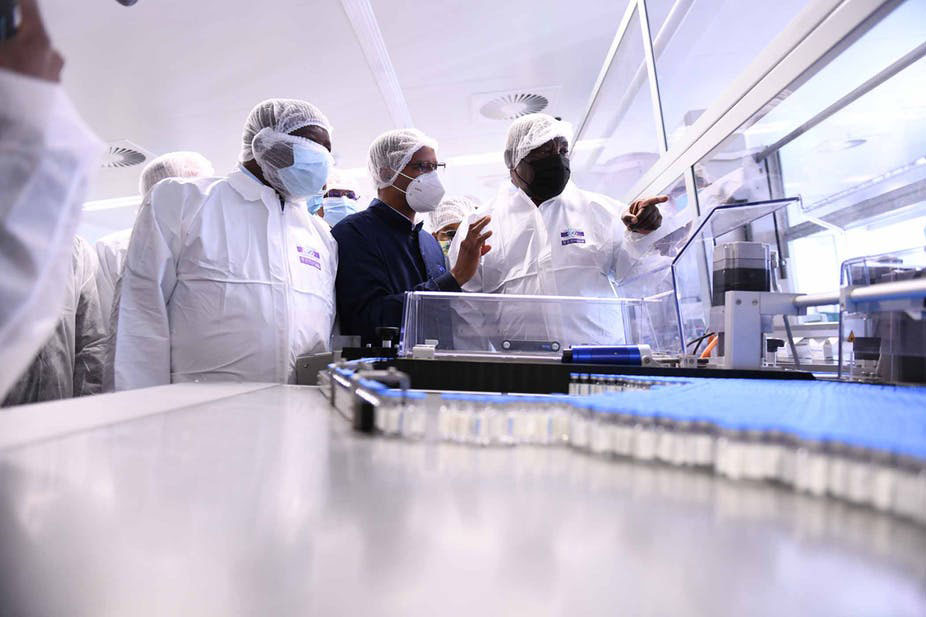
- Rwanda: BioNTech inaugurated its BioNTainer mRNA site in Kigali in December 2023, with a design capacity reported at about 50 million doses a year. In 2025, the European Commission pledged a €35 million grant and the EIB offered up to €60 million in loans, and the project's scope was widened beyond COVID-19 to malaria, tuberculosis, HIV and mpox. The company's own materials still describe the site as being built, which is a reminder that mRNA know-how takes longer to localise than steel and cleanroom panels.
- Existing capacity: Aspen's 2022 ten-year agreement with the Serum Institute of India to make four routine vaccines at Gqeberha, supported by US$30 million from the Gates Foundation and CEPI, remains the template for licensing established products to an African producer.
Even with this pipeline, the base is thin. Africa CDC data reported this year counts 574 manufacturers across the continent's health-products sector, but only 25 of them involved in vaccines, and most of those do fill-and-finish rather than producing the active ingredient.

Nigeria: a large market without a factory
Nigeria shows how much there is to rebuild. According to NAFDAC, the country has not manufactured a single human vaccine since 1993, when the federal laboratory in Yaba that once supplied yellow fever vaccine to West Africa shut down. Nearly 250 million Nigerians therefore rely entirely on imports, such as yellow fever doses from Brazil and measles-mumps-rubella vaccine from India's Serum Institute. Nigerians also spent an estimated US$2.39 billion on medical care abroad in 2024.
The policy response is broadening. Biovaccines Nigeria Limited, a joint venture in which the federal government holds 49% and May & Baker 51%, received title to two Lagos properties in September 2026, though research published this year found that operations had been held up by limited funding. The Presidential Initiative for Unlocking the Healthcare Value Chain says three vaccine projects are in development, alongside work on active pharmaceutical ingredients, clinical trials and pooled procurement. In July, the federal government backed a proposed US$100 million veterinary vaccine plant with a peak capacity of 1.2 billion doses. In October, NAFDAC's director-general said Nigeria had met eight of the nine benchmarks for WHO Maturity Level 4. The missing one, vaccine lot release, cannot be met without domestic production. Regulation and manufacturing, in other words, hold each other back.
The regulatory hinge
AMA Director-General Delese Mimi Darko put the point bluntly to Semafor in July: "If your regulator is not strong, your product is a waste." The AMA, operational since October 2025 and ratified by more than 30 AU member states, does not grant marketing authorisations. Those remain national decisions. Its value lies in coordinating joint assessments, promoting reliance and mutual recognition, and cutting the cost of registering one product in dozens of markets. This week's agenda in Kigali includes inaugurating seven technical committees and launching a Regulatory Innovation and Manufacturing Readiness Hub intended to give industry a formal channel to the agency.
For manufacturers, this is a commercial question. A plant producing 30 million doses cannot survive by selling into one national market. It needs WHO prequalification to sell to UNICEF and Gavi, and predictable regional approvals to sell to governments directly. Every month of regulatory delay is a month of fixed costs with no revenue.
The critics' case
Not everyone believes the current architecture will work. In PLOS Global Public Health, Els Torreele and Heather Sherwin argued that pull incentives tied to WHO prequalification and UNICEF tenders tend to favour larger international producers that already have the capital to reach those milestones. Emerging African firms, they argue, need support earlier, for research and development, clinical trials and regulatory dossiers. The Dutch advocacy group Wemos has said AVMA intervenes too late in the value chain. Nigerian virologist Oyewale Tomori warns that money can be spent without building capacity, pointing to an earlier US$7 million allocation for local vaccine production that he says was prioritised for disbursement through contractors.
There is also a question of comparative advantage. Darko has suggested that some countries may do better making antivirals, antibodies or analgesics than vaccines. That broader base is already emerging: Egypt's Eva Pharma holds a licence to make Eli Lilly's arthritis drug Olumiant for African markets, and South Africa is pursuing local production of Gilead's long-acting HIV-prevention drug lenacapavir.
What success would look like
The economic case for local manufacturing rests on more than pandemic insurance. A functioning biomanufacturing sector creates skilled jobs in quality assurance, regulatory science and engineering. It keeps foreign exchange at home and anchors universities and clinical-research networks. But those benefits arrive only if plants run at commercial volumes. Four tests will matter over the next 18 months:
- Whether AVMA's first disbursement actually lands in the second half of 2026, and to whom.
- Whether AVMA+ tenders for up to 70 million African-made doses are designed so that start-up producers can realistically win them.
- Whether the AMA's joint-assessment and reliance pathways measurably cut approval times for locally produced products.
- Whether African governments commit their own procurement budgets, not just donor-funded orders, to regional suppliers at a modest price premium.
COVID-19 showed what dependence costs. The next phase will show whether Africa can turn political resolve into the dull infrastructure of a real industry: offtake contracts, regulatory dossiers and order books. The factories are rising. The markets still have to be built.
Published By | Features Editor