On election day, a president seeking an unprecedented fourth term faces the son of the jailed former president, with polls tight, Washington watching and the question of how the loser will react hanging over the count.
World Politics
Overview
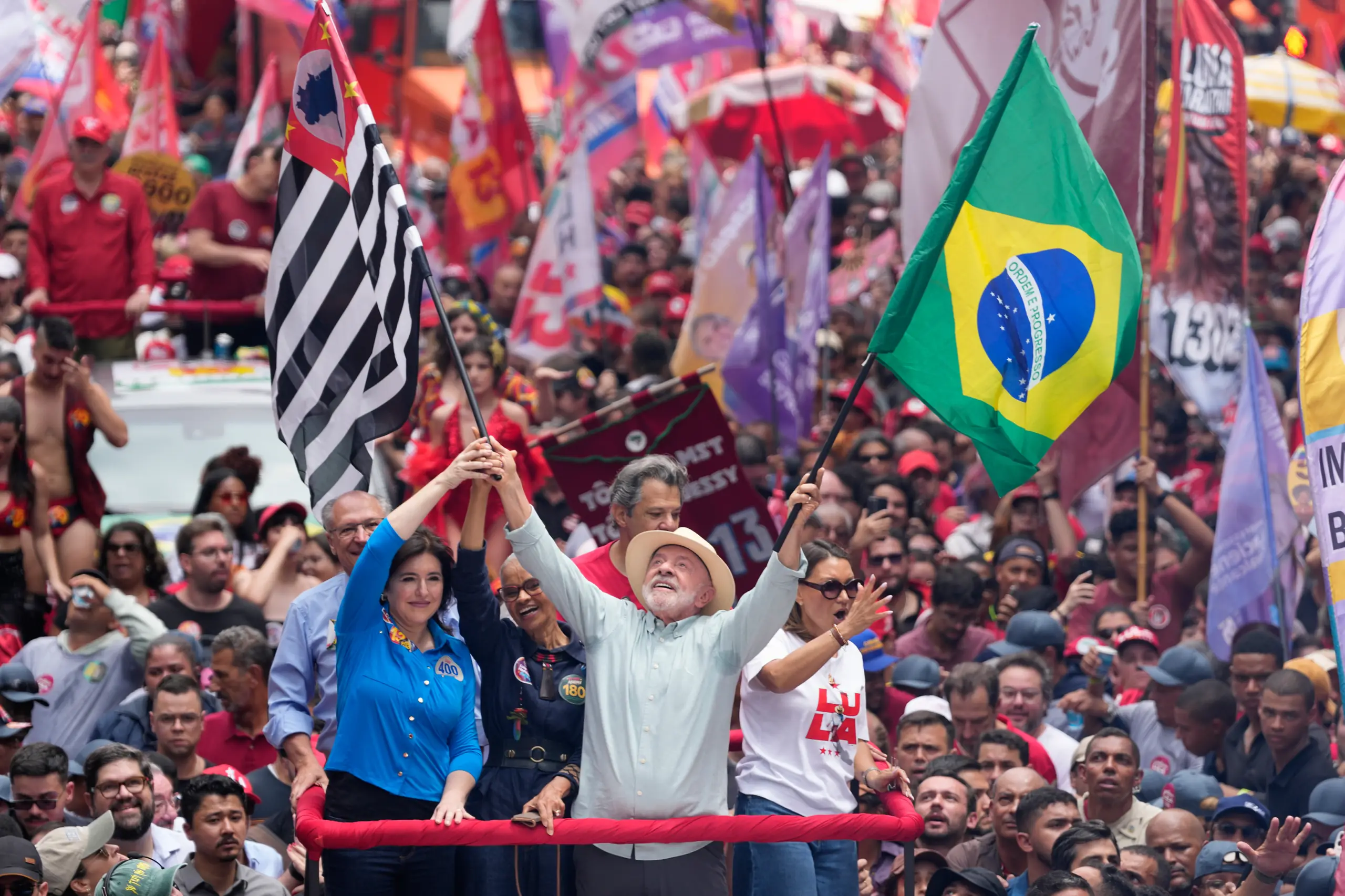
Brazilians go to the polls today, October 4, to choose a president, and the contest has taken the shape of a family rematch with the country's recent political traumas written into it. President Luiz Inácio Lula da Silva, who is 80, is seeking an unprecedented fourth term. His main challenger is Senator Flávio Bolsonaro, 45, the son of former president Jair Bolsonaro, who is serving a 27-year prison sentence for his role in the effort to overturn the 2022 election result. Eleven other candidates are on the ballot, which makes it harder for either frontrunner to clear the 50 percent of valid votes needed to win outright. If nobody does, a runoff is scheduled for October 25.
This briefing was prepared before polls closed and before any results were available, so it describes the race as it stood on election day. The final pre-vote polls show Lula ahead but with a shrinking margin, and the head-to-head runoff numbers are close enough that several pollsters put the two men within a point or two of each other.

Background: A Country Still Reckoning With January 2023
The election cannot be understood apart from the aftermath of the January 2023 attack on Brazil's government buildings in Brasília by supporters of Jair Bolsonaro. The former president now faces a 27-year prison sentence for his part in the plot, and his son Eduardo, who left for the United States, has been barred from office for twelve years, according to earlier reporting. Flávio has positioned himself as the family's political heir and has said he would seek to reverse the judicial outcomes if elected, according to the Washington Office on Latin America's analysis. That promise energizes his base and alarms Lula's supporters, who frame the vote as democracy against authoritarianism.
Lula's own return to power in 2022 followed his earlier presidencies and a corruption conviction that was later annulled. Four years on, he campaigns on economic redistribution, a strong role for the state in development, and the continuation of welfare programs. Flávio offers tax cuts, conservative social policies, a tougher approach to crime and closer trade ties with the United States modeled on Argentina's, according to Axios. He met Donald Trump at the White House in May and pledged that Brazil would join Trump's Shield of the Americas initiative if he won.
The contrast between the two men is also generational and stylistic. Lula, a former union leader, built his career on labor politics and social spending, and at 80 he is asking voters to trust experience and a record that includes the sharp fall in Amazon deforestation. Flávio, a senator, runs as a younger standard-bearer for a movement that remains devoted to his father, and he has had to balance loyalty to that legacy against the need to win over moderate voters who are tired of polarization. Where he lands on that balance, and whether his campaign's promise to revisit the judicial outcomes helps or hurts him in the second round, is likely to be one of the main stories of the next three weeks.
The Polls
Four major surveys released in the final days, reported by Reuters, show Lula ahead in the first round. CNT/MDA had him at 47.8 percent of valid votes against 42.1 percent for Bolsonaro. Datafolha had 45 percent to 42 percent, Quaest 46 percent to 45 percent, and AtlasIntel/Bloomberg 47 percent to 44.1 percent. Margins of error ranged from one to just over two percentage points, so the Quaest result in particular is effectively a tie.
The runoff projections are tighter still. CNT/MDA showed Lula at 47.3 percent to 43.1 percent, Datafolha at 47 to 46, and AtlasIntel at 47.6 to 47.4. Quaest was the outlier, showing Bolsonaro ahead 44 percent to 42 percent in a second round. That spread of outcomes explains why neither campaign can be confident, and why both are talking about winning on the first day. At his closing rally in São Paulo on Saturday, Lula told supporters, "Tomorrow, we're going to win the elections in the first round." Bolsonaro, after a motorcycle caravan through São Paulo and a rally in Rio, said he was convinced everything was in place to win in the first round as well, according to Al Jazeera. Most observers expect neither to manage it.
There is also a pronounced gender divide, according to WOLA: Flávio leads among men, while Lula holds an advantage of about 18 points among women.
The Issues Driving the Vote
Public safety tops voters' concerns. WOLA reports that 31 percent of voters name violence as the country's most pressing problem, even though the 2026 data show the lowest violent death rate since 2012. The disconnect between the numbers and the perception is itself political, since police killings, femicides and organized crime dominate coverage, and Bolsonaro's tougher posture on crime is a central pitch.
The environment is a second fault line. Nearly 60 percent of the Amazon rainforest lies in Brazil, and Axios notes that deforestation has fallen by roughly half under Lula, while Flávio has questioned climate science and backed loosening environmental rules. For international observers, and for climate negotiators, that contrast gives the election global weight.
Representation also features. New rules require proportional campaign funding and airtime for Black, women and Indigenous candidates, and WOLA notes that Black candidacies make up nearly half the field. It also observes that Lula's platform addresses LGBTQ+ rights explicitly, while Flávio's formal plan does not.
The Shadow of Washington
The United States is an unusually visible presence. Trump has said he is watching the election "very closely" and called it "very important," though he has not formally endorsed anyone, according to Axios. His administration imposed additional 25 percent tariffs on Brazilian goods this summer, which Lula has characterized as electoral interference. WOLA reports that trade disputes, terrorist designations and the administration's favoritism toward the Bolsonaros have intensified polarization, and that Brazil's intelligence agency classified the risk of foreign interference as "critical."
For Lula, the tariff fight has been double-edged: it lets him cast himself as a defender of sovereignty, but it also puts pressure on exporters. For Flávio, the Trump connection promises market access and political backing, but it risks the charge that he is Washington's candidate.

Questions Over Trust in the Count
A less comfortable subplot concerns the legitimacy of the result. Al Jazeera reports that Flávio has echoed his father's unsubstantiated claims questioning the reliability of Brazil's voting system, which could set up a contested aftermath if he loses. Brazil's electronic voting machines have been used for decades and its electoral authorities have defended them, and the 2022 result was certified despite similar claims. Even so, the echo of those claims in a close race raises the stakes of the first hours after polls close, when both campaigns will be watching the count and the electoral court will be under pressure to move quickly and transparently.
Flávio also faces scrutiny over the financing of a film about his father, an investigation that Al Jazeera notes has followed him through the campaign. It has not, on the evidence of the polls, dislodged him from contention.
Observers should also watch turnout and the share of blank and spoiled ballots, which can signal how many voters feel unrepresented by either option, and the first official results from the electoral court, which in Brazil typically arrive quickly because of the electronic system. A clear early lead for either candidate will shape the narrative for the runoff, while a razor-thin gap for second place or for the top spot would invite exactly the kind of disputes that both campaigns' supporters are already primed to expect.
What Comes Next
If, as most polls suggest, no one passes 50 percent, the next three weeks will be a sprint to October 25. The first-round tally will matter beyond the top two. Voters are also choosing members of Congress and governors on the same day, and the strength of Bolsonaro's allies in the legislature will shape what a Lula fourth term could accomplish, or what a Bolsonaro presidency could do about the judicial outcomes he has criticized. Third-place and fourth-place finishers will become targets for endorsements, and the gender gap and the Quaest runoff result suggest that a small shift among undecided voters could decide the presidency.
For investors and foreign governments, the runoff will bring renewed attention to tariffs, Amazon policy and Brazil's alignment between Washington and Beijing. For Brazilians, the more immediate test is whether the losing side accepts the result. A decisive first-round win for either candidate would reduce the risk of a prolonged fight, but the polls point to a close finish, and in a country that has already seen one election result met with violence, that is the question that will matter most once the votes are counted.
Published By | News Editor