Written By | Sports Desk
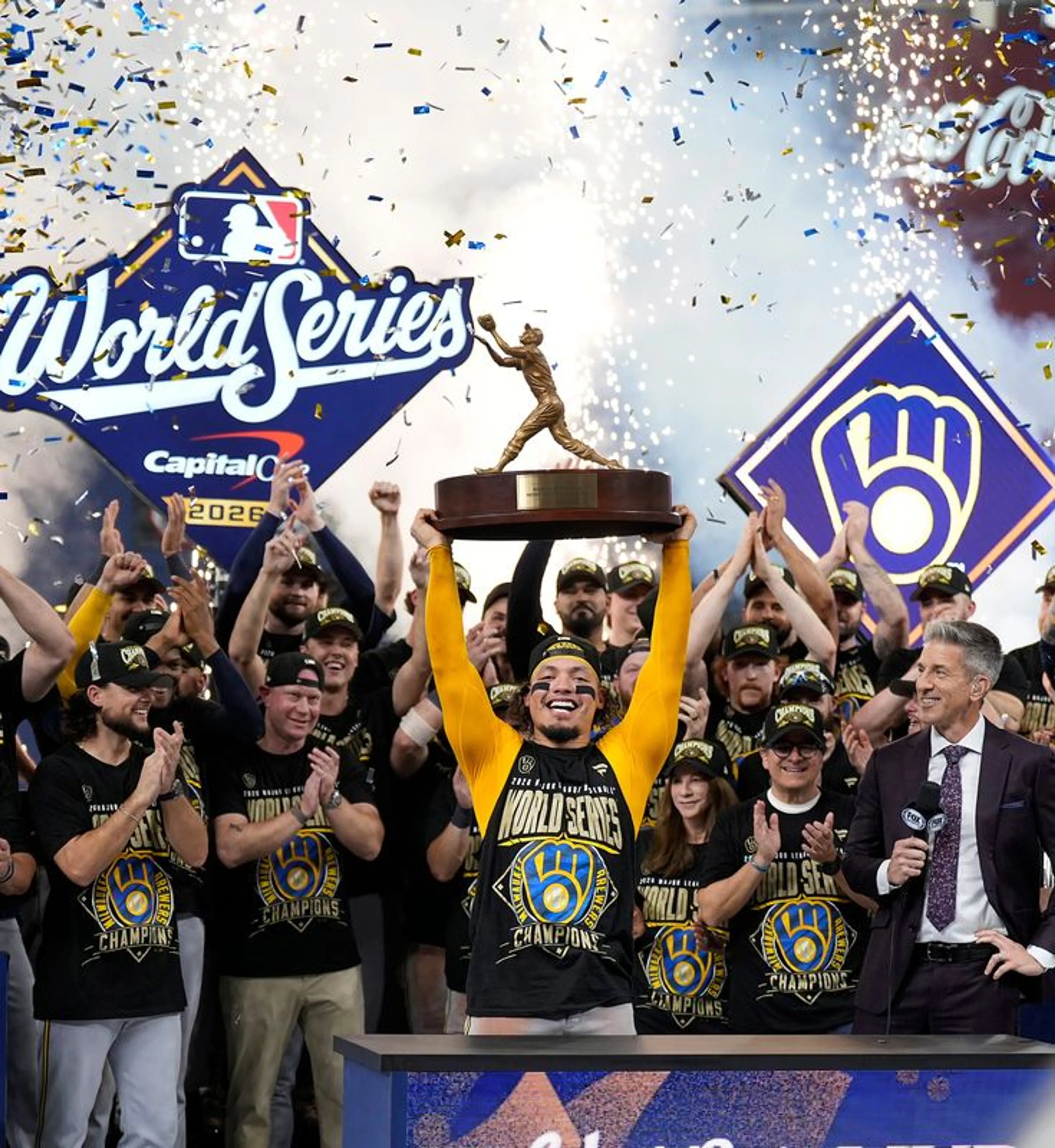
A 103-win juggernaut, a rookie shortstop on a historic hitting streak and a bullpen that refused to crack gave a small-market franchise the one thing it had never had in 57 years.
ST. PETERSBURG, Fla. / MILWAUKEE
It ended at 11:13 p.m. Eastern on Wednesday night, with a routine grounder to second base. Brice Turang fielded it, threw to first, and the Milwaukee Brewers, a franchise that had never won a World Series in its 57-year history, were champions. The final score at Tropicana Field was 4-1 over the Tampa Bay Rays in Game 5, and it closed out a postseason in which Milwaukee went 11-2.
The title is the first for the franchise and, according to MLB.com, the first for the city of Milwaukee since the 1957 Braves. Today, Friday, the celebration moves from the ballpark to the streets: a championship parade is scheduled for 10 a.m. Central, starting at North 4th Street and West Wisconsin Avenue and ending at the Summerfest grounds.
A season built on depth
Nothing about the October run came out of nowhere. The Brewers finished the regular season with a franchise-record 103 wins, the best record in baseball. They beat the San Diego Padres in the National League Division Series and then swept the Los Angeles Dodgers in the NLCS, the team that had ended Milwaukee's season in the 2018 and 2025 NLCS rounds. It was the club's first World Series trip since 1982, and it marked their eighth postseason appearance in nine years.
Manager Pat Murphy, 67, a two-time reigning NL Manager of the Year, summed up the group in two words after the clincher: "We were relentless." Christian Yelich, 34, one of the veterans who had endured those earlier playoff exits, offered a more personal verdict on what a championship feels like: "It's better than you think it would be." Front-office leader Matt Arnold added that the team's heart cannot be measured by the metrics the club relies on.
The 103-win total deserves its own emphasis. It is the most wins in franchise history and the best mark in the majors, which means the Brewers did not sneak into October on a hot streak. They arrived as the favorite on paper and, with a postseason record of 11-2, played like it. Only the two losses, including the heartbreaker in Game 4, interrupt an otherwise tidy ledger.
The closer look: how Game 5 was won
Game 5 was a story of young arms and a young bat. Right-hander Jacob Misiorowski threw more than five scoreless innings before a right calf cramp ended his night in the sixth. Rookie shortstop Cooper Pratt drove in the first run with a second-inning single, singled again in the fifth and scored, and in the sixth added a sacrifice fly that stretched the lead to 4-0. Along the way he collected a hit in six straight World Series plate appearances, a streak ESPN notes had not been matched since David Ortiz in 2013 and which MLB.com describes as tying and then breaking a World Series rookie record.
William Contreras was named World Series MVP, according to ESPN. The catcher posted an .863 OPS in the series, threw out three would-be base stealers, and went 10-for-13 on automated ball-strike challenges. Milwaukee's pitching held Tampa Bay to a .182 batting average for the series.
The ninth inning supplied the only anxiety. Closer Trevor Megill allowed a run after a Liam Hicks double and a bad bounce, but he finished the job, getting the final out on the groundout to Turang.
It is worth pausing on how many different people contributed. A rookie shortstop made history with his bat, a young starter dominated before his body gave out, a catcher steadied everything behind the plate, and a manager in his late sixties kept the clubhouse calm. That spread of heroes is the best argument that this was a team title rather than a star-driven one.
A series that tested them
The Rays did not go quietly. Game 1 featured a game-ending double play that was called off, and the Brewers won anyway. In Game 2 Milwaukee erased a four-run deficit. Game 3 was a rout, highlighted by a record-setting eight-run inning, with the Brewers pitching staff finishing the night with Brandon Woodruff, who had decided against season-ending shoulder surgery to remain available.
Then came the heartbreak. In Game 4, the Brewers were three outs from the title before Tampa Bay rallied with a two-run 12th inning to win 4-3 and force a fifth game. A team that had to absorb that blow and still win the next night is the best argument for Murphy's one-word theme.
The names behind the numbers
The record book will remember several performances. Reliever Aaron Ashby set a single-postseason record for a relief pitcher with 18 consecutive scoreless innings. Outfielder Jackson Chourio tied Babe Ruth's mark with 10 hits in the first four games of a World Series. Starter Robert Gasser posted a 0.60 ERA across three postseason starts. These were not isolated flashes; they were the product of a roster that kept finding someone new to carry the load.
Small market, big audience question
The title arrived against an unusual television backdrop. Fox's early-series numbers were down only modestly from last year's Dodgers-Blue Jays matchup: Game 1 drew about 12.26 million viewers and Game 2 about 10.85 million, declines of roughly 8% and 7%. Game 3, which aired against Monday Night Football and, for the first time, opposite the WNBA Finals, reportedly averaged around 8.3 million, per Sports Media Watch, which called it possibly the smallest audience on record for a World Series game; official figures were not yet released. Early figures for Game 4 pointed to about 13.5 million, a series high.
The debate over whether a Milwaukee-Tampa Bay final could draw is now settled in part: the audience was smaller at its low point but dependably large when the games turned dramatic.
For Fox, the lesson is probably about scheduling and the shifting competition for eyeballs: a baseball finale now shares October evenings with the NFL and the WNBA postseason. For the sport, the more important number may be the one that cannot be measured by Nielsen, which is how many new fans in Wisconsin and beyond tuned in because the home team was good, young and fun to watch.
What this means for you
If you follow baseball casually, the Brewers' win is a reminder that sustained, patient roster building can beat the biggest payrolls. If you live in or near Milwaukee, expect Friday's parade route to be crowded and plan accordingly. And if you bought a 2026 Brewers cap in April, congratulations: it has just become a collector's item.
The bottom line
For decades, Milwaukee's baseball story was about near-misses: the 1982 loss, the NLCS exits of 2018 and 2025. On Wednesday night that story ended with a groundout to second base, and a new one began. A franchise that was never supposed to win one now has a banner to hang, a parade to ride, and a rookie shortstop who will be telling the Ortiz comparison to anyone who asks.



