Written By | International News Agencies
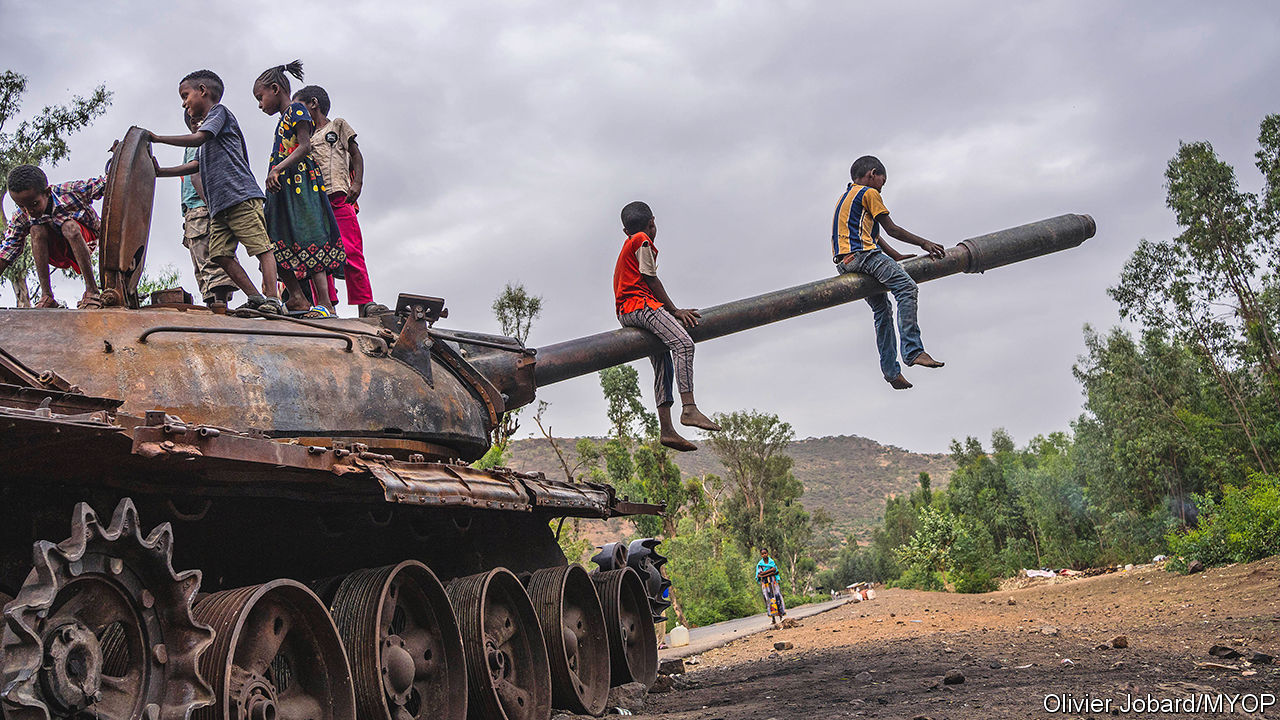
Government-allied fighters entered Mekelle on Sunday, Oct. 4, after the TPLF announced its withdrawal, the Associated Press reported.
ADDIS ABABA
Barely two weeks after fighting resumed and broke the 2022 Pretoria peace agreement, Ethiopia's northern conflict is turning into something larger than a rematch between the federal government and Tigrayan forces. Witnesses and a government-allied commander say Eritrean soldiers have crossed into Tigray, and the two countries have severed diplomatic ties. Just days earlier, Prime Minister Abiy Ahmed took the oath for a new five-year term and told parliament that landlocked Ethiopia must have an outlet to the sea.
The reports of Eritrean troops are unverified, and Asmara has not confirmed them. Even so, they land at a moment when Ethiopian and allied forces have taken Mekelle, Tigray's regional capital, and the Tigray People's Liberation Front (TPLF) has pulled back its administration. The question facing the Horn of Africa is whether the federal victory in the capital closes the war or opens its most dangerous phase.
What happened this week
Government-allied fighters entered Mekelle on Sunday, Oct. 4, after the TPLF announced its withdrawal, the Associated Press reported. The Tigray Peace Force, a pro-government Tigrayan group that includes former members of the TPLF's armed wing, imposed an 8 p.m.-to-6 a.m. curfew in the city on Wednesday. Reuters reported that Ethiopian forces captured the city after the TPLF confirmed it had moved its regional administration "temporarily" elsewhere.
On Wednesday, at least two witnesses told Reuters they saw "dozens" of Eritrean soldiers drive through Adigrat, a town about 25 kilometers (15 miles) south of the Eritrean border, in two trucks. The witnesses identified the soldiers by their off-white camouflage uniforms. Reuters could not independently verify the accounts. If confirmed, the sighting would be the first time Eritrean forces had been seen inside Ethiopia since fighting resumed in late September.
Gebreigziabher Beyene, commander of the Tigray Peace Force, told Reuters: "The Eritrean army has entered Tigray in uniform, equipped with heavy weaponry." He said his force was being hit by drones and that Eritrea was deploying troops so the fighting would take place inside Tigray rather than spill into Eritrea.
A second Peace Force commander, Ermiyas Ababu, told the AP that Eritrean personnel entered Adigrat on Tuesday, Oct. 6, and Idaga Hamus on Wednesday, Oct. 7, and were conducting surveillance there. The conflict monitor ACLED, through East Africa analyst Jalale Getachew Birru, gave a separate account: Eritrean troops crossed at Zelambesa on Wednesday, and Ethiopian military drones struck them at Guada as they moved toward Idaga Hamus. ACLED had not answered the AP's question about the basis for its claims by Thursday morning. The AP said it could not verify either account.
Eritrea's information minister, Yemane Gebremeskel, said on X that Ethiopia was constructing "a fallacious narrative of 'self-defense'" to justify military action. Reuters noted he did not deny that troops had crossed the border; the AP noted he did not address the specific movements or strikes ACLED described.
How the Pretoria agreement unraveled
The November 2022 Pretoria agreement ended a two-year war between the federal government and Tigrayan forces. It had been fraying for much of the past 18 months. The Critical Threats Project, a Washington-based research group, wrote in an Oct. 1 assessment that the agreement had not functioned since the TPLF's March 2025 takeover of the Tigray Interim Administration. It said the federal government's revocation of the TPLF's legal status, and the TPLF's May 2026 move to reinstate the pre-war regional government, effectively voided the deal. An African Union process led by envoy Olusegun Obasanjo, whose most recent meeting with TPLF leader Debretsion Gebremichael came in late August, produced no progress, according to the same assessment.
Fighting resumed in the last week of September. Reuters dates the resumption to Sept. 23, when it says the TPLF and a seven-group armed alliance seized three airfields in Tigray, including Alula Aba Nega Airport, about 10 kilometers east of Mekelle. The Critical Threats Project dates the Afar-front fighting to Sept. 22. Federal and allied forces then pushed north along the A2 highway and retook the airport, according to Reuters and Agence France-Presse reports cited by Al Jazeera.
The alliance includes the TPLF, the Afar Revolutionary Democratic Unity Front, the Amhara Fano National Movement and the Oromo Liberation Army, though the Critical Threats Project reported that three smaller members would not contribute militarily and that the Oromo Liberation Army had called the grouping a "procedural consensus" on Sept. 17. Ethiopia's government accuses Eritrea, Egypt and Sudan of backing the alliance. All three deny it.
The fighting has spread beyond Tigray. Al Jazeera reported on Oct. 3 that combat reached Amhara and Afar. The Ethiopian military said about 270 Tigrayan fighters were killed and more than 200 wounded around North Wollo, and Al Jazeera cited an explosion at the Ministry of Defence in Addis Ababa in early October, the first sign of the conflict reaching the capital. The Critical Threats Project said suspected drone strikes hit several locations in the capital on the night of Sept. 30 into Oct. 1, though it found no visible damage in satellite imagery. Rebel-linked sources told Reuters the alliance conducted the strikes.
The diplomatic rupture with Eritrea
Relations between Addis Ababa and Asmara, restored in 2018 under Abiy after more than two decades of hostility, are now broken. Ethiopia said it would close its embassy in Asmara and expel 10 Eritrean diplomats. Eritrea responded by severing all diplomatic ties; its foreign ministry said Ethiopia had left it "no option but to reciprocate in kind." Reports date the Eritrean announcement to Oct. 1 or 2.
Eritrea has accused Ethiopia of an "agenda of incessant hostility," including encroaching on its coastal areas and arming opposition fighters. Ethiopia, for its part, accuses Eritrea of funding the TPLF. Ethiopian army chief Birhanu Jula made that charge on Sept. 25, according to the Critical Threats Project. Eritrea denies it.
The Critical Threats Project described the Eritrea-TPLF relationship as an alliance of convenience, driven by Eritrean grievances over the settlement of the first war between the two states and by Ethiopian interest in the Eritrean port of Assab. Its analysts said Eritrea could intervene directly if Ethiopian forces captured Mekelle or advanced toward the border. Federal forces have now done the first.
The Red Sea, and why it matters beyond Tigray
On Monday, Oct. 5, Abiy was sworn in at parliament in Addis Ababa. In his speech he repeated that Ethiopia would pursue a Red Sea port, calling access critical to the country's "civilisation." He said: "Based on the principle of give and take, we will work diligently to ensure that Ethiopia has an outlet to the sea." Ethiopia lost its coastline in 1993, when Eritrea became independent.
The timing sharpened neighbors' suspicions. On Sunday, Oct. 4, Egypt, Eritrea, Sudan and Somalia met in New Alamein, Egypt, and said Red Sea governance was the exclusive responsibility of coastal states. They also rejected actions affecting Nile water use, a reference to the dispute over Ethiopia's Grand Ethiopian Renaissance Dam. Ethiopia was not at the table. Al Jazeera reported that the declaration called for a peaceful, political solution to the war in Ethiopia, a pointed intervention in a country's internal conflict.
Ethiopia's Foreign Ministry said it remained committed to dialogue with its neighbors, and on Oct. 5 said any Red Sea talks must account for its "legitimate interests and enduring connection" to the sea. Somali President Hassan Sheikh Mohamud, who attended the Egypt meeting, nevertheless congratulated Abiy on his re-election and said he looked forward to closer relations. Somalia has said it does not object to Ethiopian access through Somali territory, subject to formal negotiation.
Humanitarian toll and the fragility of the front
The human cost is already visible. Al Jazeera reported on Oct. 3 that at least 52 civilians had been killed in northern Ethiopia, and that Doctors Without Borders had reported a surge in wounded. Amnesty International cited credible accounts of civilian objects destroyed by shelling and airstrikes and of intensified forced conscription, conduct it said may violate international humanitarian and human rights law. Amnesty's regional director, Tigere Chagutah, urged the African Union to convene an emergency session of its Peace and Security Council.
Shire, a town that has sheltered displaced people and hosted aid operations, is now exposed: residents told the AP that TPLF forces withdrew on Wednesday before government forces arrived, and shops closed for fear of looting.
Analysis: a capital captured is not a war ended
Abiy's government can now claim a decisive tactical success. It holds Mekelle, has beaten back a rebel push in Afar that threatened the Ethio-Djibouti highway through which, the Critical Threats Project reports, more than 90 percent of Ethiopia's trade passes, and has watched the TPLF's cohesion fray. The Critical Threats Project documented how the TPLF has relied on mass conscription since June amid growing reluctance to join. Tigray's police commissioner reportedly defected to the federal government on Sept. 23.
But the same analysis suggests why the victory may be hard to convert into peace. The Tigray Peace Force, now a key partner for Addis Ababa, is itself drawn from former TPLF fighters and is operating in a region where memories of atrocities from the 2020–2022 war remain raw. AllAfrica reported that Adigrat residents had seen military convoys heading south and that Tigrayans remain anxious, recalling alleged atrocities from that war. An outright Eritrean deployment would add a third army with its own record in Tigray and its own agenda.
There is also the regional dimension. Laura Hammond, a professor at SOAS University of London, told Al Jazeera that Eritrea's support for the TPLF and its allies shows spillover risks "are already materialising," and warned that Eritrea could become more involved inside Tigray if the conflict continues. Sudan's war has drawn in both Ethiopia and Eritrea, according to the same analysis, and Red Sea trade routes are already under strain from the wider Middle East conflict.
Diplomacy offers little relief. The African Union chairperson called on Sept. 23 for dialogue and a return to Pretoria, and the European Union and the UN secretary-general backed de-escalation. The United States and the United Arab Emirates, a key backer of Abiy, urged restraint but condemned the TPLF, according to the Critical Threats Project, which may give Addis Ababa room to press its advantage.
What to watch next
Four developments will indicate where the conflict is headed. First, whether Eritrea's presence inside Tigray is confirmed, and whether Ethiopia treats it as a casus belli or as justification for a direct strike on Eritrean territory. Second, what happens in Shire and the western Tigray corridor, where humanitarian access and the risk of reprisals are greatest. Third, whether the African Union's Peace and Security Council meets and whether any mediator can reach both the TPLF's leadership and a government that has revoked its legal status. Fourth, how Abiy's Red Sea rhetoric evolves now that he has a fresh mandate and a battlefield advantage: "give and take" can describe a negotiation, or an ultimatum.
For now, the picture is of a federal government gaining ground and a region losing its footing. Most of the claims about Eritrean movements rest on a handful of witnesses and partisan commanders. What is not in dispute is that the diplomatic structure that kept Ethiopia and Eritrea out of open conflict since 2018 is gone.



