Written By | International News Agencies
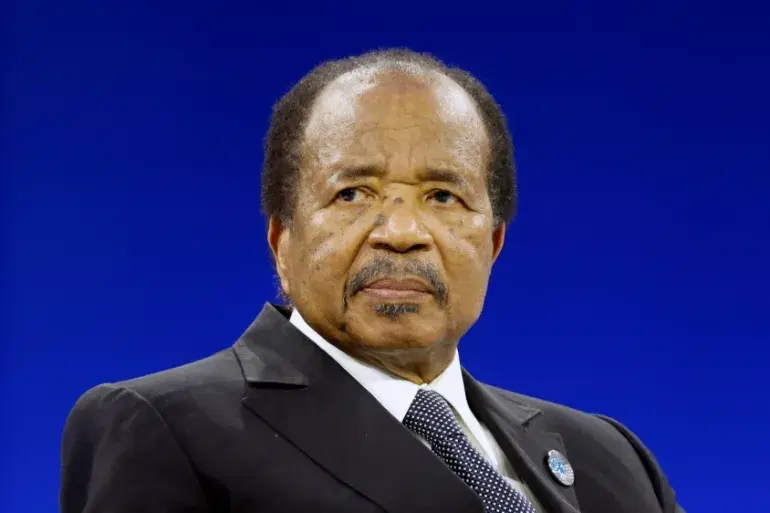
President Paul Biya, 93, has not been seen in public for 72 days
Yaoundé, Cameroon
President Paul Biya, 93, has not been seen in public for 72 days, and the government's insistence that he remains firmly in charge is starting to strain credulity even among Cameroonians accustomed to his long absences. Biya left Yaoundé on June 7 for what his office described as a "brief private stay" in Europe, reportedly in Geneva. He has not returned, and no one in his government will say when he will. In the meantime, he has signed decrees reshuffling the top ranks of the military, leaving the opposition to ask a question the constitution does not answer cleanly: who, exactly, is running Cameroon?
The stakes go well beyond one elderly leader's travel schedule. Biya has ruled Cameroon since 1982, making him the world's oldest sitting head of state and one of its longest-serving, and he was re-elected in October 2025 to an eighth term that is constitutionally set to run until 2032, by which point he would be approaching 100. That election was itself marred by allegations of irregularities and deadly protests, underscoring how contested his continued rule already was before he vanished from public view. Now, with the president unseen and unheard for more than 10 weeks, Cameroon's political class is quietly rehearsing a succession it has spent four decades trying to avoid discussing openly.
A government on the defensive
The government's public position has been that there is nothing to see. Minister of Communication René Emmanuel Sadi, the government spokesman, told Radio France Internationale in early August that reports of Biya's declining health were unfounded. "President Paul Biya is alive. President Paul Biya has not resigned — that must be stated clearly," Sadi said. "President Paul Biya will soon return to Cameroon; therefore, at this stage, there are no grounds to speak of a vacancy in the leadership of the State."
Pressed for a timeline, Sadi could not offer one. "I cannot tell you exactly when President Paul Biya is returning. And even if I knew, it is not my place to announce it here. I can at least tell you that he is coming back very soon," he said. Sadi suggested the extended stay might owe to circumstances outside the president's control: "He may be away for reasons sometimes beyond his control. He might extend his stay due to force majeure, while ensuring that the family continues to function properly." He maintained that the machinery of state has not missed a beat. "Even in the absence of the President of the Republic, our country's institutions are functioning normally," he said, pointing to ministers continuing their duties as evidence of stability.
The opposition is not persuaded. Roger Justin Noah, First Deputy Secretary-General and acting national secretary for communication of the Cameroon Renaissance Movement (MRC), told RFI that the secrecy itself is the problem. "If he is indeed facing health issues, the Cameroonian people have a right to know; there is no reason to maintain ambiguity regarding the President of the Republic's state of health," he said. The MRC has also pressed the more pointed question of who is actually exercising presidential authority while Biya remains abroad — a question the government has declined to answer directly, insisting instead that no formal vacancy exists because none of the constitutional triggers for one has been met.
What the constitution actually says
That legal argument is, on its face, correct, which is precisely what makes the situation so fraught. Under Article 6(4) of Cameroon's constitution, a presidential vacancy can only be declared following the death, resignation or permanent incapacity of the head of state, and only the Constitutional Council has the authority to make that declaration. Absent such a ruling, Biya remains president in full, however long he stays away. Sadi has emphasized this point directly: "In short, the Constitutional Council has not declared a vacancy in the office of Head of State."
If a vacancy were ever declared, power would pass provisionally to the president of the Senate. That office itself has just changed hands in a way that reshapes the succession picture. Marcel Niat Njifenji, who had held the Senate presidency since 2013 and was for years the person who would have stepped into an interim role in his nineties, was replaced in a Senate vote on March 17 by Aboubakary Abdoulaye, a 64-year-old traditional ruler who has served as lamido of Rey-Bouba since 2006. Niat Njifenji died weeks later, on April 11, at 91. The result is that Cameroon's constitutional line of succession is, for the first time in over a decade, no longer headed by a nonagenarian — a change of real consequence should Biya's absence ever trigger the formal machinery Sadi insists has not been triggered.
A reshuffle with a message
While the president has stayed out of sight, he has not stayed out of the decision-making. On Aug. 3, Biya signed three decrees carrying out the broadest shake-up of Cameroon's military leadership in years, replacing commanders in four of the country's five joint military regions. The changes reached into the most sensitive layers of the security apparatus: the head of the Presidential Guard was promoted from colonel to brigadier general, the elite Rapid Intervention Brigade received a new commander, and Major General Ebaka Hippolyte was elevated within the Armed Forces General Staff.
Analysts read the timing as deliberate. Coming 58 days into Biya's absence, the reshuffle allowed the presidency to test loyalties and install trusted officers in the very units — the Presidential Guard and the Rapid Intervention Brigade — that would matter most in any contested transition. It also served as a pointed reminder that Biya, wherever he is, retains the authority to reorder the armed forces at will, a fact that complicates any narrative of an incapacitated or sidelined leader.
The reshuffle also lands amid genuine security strain. In the Far North, Boko Haram and its offshoots continue to mount suicide attacks and raids on villages. In the Anglophone Northwest and Southwest regions, a separatist conflict now in its ninth year continues to grind on, having killed thousands and displaced hundreds of thousands since it began. Rotating regional commanders in the middle of two active conflicts carries operational risk, but the presidency appears to have judged the political benefits of placing loyalists in key posts as worth that risk.
The cost of uncertainty
The political vacuum is already showing up in the country's finances. Cameroon's dollar-denominated bond has been the worst-performing sovereign debt instrument in Africa since early June, precisely when Biya departed, according to market data reported by Bloomberg. That fragility comes even as the government presses ahead with an environmental bond issuance worth roughly 400 billion CFA francs, or about $692 million, a sign that Yaoundé is trying to project business-as-usual confidence to international investors even as domestic uncertainty deepens. Cameroon's outsized regional role compounds the stakes: as Central Africa's largest economy and a logistics hub whose port at Douala serves fuel, food and freight networks across the CEMAC bloc, sustained instability at the top in Yaoundé would reverberate well beyond the country's borders.
There are also signs the ruling Coalition for the Defence of the Republic (CPDM) is quietly preparing for a transition it will not discuss publicly. The party convened a rare leadership meeting in July, its second such gathering in quick succession, which observers have interpreted as evidence that senior officials are war-gaming succession scenarios even as they publicly deny any need to do so. A new government was only formed at the end of December 2025, after months of delay following the October election — a sluggish start that has left many of the administrative structures around Biya thinner than usual just as the question of his capacity has become impossible to ignore.
What to watch
Three things will determine how this crisis develops in the coming weeks. First is whether Biya reappears in Yaoundé at all, and in what condition — a public appearance would substantially calm the speculation, while continued silence will likely intensify it and could eventually force the Constitutional Council to confront the vacancy question it has so far avoided. Second is how the newly promoted military commanders behave in their posts, particularly those atop the Presidential Guard and the Rapid Intervention Brigade, whose loyalties diplomats and analysts are watching closely as the units most likely to matter in any contested handover. Third is whether the CPDM convenes again before any formal announcement, which would suggest the party leadership believes a transition, managed or otherwise, may be closer than the government's public reassurances suggest.
For now, Cameroon is governed by decree from an undisclosed location in Europe, its institutions insisting that everything is normal while its opposition, its markets and its regional neighbors watch for the moment when it no longer is.



