Written By | Entertainment Desk
San Sebastián's 74th edition opens today with Fatih Akin, Werner Herzog and Naomi Watts on the guest list
SAN SEBASTIÁN, Spain
The poster for this year's San Sebastián International Film Festival shows Ricardo Darín, the Argentine actor who took the festival's Donostia Award in 2017, looking out at the Cantabrian coast. It was unveiled in June at the Tabakalera cultural centre by two people standing side by side: the man who has run this festival since 2011, and the woman who will run it from January.
That image is the story of the 74th edition, which opens today and runs through September 26. On paper it is a nine-day showcase of seventeen competition films, two lifetime-achievement honours and more than a hundred screenings across a Basque city of 190,000 people. In practice it is a farewell.
The handover
José Luis Rebordinos is retiring after this edition. In April, the festival named Maialen Beloki as his successor, effective January 2027 — a promotion from within that surprised almost nobody who knows the building.
"Maialen is a highly qualified professional with an in-depth knowledge of the festival," Rebordinos said of the appointment. "She has been part of the team for seventeen years, serving as deputy director for the last eleven of those. I can't think of anyone better suited to the role."
Rebordinos has been unusually candid about why he is going. He told the Spanish outlet Mundiario this week that he simply no longer has the energy the job demands — a refreshingly unmythological explanation from an industry that tends to dress up its exits. He is not disappearing entirely; he expects to consult with other festivals on Spanish and Latin American cinema. But, he said, "I won't be on the front line. Rather, I will always be working in support of others."
The one regret he has voiced publicly is a guest he could not land for his final year. Even festival directors have a wish list they never finish.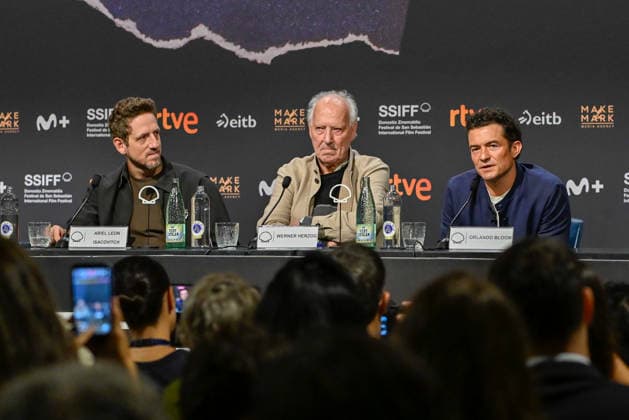
Seventeen films and a Golden Shell
The competition itself is one of the strongest Rebordinos has assembled, which one suspects is not an accident. It opens tonight with the world premiere of Ghost Song — Geister in the original German — from Fatih Akin, the Hamburg-born director whose career has swung between raucous crowd-pleasers and genuinely upsetting drama.
Around it sits a lineup that reads like a survey of world cinema's working generation. Mike Leigh brings Tender Loving Care. Pablo Larraín has My Sad Dead. Jesse Eisenberg is in the Golden Shell race with The Debut. Nicole Garcia has Milo; Fred Cavayé has a new Les Misérables; Amanda Kernell's Brace Your Heart carries five Nordic and Balkan co-production partners; Yeşim Ustaoğlu has What Remains; Hans Petter Moland adapts Growth of the Soil. Spain is represented by Mikel Gurrea's Saints, Javier Ruiz Caldera's 5 More Minutes and Roberto Bueso's The Bad Father.
The festival has also introduced a new official prize this year, for Best Original Music among competition titles, presented in partnership with the Spanish rights society SGAE. It is a small addition with a pointed argument behind it: that scoring is a craft the major festivals have been slow to honour formally.
The out-of-competition Perlak section — San Sebastián's traditional harvest of the year's best festival titles — is almost absurdly stacked. Ryusuke Hamaguchi, Lukas Dhont, Paweł Pawlikowski, Cristian Mungiu, Nanni Moretti, Andrey Zvyagintsev, Ira Sachs, Na Hong-jin, Martin McDonagh and Olivia Wilde all have films there. Elsewhere in the programme, Lee Chang-dong, Tsai Ming-liang, Radu Jude, Bruno Dumont and Jane Schoenbrun are showing work. The closing night, outside competition, belongs to Michaël R. Roskam's Le Faux Soir.
Two Donostias, and the third that got away
In July, Rebordinos said out loud what he wanted for his last year: "For me, the ideal is three." He was talking about Donostia Awards, the festival's lifetime honour.
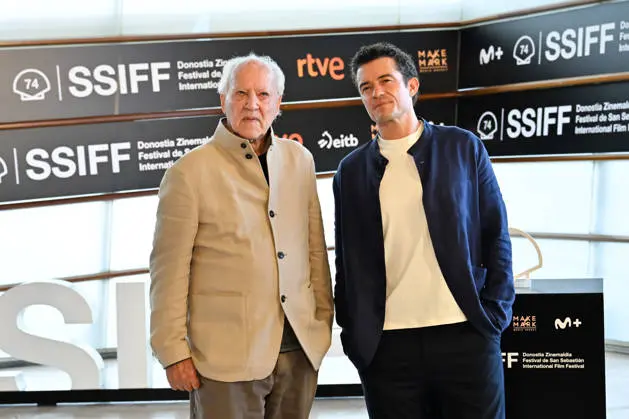
He got two. Werner Herzog was announced in early August — a director whose relationship with cinema has always been closer to an expedition than a career. Naomi Watts followed on August 31, paired with a Donostia screening of her new film The Housewife. Both will collect their awards in the Kursaal during the week.
Two is not three, but two is Herzog and Watts, which is a respectable place to stop.
What Rebordinos actually built
Asked what he is proudest of across fifteen years, Rebordinos did not name a film or a star. He named infrastructure.
First, he said, was the growth of the festival's industry activities — the market, the co-production forums, the machinery that turns a screening into a financed film. Second was turning San Sebastián into something that operates year-round rather than for nine days in September, through its film school and residency projects. Third was the archive.
It is a revealing list. Festivals are judged publicly on red carpets and competition juries, but they survive on whether they can help films get made and remembered. Under Rebordinos, San Sebastián stopped being only a place where Spanish and Latin American cinema was shown and became a place where it was built. The Made in Spain strand alone runs to 24 titles this year, opening with Albert Serra and including new work from Pedro Almodóvar and Isabel Coixet. The Klasikoak retrospective devotes twenty films to the French crime novelist, screenwriter and director José Giovanni.
What this means for you
If you are not in the Basque Country this week, San Sebastián still matters to what you will watch next year. This is the festival where European and Latin American films that later travel to arthouse cinemas and streaming services get their first serious audience and their first reviews. The Golden Shell winner announced on September 26 will, in all likelihood, turn up on a platform near you within twelve months.
It is also a useful moment to watch a leadership transition in real time. Film festivals are among the last cultural institutions where a single programmer's taste shapes what a continent sees. Beloki inherits that power in January, after seventeen years of learning where the bodies are buried.
Tonight, though, the lights go down on Fatih Akin's ghosts, and a man who has spent a decade and a half making this festival matter takes his seat for the last time as the person responsible for everything in the room.
He asked for three Donostias. He got two, a stacked competition, a new music prize and a successor he chose in everything but name. For a final edition, that is close enough to a happy ending.



