Written By | Health News Agencies
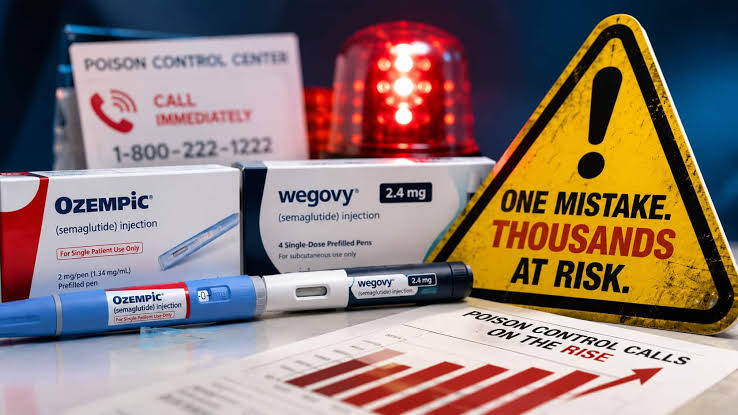
A five-fold surge in poison center calls has researchers pointing not at the drug itself — but at how millions of Americans are injecting it wrong
SAN ANTONIO, Texas
The phone rings at the South Texas Poison Center, and on the other end is a familiar kind of panic. A patient, sometimes terrified, sometimes just confused, describes symptoms that sound almost like food poisoning: relentless nausea, vomiting that won't stop, a stomach that feels like it's twisting itself in knots. When the poison specialists ask what medication they're on, the answer, more and more often these days, is the same. Ozempic. Or Wegovy. Or one of the other injectable weight-loss and diabetes drugs that have become a fixture of American medicine cabinets.
It is a call that poison control centers across the country are fielding thousands of times a year now — and a new study says the surge is almost entirely preventable.
Researchers at the University of Texas at San Antonio and the South Texas Poison Center have traced a startling pattern: in the years since semaglutide, the active ingredient in Ozempic and Wegovy, was approved by the FDA for chronic weight management, calls to poison control centers about the drug have exploded. Before the 2021 approval, poison centers nationally logged around 1,000 to 1,500 semaglutide-related cases a year. By 2023, that number had rocketed past 8,000 — more than a five-fold increase in just two years.
The findings, published in the Journal of Medical Toxicology and gaining fresh traction in the press this week, are based on an exhaustive review of every GLP-1 receptor agonist exposure logged in the National Poison Data System between 2012 and 2023. And the culprit, according to the research team, isn't some hidden danger lurking in the drug's chemistry. It's something far more mundane — and far more fixable.
Not an Overdose. A Mix-Up.
"Can you imagine something you're supposed to trickle up to, and you're going full blast and seven times more often than you're supposed to?" said Jordan Miller, joint first author of the study, describing the scale of the errors researchers were seeing.
Semaglutide is designed to be injected exactly once a week, with doses that start low and climb gradually over months as the body adjusts. That slow ramp-up isn't a suggestion — it's the entire safety mechanism built into the drug. Jump the line, and the gut simply cannot keep up.
But according to the UTSA team, that's precisely what large numbers of patients have been doing. The two dominant errors identified in the data were patients injecting themselves daily instead of weekly — a sevenfold overdose by sheer frequency — and patients starting treatment at the highest available dose instead of the recommended step-up schedule, skipping the weeks of gradual acclimation entirely.
"One of them was this quite odd category of semaglutide," said David Han, one of the study's joint senior authors and a researcher affiliated with UTSA's College of AI, Cyber and Computing. "We suspected that the call volume was skyrocketing because of the misuse and mishandling of this drug and that it may be attributed to the FDA approval of this drug for weight management."
The numbers back him up. Semaglutide alone accounted for a striking 64% of all GLP-1 receptor agonist-related poison center calls in the study period, and semaglutide-specific call volume kept climbing at a rate of nearly 10% per quarter even after the initial post-approval spike. Ozempic and Wegovy, in other words, weren't just part of the trend — they were driving it.
What Actually Happens When You Get the Dose Wrong
For most callers, the fallout is unpleasant but not catastrophic. The overwhelming majority of cases produced what researchers classify as mild gastrointestinal symptoms — the nausea, vomiting and abdominal cramping that semaglutide is already notorious for, just turned up to an unbearable volume. Semaglutide works by slowing digestion and signaling fullness to the brain; take too much, too fast, and the digestive system essentially rebels.
But the tail end of the symptom list is where things get genuinely dangerous. Reported adverse events tied to dosing errors have included fainting spells, severe headaches and migraines, dehydration serious enough to require IV fluids, gallstone formation, and — in the most serious cases — acute pancreatitis, a painful and potentially life-threatening inflammation of the pancreas that can require hospitalization.
None of this stems from the drug being secretly unsafe at its intended dose. Semaglutide has been used safely by millions of patients for both diabetes management and weight loss since its original 2017 approval as Ozempic and its 2021 expansion as Wegovy. The problem, the UTSA researchers are careful to emphasize, is entirely about how the drug is being administered — not what it does when used correctly.
Part of the confusion may trace back to the sheer speed of semaglutide's cultural takeover. What began as a niche diabetes medication became, within a few short years, one of the most talked-about drugs in America — driven by celebrity endorsements, social media chatter, telehealth prescribing services, and in some cases, compounded or gray-market versions of the drug that don't come with the same pharmacist counseling a patient would get at a traditional pharmacy. The FDA itself issued a warning earlier this year to health care providers, compounders and patients specifically about dosing errors tied to compounded injectable semaglutide products — a parallel problem the agency has been tracking as demand for the drug has outstripped supply of the brand-name versions.
The Fix Is Almost Insultingly Simple
If there's good news buried in the data, it's this: the researchers believe nearly all of these 8,000 annual calls are preventable with something as basic as clearer patient education.
"Simple education about proper weekly dosing and gradual dose increases could help prevent many of these avoidable incidents," the study authors concluded. That means patients need to walk out of the pharmacy or off a telehealth call with an unambiguous understanding of three things: the injection happens once a week, not once a day; the starting dose is deliberately low; and the dose only increases on a doctor-approved schedule, typically every four weeks, never on the patient's own initiative.
For a drug delivered via a pre-filled pen that can look deceptively similar to more familiar injectables — like insulin pens, which many diabetic patients do use daily — the potential for a fatal mix-up in routine is easy to see. Patients switching between medications, or juggling multiple pens for different conditions, appear to be especially vulnerable to the daily-versus-weekly confusion.
What This Means for You
If you or someone in your household is using Ozempic, Wegovy, or a compounded semaglutide product, the message from this research is blunt: double-check the label, double-check the schedule, and if there is ever a moment of doubt about how much or how often to inject, call before you inject — not after.
America's Poison Centers operates a free, 24-hour hotline at 1-800-222-1222 for exactly this kind of question, and the researchers stress that the line exists as much for prevention as for emergencies. If you've already made an error — injected an extra dose, or realized you've been dosing daily instead of weekly — the guidance is the same: call the poison hotline or your prescriber immediately rather than waiting to see how you feel. Symptoms like persistent vomiting, severe abdominal pain that doesn't resolve, or signs of dehydration such as dizziness and reduced urination warrant urgent medical attention.
For prescribers and pharmacists, the study is something of a wake-up call about the gap between how fast GLP-1 drugs have entered the mainstream and how well patients are actually being walked through their use. With demand for these drugs still climbing — and with compounded, off-brand versions continuing to circulate outside traditional pharmacy channels — the researchers argue that dosing education can no longer be treated as an afterthought tacked onto a five-minute prescribing appointment.
The Bigger Picture
Semaglutide's meteoric rise has already reshaped everything from grocery store sales patterns to the bariatric surgery industry to the cultural conversation about weight loss itself. This study is a reminder that the drug's success story has a less glamorous underside: a healthcare system that scaled prescribing far faster than it scaled patient education, leaving poison control centers to absorb the fallout one confused, nauseated phone call at a time.
The UTSA team's data runs only through 2023, and given how much semaglutide use has continued to grow since then — alongside newer GLP-1 competitors — there's little reason to think call volumes have done anything but keep climbing. What is different now, at least, is that the pattern has a name, a mechanism, and a remarkably simple fix. Whether the healthcare system moves fast enough to actually implement it is the open question the researchers leave for policymakers, pharmacists and prescribers to answer.
For now, the advice for the millions of Americans holding one of these pens is the same as it's always been, just with new urgency behind it: read the label, trust the schedule, and when in doubt, call before you inject.



