Agriculture
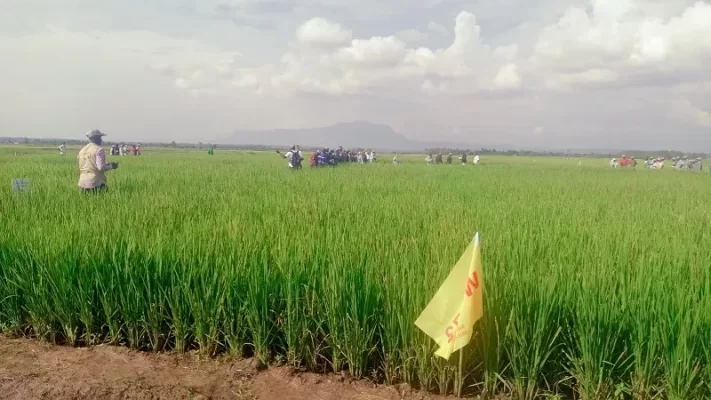
Along the Kibaale–Ivukula Road in Namutumba District, where the Nawaibete Swamp cuts through Busoga's rolling farmland, a small demonstration plot has become an unlikely pilgrimage site. Farmers have been walking from neighbouring parishes over the past week to see rows of rice standing taller and fuller than anything grown locally in living memory — the product of a hybrid seed variety called WDE75 that its backers say could reshape rice farming in one of Uganda's most food-insecure regions.
The variety, introduced earlier this year by the Busoga Consortium for Development (BCD) under the FAO China–Uganda South-South Cooperation Project Phase III, has just completed its first pilot harvest, and the results have startled even the agronomists who planted it. According to project data released this week, WDE75 produced yields up to three times higher than the local paddy varieties long grown in the Busoga sub-region — this despite prolonged dry conditions that have stressed crops across much of the country this season.
“Based on the performance we are seeing, this variety has the potential to become one of the best rice varieties for farmers in the future, especially those intending to produce rice for commercial purposes,” said Xu Xiaoli of Zoeve Seed Company, one of the Chinese partners working alongside Uganda's National Agricultural Research Organisation (NARO) to test the hybrid. She said WDE75 combines high productivity with resilience to erratic rainfall, positioning it as a bridge crop for farmers seeking to move from subsistence to commercial rice production.
The harvest event, held at demonstration gardens in Ivukula Sub-county, drew BCD Director General Anthony Mula, Busoga Kingdom's Minister for Agriculture Samuel Nathan Nkenga, district officials and representatives of the China–Uganda FAO South-South Cooperation Programme — a signal of how much political weight local leaders are now placing on a single seed trial. “DG, we want to thank you and the Chinese partners for choosing Namutumba. You have saved us because this project is directly benefiting our farmers,” Nkenga said at the event.

A region that has learned to distrust the rains
The timing matters. Uganda's Ministry of Water and Environment has forecast a warmer, below-normal rainfall season for June through August 2026, with central and western districts expected to be especially dry, and northern and eastern areas — Busoga among them — swinging between dry spells and intermittent showers. Farmers across the country have already logged heavy losses this season, from maize and sorghum failures in the north to cattle deaths in the cattle corridor. Against that backdrop, a rice variety that reportedly held up through “prolonged dry conditions” is not just an agronomic curiosity — it is a potential hedge against a climate pattern that is becoming the norm rather than the exception.
Ivukula Sub-county Agricultural Officer Iva Mugomba said the variety's resilience was the detail that changed minds among sceptical farmers. “Expanding this project will help increase rice production, improve household incomes and strengthen food security among farming communities,” she said. For Steven Balikowa, one of the pioneer farmers hosting a demonstration garden, the shift has been almost as much about perception as production. “Farmers have been coming to these gardens to compare what they see here with what they have been growing. Many are now ready to adopt this improved rice variety because of its performance,” he said.
That change in attitude is exactly what BCD is now trying to scale. Mula said the consortium, working with the Sichuan Academy of Agricultural Sciences, the FAO South-South Cooperation Programme and Uganda's Ministry of Agriculture, Animal Industry and Fisheries, would expand the pilot to 100 farmers in the next planting season, with each cultivating one acre of the hybrid. BCD is also encouraging farmers to observe wetland-use guidelines as the project grows, since much of Busoga's rice is grown in swamp gardens that fall under Uganda's environmentally sensitive wetland zones — a tension that has flared elsewhere in the country this year, including in Ngora District, where cattle keepers and crop farmers have clashed over wetland eviction orders.
Why a threefold yield jump matters for the national picture
Uganda's stakes in rice self-sufficiency are substantial and, by the government's own numbers, still distant. The country imported an average of 344,000 tonnes of rice annually between 2020 and 2023, at a cost of nearly $152 million a year — the bulk of it sourced from Tanzania. Uganda's National Rice Development Strategy (NRDS2), which runs through 2030, set a target of lifting national paddy production from 247,000 metric tonnes in 2023 to 717,000 metric tonnes by 2030, nearly tripling the harvested area from 115,000 hectares to 190,000 hectares, and — critically — raising average yields from 2.1 tonnes per hectare to 3.8 tonnes per hectare. A variety demonstrating triple the yield of existing local paddy, even at small pilot scale, speaks directly to that yield target, which many agronomists consider the strategy's most difficult component to hit.
The Busoga project is not the government's only bet on rice. Uganda and South Korea have separately launched a $4 million, five-year seed-multiplication project at the Tochi irrigation scheme aimed at producing roughly 13,000 tonnes of certified high-yield seed annually. But the WDE75 pilot is distinctive because it is farmer-facing and demand-driven: seed interest, according to BCD, has already outstripped what the current pilot can supply, with neighbouring farmers visiting demonstration plots specifically to request access to the variety for the next season.
This is also not the first time the FAO China–Uganda South-South Cooperation has delivered outsized results in Busoga. Under the project's first two phases, rice production per hectare in project areas quadrupled, alongside gains in milk production, and the partnership has since branched into millet, chili pepper exports to China, and aquaculture feed technology. More than 3,000 Ugandan farmers and 80 government staff have been trained under the programme to date, according to FAO figures, making Busoga something of a live laboratory for Chinese-Ugandan agricultural technology transfer.

Caution alongside the optimism
Agricultural economists caution that pilot-scale results — a handful of demonstration gardens tended with close technical supervision — often outperform what farmers achieve once a variety is distributed at scale, where access to fertiliser, water management and consistent extension advice becomes harder to guarantee. WDE75's true test will come next season, when BCD expands cultivation to 100 farmers working independently across scattered plots, each responsible for an acre of the hybrid without the same intensity of on-site support the demonstration gardens received.
There is also the seed-supply question that has dogged other Ugandan seed interventions this year: a national seed-tracking and traceability system was rolled out in early August specifically because counterfeit and substandard seed — by one industry estimate affecting 30 to 40 percent of the commercial seed market — has repeatedly undercut promising varieties before they reach real scale. BCD has not yet detailed how it will protect WDE75 from counterfeiting as demand grows, though its multiplication-garden model, in which the consortium controls seed production directly rather than relying on open retail channels, offers some insulation.
For now, the mood in Ivukula Sub-county is one of cautious excitement rather than declared victory. Local officials describe a season that, for the rest of the country, has largely been defined by drought losses — but which, in one swamp-fed corner of Busoga, produced a rice harvest good enough to draw a steady stream of visiting farmers with notebooks and questions. Whether that curiosity converts into a durable shift away from Uganda's decades-long rice import dependency will depend on what happens when the training wheels come off next planting season.
Published By | Features Editor