Background
Russia's full-scale invasion of Ukraine, launched in February 2022, is now in its fifth year, and the diplomacy meant to end it has spent most of 2026 in a state of suspended animation. President Donald Trump returned to office pledging a rapid settlement, and for a time his two most trusted envoys — special envoy Steve Witkoff and his son-in-law Jared Kushner — carried that effort. They met President Vladimir Putin in Moscow in December 2025 for roughly five hours of talks that a Russian official described as "constructive," and again in January 2026, when the two men travelled to the Kremlin directly from Davos. Yury Ushakov, Putin's foreign policy aide, said afterwards that the discussions had been in-depth and frank and that "territorial issues" — without which, Moscow insists, there can be no resolution — were central. Neither round produced a breakthrough.
What derailed the process was not a collapse at the table but a war on the other side of the world. When the United States and Israel opened their campaign against Iran in February 2026, American diplomatic bandwidth, military inventory and political attention swung to the Gulf. US-mediated contacts between Moscow and Kyiv froze. Subsequent working-level exchanges among American, Russian and Ukrainian officials failed to restart them. Putin himself recently described the negotiations as simply "frozen."
The war ground on regardless, and its human cost has become difficult to state with precision. A study released in July by the Center for Strategic and International Studies estimated that the conflict has cost Russia some 450,000 lives, with Ukrainian fatalities put at between 125,000 and 150,000. Both figures are estimates derived from open sources; neither government publishes reliable casualty data, and independent analysts differ substantially on the totals.
The Iran war has also had a direct battlefield effect on Ukraine. Ukrainian officials have repeatedly blamed a shortage of Patriot interceptors — worsened by competing American demand in the Gulf — for their inability to stop the mass missile-and-drone barrages that Russia now launches against Ukrainian cities on an almost nightly basis. Kyiv has this month adopted a two-tier air raid alert system on the grounds that saturation drone attacks have become the new normal rather than the exception.

Key Developments
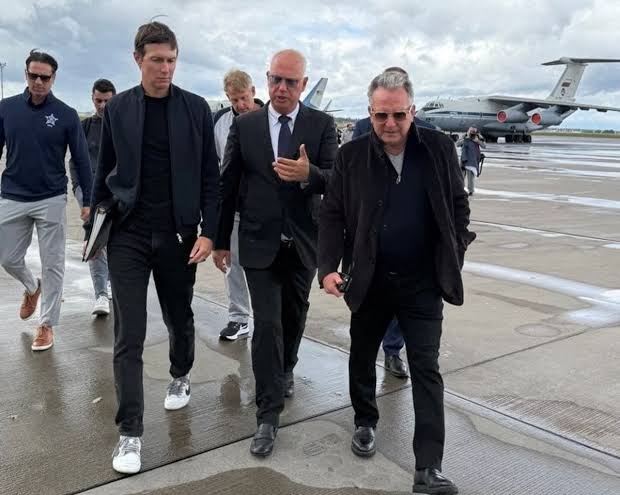
Speaking to reporters at the White House on Friday, September 4, Trump confirmed that Witkoff and Kushner would travel over the weekend. "We have an idea for peace," he said, offering no detail on its contents. "I sent Steve Witkoff and Jared Kushner, two great negotiators. They've done a great job, and we sent them over to see whether or not we can get something done. And there may be a good chance that we'll do it."
According to the Russian state news agency TASS, the two envoys are due in Moscow on Saturday and Sunday, their first visit to the Russian capital since January. President Volodymyr Zelenskyy said they would be in Ukraine on Sunday; Ukrainian reporting has placed the Kyiv meeting on September 6. It will be Witkoff's and Kushner's first trip to Ukraine since Trump returned to power — a notable asymmetry, given that they have now been to Moscow three times in nine months.
The logistics themselves were negotiated for weeks. Officials briefed reporters that Washington pressed Ukraine to suspend its drone attacks on Moscow and on Russian energy infrastructure while the envoys were inside Russia, and pressed Russia in parallel to halt missile attacks on Kyiv. Zelenskyy said publicly that Ukraine would guarantee conditions for the envoys' safe travel and that there would be no Ukrainian airstrikes for the duration, calling on Moscow to reciprocate. "Our goal is to make the visit and the talks with the US side as constructive and substantive as possible," he wrote. "We need to look for real options for how to move this war toward an end."
Ukrainska Pravda, citing sources in several military brigades and a senior security official, reported that Ukrainian units along the entire line of contact had been ordered to observe a temporary "silence regime" from midnight on September 5 until 23:59 on September 8 — a pause that extends well past the envoys' departure. The order has not been formally confirmed by Kyiv. Whatever its status, it did not produce quiet: an air raid alert sounded in Kyiv at 00:00 on September 5, precisely as the pause was due to begin, with Russian drones reported over the Kyiv and Kharkiv regions.
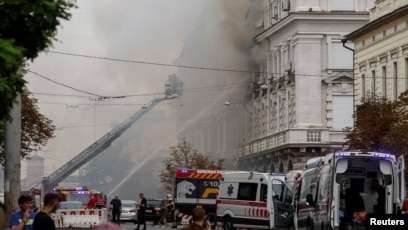
The mission's announcement came only hours after the single most symbolically charged Russian strike of the year. On Friday, in a daylight attack, a Russian drone hit the headquarters of the Security Service of Ukraine, the SBU, in central Kyiv. Zelenskyy said the strike was aimed directly at the personal office of the agency's acting chief. Kyiv Mayor Vitali Klitschko said at least 12 people were injured. It was the first time the SBU's headquarters had been struck since the start of the full-scale invasion, and Ukrainian officials treated it as a deliberate message rather than a stray drone.
Reactions
Zelenskyy instructed the SBU to prepare what he called an "appropriate, tangible response," while Foreign Minister Andrii Sybiha described the strike as a "major escalation." Reporting from Kyiv for Al Jazeera, correspondent Audrey MacAlpine said residents were less shocked that the building had been hit than unnerved by what the hit implied. "It's not so much that people never expected the SBU to be hit, but it really raises the question of if Russia can hit this, what else can it hit?" she said, adding that some in the city wondered whether the attack was intended to dissuade the American envoys from travelling at all.
Trump, for his part, continued to frame the war's intractability as a matter of temperament rather than territory. A deal has remained elusive, he told reporters, because of a "personality problem" between the two leaders. "President Zelenskyy and President Putin truly hate each other," he said. "They have serious hate, and it's getting in the way." Ukrainian officials have long rejected that framing, arguing it obscures a set of concrete and unresolved substantive demands.
The same White House appearance produced a second remark that landed badly in European capitals. Asked about German accusations that Russian intelligence had orchestrated sabotage at Leipzig Airport, and whether such actions amounted to an attack on NATO, Trump replied: "I speak to him. I know him very well. Putin's not looking to attack NATO territory." The comment arrived in the middle of a widening European debate about Russian hybrid operations — German authorities this week said they suspect Russian intelligence was behind an arson attack on a domestic defence firm — and did little to reassure allies who read the sabotage campaign as a test of the alliance's threshold.
In Kyiv the dominant reaction was wariness rather than hope. Ukrainian officials have consistently warned that Moscow may use the appearance of negotiation to buy time while continuing its military campaign, a pattern they say has repeated through several rounds of talks. On Capitol Hill, meanwhile, Senator Richard Blumenthal urged the House to take up the Russia and Iran sanctions bill that the Senate passed in August, describing a moment of "extreme urgency" — a reminder that the legislative pressure track and the diplomatic track are now running in parallel and not necessarily in step.

What's Next
The immediate question is whether Russia reciprocates the Ukrainian pause. If the reported silence regime holds through September 8 on both sides, it would be the first meaningful bilateral quiet of 2026 and would give the envoys something tangible to build on. If Russian strikes continue — as they did in the opening minutes — Kyiv will have absorbed a unilateral operational cost for nothing, which is precisely the outcome Ukrainian commanders feared.
The substantive agenda is unchanged and unforgiving. It is not publicly known whether Witkoff and Kushner are carrying a genuinely new American plan or simply pressing both capitals to close existing gaps. Three issues have blocked every previous attempt. The first is the Donbas: Putin has held that any settlement requires Ukrainian withdrawal from the Donetsk and Luhansk regions, while Zelenskyy warned in April that abandoning the Donbas would open a clear path toward Kharkiv and Dnipro and that replacement fortifications would take up to 18 months to build. He has at times signalled a willingness to discuss parts of Donetsk, but not on Moscow's terms. The second is the shape and credibility of postwar American security guarantees. The third is sequencing — whether a ceasefire precedes a settlement or follows it, with Putin opposed to freezing the lines before political terms are agreed.
There is also a plausible reading in which the weekend produces the same result as December and January: long, cordial, inconclusive meetings, a Kremlin statement describing the talks as constructive, and no movement on territory. The precedent argues for restraint in expectations. What is different this time is the timing — the envoys arrive with the war in its fifth year, with a Russian drone having just struck Ukraine's security headquarters, with sanctions legislation pending in the House, and with a US president publicly telling Europeans that he does not believe Putin intends to attack them. Each of those facts will shape what Moscow thinks it can extract.
Published By | News Editor