Background
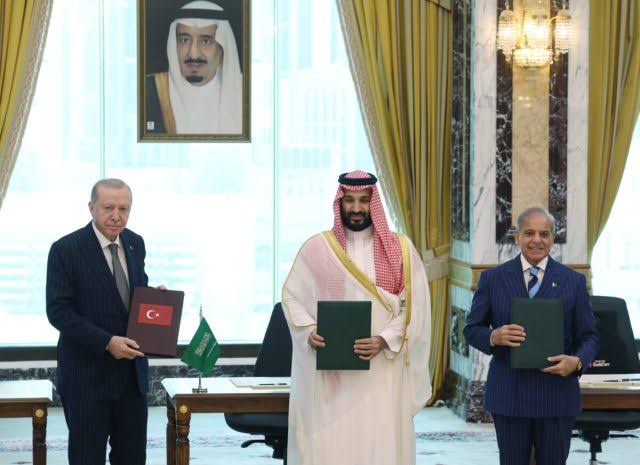
On August 7, 2026, the leaders of Saudi Arabia, Turkey and Pakistan gathered at Al-Safa Palace in the holy city of Mecca to sign what officials are calling the Makkah Joint Defence Agreement, a trilateral mutual-defense treaty that commits each of the three states to treat an armed attack on any one of them as an attack on all three. The agreement was signed by Saudi Crown Prince and Prime Minister Mohammed bin Salman, Turkish President Recep Tayyip Erdogan, and Pakistani Prime Minister Shehbaz Sharif, following what officials described as nearly a year of quiet negotiations.
The pact arrives at the tail end of an unusually turbulent eighteen months for the region. The 2026 Iran war, which began in February with a wave of American and Israeli strikes, has repeatedly spilled beyond Iran's borders, drawing missile and drone exchanges into Bahrain, Kuwait, Qatar, Jordan and even briefly Egyptian territory. Gulf states that host U.S. forces have found themselves targeted by Iranian retaliation even when they were not direct parties to the fighting, a pattern that has visibly unsettled Riyadh. Analysts have also pointed to the lingering shock of an earlier Israeli strike on Doha as a catalyst that pushed Gulf and Muslim-majority powers toward closer security coordination, arguing that the strike demonstrated the limits of relying solely on American protection.
Structurally, the agreement is being described by historians and regional analysts as the first formal mutual-defense formula joining major Muslim-majority military establishments since the Baghdad Pact of the 1950s, the Cold War-era alliance that once linked Turkey, Iraq, Iran, Pakistan and the United Kingdom before it unraveled amid regional revolutions. That comparison, invoked repeatedly in early coverage, underscores how unusual it is for Ankara, Riyadh and Islamabad to formalize a collective-defense commitment of this kind, given the countries' differing alliances, sectarian compositions and, in Turkey's case, NATO membership.
Key Developments
The core of the Makkah Joint Defence Agreement is a clause modeled conceptually on NATO's Article 5: an armed attack against Saudi Arabia, Turkey or Pakistan will be regarded as an attack against all three, obligating a collective response. Beyond that headline commitment, the agreement's public text is relatively general, calling for the enhancement of "all aspects of defense cooperation" among the signatories without yet spelling out detailed command structures, force-contribution formulas, or interoperability standards.
Officials and analysts have framed the pact as combining three complementary sources of power: Turkey's expanding defense-industrial base, including drone and missile production that has become a major export line for Ankara; Saudi Arabia's financial resources and regional diplomatic weight; and Pakistan's combat-tested military and its status as the only nuclear-armed state in the Muslim world. That last element has drawn particular attention. Pakistan's inclusion means that, for the first time, a Gulf Arab state has entered a formal mutual-defense arrangement with a nuclear power, even though officials in Islamabad and outside analysts were quick to note that nothing in the text announced on Friday explicitly extends Pakistan's nuclear deterrent to its new partners. Pakistani officials have historically described their nuclear arsenal as oriented toward India, not available for export as a security guarantee to third parties, and that position does not appear to have formally changed with this agreement.
Despite the historic framing, several analysts cautioned that the pact today functions more as a political communiqué than an operational alliance. The three militaries run largely incompatible weapons systems, do not share a unified command structure, and have no integrated air-defense network of the kind that underpins NATO's collective posture. Michael Kugelman of the Atlantic Council described the agreement as a "logical outgrowth" of the three countries' deepening bilateral ties in recent years rather than a sudden strategic pivot, suggesting the substance of joint command arrangements, if any, will need to be negotiated separately and over a longer timeframe.
Reactions
The pact's reception has varied sharply by capital. In New Delhi, the Indian government said it was "closely following" the agreement and would assess how any alignment or potential integration of Pakistani strategic capabilities with Saudi and Turkish forces might affect India's own security calculus — a notably measured but watchful response given the long-running India-Pakistan rivalry.
Israel's government offered no official comment; Prime Minister Benjamin Netanyahu's office declined to respond to press inquiries about the pact. That silence was filled by other Israeli voices: former Prime Minister Naftali Bennett publicly described Turkey as "the new Iran" and accused Ankara of assembling a "hostile Sunni axis with nuclear Pakistan," reflecting anxiety in parts of the Israeli security establishment about a consolidating bloc of Muslim-majority powers, several of which have been openly critical of Israel's conduct in Gaza and the wider region over the past two years.
Iran's response was comparatively conciliatory in tone, with Iranian officials calling for greater Muslim unity in the wake of the announcement rather than issuing a direct condemnation — a notable posture given that some regional commentary had framed the pact partly as a hedge against Iranian power. Analysts at the Atlantic Council argued the agreement sends three distinct signals simultaneously: to Tehran, that any future attack on Saudi territory now implicates both a nuclear-armed state and a large NATO-integrated army; to Washington, that Gulf and South Asian partners are prepared to diversify their security guarantees if American protection appears inconsistent; and to Israel, that the earlier strike on Doha carried a lasting diplomatic cost in the form of accelerated alliance-building among Muslim-majority states.
Some outlets have already begun describing the arrangement informally as a "Sunni NATO" or "Islamic NATO," though that framing is a media shorthand rather than language used in the agreement's own text, and it glosses over the fact that Iran itself is a majority-Shia state whose own relationship to the pact remains ambiguous rather than adversarial in its public statements so far.
What's Next
Several open questions will shape whether the Makkah Joint Defence Agreement becomes a substantive alliance or remains largely symbolic. Chief among them is the nuclear question: whether, over time, Pakistan's arsenal comes to function as an implicit deterrent umbrella for its new partners, even without a formal declaration to that effect, and how India recalibrates its own posture in response. A second question is institutional: whether the three states move to establish a joint command, shared intelligence architecture, or standardized equipment procurement, none of which currently exists and all of which would require years of negotiation and investment to build out.
Regional diplomacy will also be a factor. Other Gulf states such as the UAE and Qatar were not signatories, and it remains to be seen whether they will seek to join a similar arrangement, pursue parallel bilateral guarantees with Washington, or stay outside the new bloc altogether. Washington's own reaction will be closely watched: American officials have not yet issued a detailed public assessment of the pact, and the extent to which the United States views it as complementary to, or in tension with, its own regional security commitments could influence how quickly the agreement moves from communiqué to functioning alliance. For now, most analysts agree the pact's near-term value is deterrent and symbolic — a signal of realignment more than a change in the region's immediate military balance.
There is also a domestic political dimension in each of the three capitals worth watching. In Turkey, Erdogan has leaned heavily on defense-export diplomacy as a pillar of his foreign policy in recent years, and the pact offers a showcase for Turkish drone and missile technology to two wealthy partners. In Pakistan, Prime Minister Shehbaz Sharif's government has faced economic strain at home, and a higher-profile security relationship with Gulf financial powers could translate into investment and aid alongside the defense commitments. And in Saudi Arabia, Crown Prince Mohammed bin Salman has spent the past several years diversifying the kingdom's security relationships beyond its traditional reliance on Washington, a trend this pact both extends and accelerates. How each leader manages these overlapping domestic incentives may ultimately matter as much to the agreement's durability as the geopolitical signaling it sends to Tehran, Washington and Tel Aviv.
The signing also comes against a backdrop of years of intermittent, largely unsuccessful efforts within the Organisation of Islamic Cooperation to build collective Muslim-world security mechanisms, most of which foundered on sectarian divides, rival regional ambitions, and disagreements over how to treat Iran. The Makkah agreement's narrower trilateral format — rather than a broader OIC-wide framework — appears designed to sidestep those historic obstacles by limiting commitments to three states whose bilateral relationships have already deepened considerably in recent years, including growing Saudi-Turkish defense-industrial cooperation and a long-standing Pakistan-Saudi security relationship that dates back decades and has previously included informal understandings about military support in a crisis.
Published By | News Editor