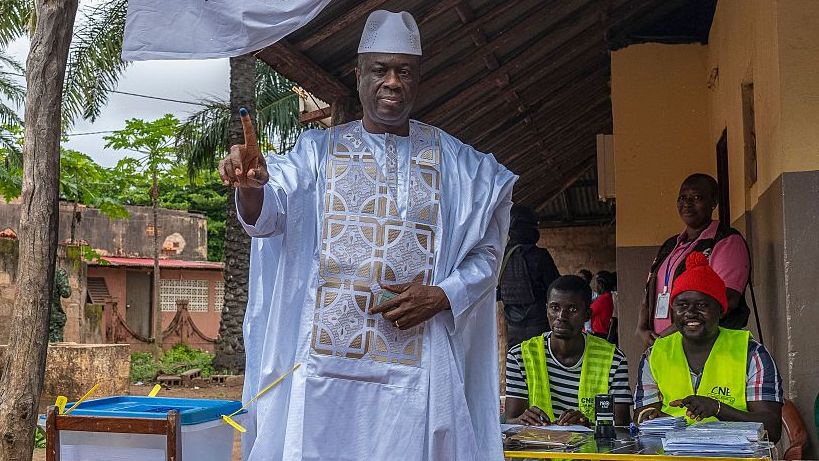
BISSAU, Guinea-Bissau
Guinea-Bissau's Supreme Court is expected within days to issue the final proclamation of a referendum that rewrites the country's constitution to concentrate power in the presidency. As of Sept. 2, the court had received no legal challenge to the vote. That is not because the result is uncontested. It is because the parties that would have contested it urged their supporters not to vote at all, their leader is in pre-trial detention, and the country's Constitutional Court has been suspended since the military seized power last November.
The National Electoral Commission announced provisional results on Sept. 1: 70 percent in favor, 30 percent against. Some 544,060 people cast ballots, close to 60 percent of roughly 915,000 registered voters, according to figures released by the commission. On the night of the Aug. 30 vote, the commission's executive secretary, Idrissa Djalo, had estimated participation at above 55 percent.
The referendum is the pivot on which Guinea-Bissau's transition turns. Presidential and legislative elections are scheduled for Dec. 6, and whoever wins them will govern under a constitution written by an unelected military administration rather than the one under which they campaigned to lead the country.

What changes
The core of the new text is the relationship between the presidency and everything else.
Guinea-Bissau has operated since its 1993 constitution under a semi-presidential system in which the president is head of state and the prime minister — drawn from the parliamentary majority — is head of government, running the cabinet and the day-to-day administration. Under the new text, the president may appoint and dismiss the prime minister and members of the government, create or abolish ministries, chair the Council of Ministers, and dissolve parliament in the event of a grave political crisis.
The changes extend well beyond the executive. The National People's Assembly shrinks from 102 seats to 65, and the number of electoral constituencies falls from 29 to 12. Presidential candidates must have lived continuously in Guinea-Bissau for the five years preceding the election, and must pay a deposit of 50 million West African CFA francs — roughly $90,000. Political parties must have at least 5,000 members, including a minimum of 300 in each region, before they can sponsor a presidential candidate. The text also establishes a Constitutional Court.
Each of those provisions has an identifiable target. The residency requirement bears directly on politicians who spent the post-coup period abroad. The deposit and membership thresholds raise the cost of entry for smaller parties. The reduction in constituencies redraws the map on which the December legislative election will be fought, in a country where regional and ethnic voting patterns are well understood by the people drawing the lines.
How the country got here
The military took power on Nov. 26, 2025, in a coup led by Defense Chief of Staff Gen. Horta Inta-A Na Man — widely referred to as Gen. Horta N'Tam — while the National Electoral Commission was counting ballots from a presidential election in which both then-President Umaro Sissoco Embaló and opposition candidate Fernando Dias had claimed victory. The military destroyed ballots and detained opposition leaders. The Africa Center for Strategic Studies described it as the country's fifth coup since 1980; Africanews counts five coups and a series of attempted coups since independence in 1974. Either way, Guinea-Bissau's record of unconstitutional transfers of power is close to unmatched on the continent.
The junta then reorganized the machinery that would validate its transition. In February 2026 it replaced the leadership of the National Electoral Commission and created a new secretariat, installing Supreme Court Judge Carmen Isaura Lobo as its head. That mattered because the commission's professional composition had been the main reason Guinea-Bissau, for all its instability, had a track record of competitive elections and genuine alternations of power: its executive secretariat was drawn from magistrates nominated by the Superior Council of the Judiciary and elected by a two-thirds parliamentary majority for four-year terms. Repeated dissolutions of parliament left vacancies unfilled, which the junta then cited as grounds for dismissing the commission. Critics call the new secretariat illegal. The military government also replaced the leadership of the Superior Military Court after it opposed criminalizing the largest opposition party's leadership.
Political space has narrowed sharply. Demonstrations and strikes are prohibited, political activities banned, opposition party headquarters closed and the Constitutional Court suspended. Independent media have been restricted and journalists report increased intimidation. A nationwide demonstration in December 2025 demanding the restoration of constitutional government was blocked by the military; its organizer, Vigário Luís Balanta, president of the movement Pó di Terra, was kidnapped and found dead four months later. Demonstrators marched in Bissau on April 2 to demand justice in his case.
Domingos Simões Pereira — former prime minister, former speaker of parliament, and leader of the PAIGC, the party that led the country to independence — was blocked from contesting the November 2025 presidential election by a Supreme Court ruling the previous month. In July 2026 a military court placed him in pre-trial detention on charges of financially aiding alleged coup attempts in 2023 and October 2025.
He recorded a video message urging a boycott of the referendum, saying its backers sought to "kill our freedom and bury our democracy."
Reading a 70 percent margin
The commission's own verdict was favorable. Djalo said the poll passed without incidents that would call its credibility into question. Lobo praised the "organizational capacity, professionalism and dedication" of the teams on the ground and described the process as transparent and credible. No independent observer assessment has been published, and regional bodies have not issued a formal evaluation of the process.
Bubacar Turé, head of the Guinea-Bissau Human Rights League, said supporters of a "no" vote were not authorized to campaign, and that the draft constitution had been produced without consultation of political parties, civil-society organizations, or traditional and religious leaders. A group of civil-society organizations issued an open letter rejecting a constitution written under a military junta and calling for any revision to proceed through normal political processes.
The 70–30 split is therefore an unusually difficult number to interpret. It measures the preferences of those who turned out, in a campaign in which one side could organize and the other could not. Polling stations in the capital were largely empty on Sunday, according to a Reuters witness, and some residents told local media they had not known the referendum was happening or did not understand its purpose.
And yet a turnout near 60 percent is materially higher than a fully effective boycott would have produced. Both camps can draw comfort from that. The junta can say a clear majority of a substantial electorate endorsed the text. The opposition can say a boycott it could not publicly campaign for still kept two in five voters at home. Neither reading is unreasonable, which is precisely the problem with using a referendum to settle a question the political class was never allowed to debate.

Analysis: what an election settles
The stakes of Guinea-Bissau's December election have changed, quietly, in the last week.
Under the old text, winning the presidency meant sharing power with a prime minister who answered to parliament and could not be dismissed at will. Governments fell when they lost their majority. That arrangement was adopted in 1993 in deliberate reaction to the 19-year rule of President João Bernardo Vieira, whose concentration of authority in the executive enabled abuses, entrenched impunity and politicized the army — the root of the military's habit of intervening in politics.
Under the new text, the prime minister answers to the president. Cabinet appointments, the survival of a government and the life of the legislature all pass through a single office. That reordering is the whole argument. Supporters say Guinea-Bissau's chronic instability has run precisely through president–prime minister rivalry, and that a clear chain of command is what the country lacks. Opponents note that concentrated executive authority is what preceded the coups in the first place.
There is also a personnel question that neither side raises directly. Gen. Na Man is barred from contesting the December election under the transitional charter he upholds, and he called on young people to vote "massively" as he cast his own ballot. But his relationship with Embaló — himself a former brigadier general, who as president dissolved parliament repeatedly, appointed his own prime minister and ran a shadow cabinet of advisers drawn from the security establishment — has led independent observers to ask whether the transition is designed to restore Embaló to a presidency now equipped with substantially greater powers. At minimum, the new arrangement leaves the boundary between the presidency and the military as blurred as it has ever been.
The external dimension is smaller but not negligible. Russia expanded its engagement with Guinea-Bissau during Embaló's presidency; he attended the 2023 Russia–Africa Summit, and in February 2025 he and President Vladimir Putin signed an agreement to expand exploration of the country's natural resources. The Russian aluminum producer Rusal holds a significant bauxite concession, and Moscow has promised expanded military cooperation and officer training. Members of the opposition coalition Plataforma Aliança Inclusiva–Terra Ranka have criticized the Economic Community of West African States and other regional bodies for declining to impose sanctions on the junta.
The broader pattern is what gives a small country continental significance. West Africa has now seen several transitions in which a constitutional rewrite arrives before the election meant to restore civilian rule, so that the office being contested is not the office that existed when the coup occurred.
What to watch
The Supreme Court's proclamation of final results, expected within days, and whether the validated figures confirm the provisional margin.
Whether the PAIGC and its allies contest the December election after boycotting the referendum. Standing candidates would legitimize a constitution they call illegitimate; standing aside would concede the new institutions without a fight. There is no comfortable option, and the residency and deposit requirements narrow the choice further.
Whether Simões Pereira is released, tried or excluded before Dec. 6. The single clearest test of whether this transition is competitive is whether the country's most prominent opposition figure is on the ballot.
And whether ECOWAS, the African Union or any credible international mission observes the December vote. Nobody independent has assessed the referendum. If the same is true in December, the election will settle the question of who holds power without settling the question of whether anyone should accept it.
Published By | News Editor