Written By | International News Agencies
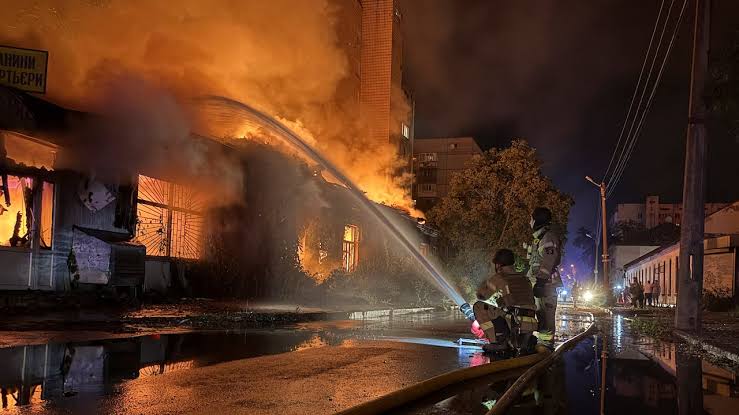
Ukraine has also been going through significant internal upheaval this summer
Background
Ukraine's war with Russia is now in its fifth year, tracing back to Moscow's full-scale invasion in February 2022 and, before that, the 2014 seizure of Crimea. According to the Council on Foreign Relations' running conflict tracker, the war has killed more than a million people on both sides when military and civilian casualties are combined, and Russian forces continue to occupy roughly a fifth of internationally recognized Ukrainian territory. Over the past two years the war has increasingly become a contest of long-range strikes: Ukraine has used drones to knock out a significant share of Russia's oil-refining capacity, while Russia has answered with escalating barrages against Kyiv and other cities, aimed at the country's power grid, housing stock and, Ukrainian officials say, civilian morale.
Diplomacy has not kept pace with the fighting. Since early 2026, U.S. officials led by special envoy Steve Witkoff and presidential adviser Jared Kushner have shuttled between Kyiv, Moscow and European capitals trying to broker a ceasefire, including a mid-year round of talks that opened in Geneva. Witkoff traveled to Moscow for a third time on August 6 to meet President Vladimir Putin, but the two sides remain divided over the most basic terms of any settlement: how much Ukrainian territory Russia would keep, and what security guarantees, if any, the West would extend to Kyiv afterward. President Donald Trump has periodically claimed talks were in their "final stages," only for the war to grind on.
Ukraine has also been going through significant internal upheaval this summer. In mid-July, President Volodymyr Zelensky accepted the resignation of Prime Minister Yuliia Svyrydenko amid fallout from a corruption scandal involving his former chief of staff, replacing her with Naftogaz chief executive Serhii Koretskyi. Around the same time, after Ukraine's largest domestic protests since the 2022 invasion, Zelensky removed his wartime commander-in-chief, Gen. Oleksandr Syrskyi, criticized for high-casualty assault tactics, and installed Gen. Mykhailo Drapatyi in his place.
Underlying all of this is a specific and worsening technical problem: Ukraine does not have enough interceptors for the U.S.-made Patriot air-defense system, the only weapon in its arsenal capable of reliably shooting down Russian ballistic missiles. Zelensky has spent much of the summer publicly pressing Washington for more Patriot batteries and interceptor stock, including a mid-August appeal to CNN offering to buy "10% of U.S. Patriots" outright. Analysts and Ukrainian officials say the shortage has been aggravated by a separate conflict competing for the same limited global supply: the U.S.-Israel-Iran war that began in February 2026 has pulled Patriot interceptors and other missile-defense systems toward the Gulf region, leaving less available for Ukraine even as Russia has shifted toward heavier use of ballistic weapons Kyiv struggles to intercept.
Key Developments
Overnight into August 20, Russia carried out one of its largest aerial attacks on Kyiv in weeks, combining ballistic missiles, cruise missiles and drones in a barrage Ukrainian officials said was deliberately engineered to overwhelm what is left of the capital's air defenses. Zelensky said Russia "had been preparing [the attack] for a long time, combining different types of ballistic missiles, cruise missiles and drones, aiming to cause as much damage as possible to civilian infrastructure." Air-raid alerts sounded across Kyiv for hours and remained in effect past dawn.
Casualty figures moved through the day as rescue crews worked through the wreckage, and outlets reported somewhat different tolls at different points: early wire reports put the dead at 12, with roughly 33 wounded, while later Ukrainian accounts, including from Zelensky himself, put the toll at 14 killed and about 40 injured. The discrepancy is typical of the early hours after a mass-casualty strike, when search-and-rescue operations are still under way and figures are revised upward. Strikes were recorded at some 28 locations around the country, though Kyiv bore the brunt of the attack. Within the capital, damage was reported across the Sviatoshynskyi, Solomianskyi and Darnytskyi districts, including fires at warehouses and residential buildings and people reported trapped in at least one shelter.
Among the most widely reported details was damage to a children's hospital in the capital: windows were blown out and vehicles on the hospital grounds caught fire, according to Kyiv's mayor and multiple Ukrainian outlets, including the Kyiv Independent, Kyiv Post and LIGA.net. It was not immediately reported whether patients or staff at the facility were among the casualties. A residential building was also damaged, part of a now-familiar pattern in which strikes on military-linked or infrastructure targets also devastate nearby apartment blocks.
Ukrainian officials said the attack again showcased the country's uneven ability to intercept ballistic missiles specifically, even as its forces continue to down the large majority of slower-moving drones and some cruise missiles. Reporting since early August indicates Ukraine has, at various points, been left with only a handful of usable Patriot interceptors on a given night, forcing commanders to ration which targets they defend.
Reactions
Zelensky used his response to the strike to renew, again, his appeal to Western partners for more Patriot systems and interceptors, a request he has repeated with increasing urgency through the summer as ballistic-missile strikes on the capital have grown more frequent and more effective at evading Ukraine's defenses. Ukrainian officials have argued for months that the war in Iran is drawing away the very air-defense supplies Kyiv needs, a point of quiet frustration in Kyiv even as Ukraine has avoided directly criticizing Washington's handling of that separate conflict.
European officials have historically responded to mass-casualty strikes on Kyiv with pledges of further sanctions on Russia; EU foreign policy chief Kaja Kallas has said in the past that further attacks on civilians would be met with further sanctions on Moscow's military-industrial base, and the EU's sanctions regime against Russia — renewed as recently as this summer — remains in place through mid-2027. Germany's government has said such strikes demonstrate that Putin "shows no willingness to negotiate," a message likely to be echoed again given the scale of this latest barrage.
The Trump administration's own response to Russian strikes on Kyiv has varied over the course of the year, at times expressing public frustration with Moscow — the president has previously posted messages urging Putin to "STOP!" bombing the capital — while at other moments emphasizing his administration's broader push for a negotiated settlement. With Washington simultaneously consumed by the Iran conflict this week, including Trump's newly announced campaign of "economic warfare" against Tehran, it remains to be seen how much bandwidth the administration will devote publicly to this latest Kyiv attack, even as it factors into Kyiv's case for more urgent U.S. military support.
What's Next
In the near term, Ukrainian officials are expected to press Washington and European capitals once more for expanded Patriot deliveries or for the license Zelensky says Trump agreed to allow, which would let Ukraine begin domestically producing its own interceptors rather than relying entirely on imports. Whether that license translates into actual production capacity soon is unclear; Trump has since sounded more equivocal in public about allowing Ukraine to build the systems itself, citing the sensitivity of the technology.
The broader ceasefire process remains stalled on the same core disputes that have blocked it for months: how much Russian-occupied territory Ukraine would be expected to cede, and what binding security guarantees, if any, Kyiv would receive from the United States and Europe in exchange for any settlement. Witkoff and Kushner are expected to continue shuttle diplomacy, but neither side has signaled a readiness to move off its current position, and attacks like this week's barrage tend to harden, rather than soften, both sides' public rhetoric in the short run.
Analysts will also be watching whether the Iran war's demands on the global Patriot supply chain ease or worsen in the coming weeks. Trump's newly declared campaign of economic pressure on Iran, unveiled the same week as this strike, points toward at least a temporary shift away from further U.S. military escalation in the Gulf, which could, in theory, free up limited air-defense resources — though there has been no indication yet that any reallocation toward Ukraine is under consideration. Until then, Ukrainian officials say, Kyiv and other cities remain exposed to the kind of large, mixed-weapon barrages seen again this week.



