PARIS
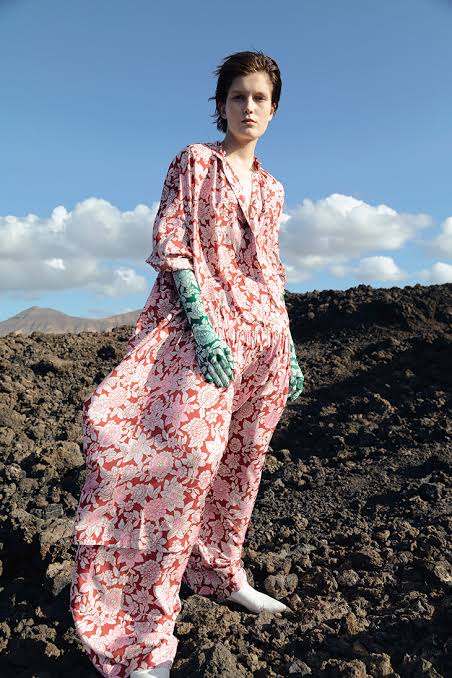
In a fashion month increasingly defined by spectacle — pyrotechnics, celebrity front rows, sets built to go viral before a single garment hits the runway — Christian Wijnants has built a career on the opposite instinct. The Antwerp-trained, Paris-based designer's autumn/winter 2026 collection, unveiled during the recent round of European fashion weeks and still generating conversation this month, is called "Lines of Serenity," and it does exactly what its name promises: it slows you down. Inspired by the karesansui, the meticulously raked dry gardens of Kyoto's Zen temples, the collection has emerged as one of the season's quieter but most critically resonant statements — proof that in a market oversaturated with maximalism, restraint itself can be the boldest choice a designer makes.
Wijnants, who has spent more than two decades building a reputation among Belgian fashion insiders for textile innovation and understated sophistication rather than headline-grabbing theatrics, drew directly on personal memory for this collection. "It's really peaceful, where you can come to relax and empty your mind," he said of the Zen gardens that inspired the line, describing autumnal trips through Japan that shaped not just the collection's concept but its entire color story. Kyoto, he has explained, became "less a theme than a temperature" — a mood of contemplation translated into cloth rather than a literal costume-department reference.

From Raked Sand to Ribbed Knit
The technical achievement at the heart of "Lines of Serenity" lies in how faithfully Wijnants translated a garden-design principle into a garment-construction one. Karesansui gardens are defined by their raked gravel, arranged in careful linear and circular patterns meant to evoke rippling water without a drop of liquid in sight. Wijnants and his studio reproduced that visual rhythm in the collection's standout knitwear, using varying gauges on the knitting machine to create twisted, extra-fine wool pieces with widened ribs that echo the raked furrows of a temple garden. Each row of stitching becomes, in the designer's own framing, "a line, a furrow, a trace" — a direct textile analog to the rake marks that Zen monks redraw in sand every morning as a form of meditation.
The outerwear carries the concept further into silhouette. Several key coats abandon collars and lapels entirely, producing robe-like shapes that reference the monks who tend the gardens themselves, paired with accentuated waists and oversized, cocooning shoulders. The standout piece — the "Cumba" coat, rendered in a deep moss green — uses forest-green faux fur sourced from Steiff, the German manufacturer best known for its century-old heritage in plush toy fabrics, an unexpected but quietly clever sourcing choice that gives the coat an unusually soft, almost living texture. Elsewhere, the "Jirono" jacket features elongated front tails and a cropped back that cinches at the waist into a sculptural knot — a gesture that Wijnants repeats across knitted tops and accessories throughout the collection, turning a single design detail into a connective thread for the whole line.
Prints Born From Discarded Landscapes
Perhaps the collection's most conceptually rich element is its print work, developed in collaboration with French photographer Quentin Chamard-Bois. Rather than commissioning new photography, Wijnants and Chamard-Bois reworked existing photographs of discarded landscape artworks, abstracting them into wind-swept forest scenes and flurries of falling leaves. The resulting prints recall, in the designer's words, a specific Zen garden he visited in Kyoto — but rendered through enough abstraction that they read as painterly texture rather than literal scenery, avoiding the trap of "tourist" imagery that so often undermines designers' attempts to reference specific cultures and places.
That sensitivity has not gone unnoticed by critics. Industry reviewers covering the Paris showings have praised Wijnants for treating his source material — a foreign cultural and spiritual tradition — with restraint rather than appropriation, translating mood and technique rather than lifting motifs wholesale. It is a distinction that matters increasingly in an industry that has faced repeated criticism for flattening non-Western aesthetics into decorative shorthand.
A Designer Who Plays the Long Game
Wijnants has never chased virality, and "Lines of Serenity" is, in some ways, a quiet manifesto for that philosophy. "I hope to be recognised for creating beautiful, thoughtfully designed clothes," the designer has said of his broader ambitions — a modest statement in an era when designers are as often judged by social engagement metrics as by craftsmanship. It's a position that has earned him a devoted following among stylists and fashion editors who prize wearability and construction over shock value, even as it has kept him somewhat outside the loudest conversations of fashion month.

"Wijnants represents a strand of Belgian design that has always prioritized ideas over image-making," noted one fashion critic covering the Paris collections this season, describing the broader lineage of Antwerp-trained designers known for conceptual rigor. "In a season full of noise, a collection that asks you to slow down and look at the stitching is almost a radical act."
What This Means for Shoppers
For consumers, "Lines of Serenity" signals a broader shift worth watching as autumn/winter 2026 pieces begin arriving in stores: a growing appetite for garments that reward closer inspection rather than instant recognition. The collection's sculptural knitwear and collarless coats are built for versatility and longevity rather than a single viral moment, appealing to shoppers increasingly wary of fast-fashion churn and drawn instead to considered, texture-driven pieces that can anchor a wardrobe for years. Expect the muted, earthy palette — mosses, sands, and forest tones — to filter into broader autumn color trends as retailers and stylists take note of the collection's critical reception.
As fashion month recedes further into memory and the industry turns toward the commercial realities of the selling season, Wijnants' Zen-garden meditation offers a useful reminder: not every collection needs to shout to be heard. Sometimes, the quietest line in the room is the one people remember longest.
Published By | Features Editor