World Politics Desk
Background
The United States has now been at war with Iran for roughly six months, a conflict that began with American and Israeli military action against Iranian targets and has since drawn in the Strait of Hormuz, disrupted global energy shipping, and pushed gasoline and diesel prices sharply higher at home, all without a clear resolution in sight. Since February, congressional Democrats — led in the Senate chiefly by Virginia's Tim Kaine, who has built a career around invoking the 1973 War Powers Resolution — have forced more than a dozen votes aimed at compelling the administration either to withdraw U.S. forces or to seek explicit congressional authorization for continued military action. Because such measures are typically brought as concurrent resolutions, they require no presidential signature and cannot be vetoed, but they only take legal effect if identical language passes both chambers of Congress; the House already did its part in July, passing a companion resolution 214 to 208.
The pattern in the Senate has been consistent, if narrowly so. A similar measure advanced in May with support from the same four Republicans who crossed over again this week. In June, a version of the resolution briefly picked up backing from those same senators before several of them reversed course after a direct meeting with President Trump — a sequence that illustrated both the resolution's persistent, if thin, bipartisan appeal and the White House's continued ability to hold its conference in line when it mattered most.
Key Developments
On Wednesday, September 24, the Senate rejected the latest version of the Iran War Powers Resolution by a vote of 49 to 50 — the narrowest possible margin for defeat. Four Republicans crossed the aisle to support it: Susan Collins of Maine, Lisa Murkowski of Alaska, Rand Paul of Kentucky and Thom Tillis of North Carolina. Tillis's vote was notable because he had not previously supported the measure; he tied his newfound support to a procedural trigger, noting that 60 days had now passed since the administration formally notified Congress in July of resumed military action against Iran — a threshold that, under the War Powers Resolution's original framework, some lawmakers argue should automatically require the withdrawal of forces absent explicit congressional authorization. Tillis, who is not seeking re-election and departs the Senate early next year, has more political latitude than most of his colleagues to break with the White House on the issue.
The deciding vote, however, came from the other side of the aisle. Pennsylvania Democrat John Fetterman was the sole member of his party to vote against the resolution, and his was the vote that actually sank it: had he voted with the rest of his caucus, the measure would have passed 50 to 49 instead of failing 49 to 50. Fetterman has been one of the Democratic Party's most consistently outspoken pro-Israel voices since the aftermath of the October 2023 Hamas attack on Israel, and he has broken from his party's position on U.S. military action tied to the Israel-Iran conflict repeatedly over the course of this year; his vote Wednesday drew immediate, sharp criticism from antiwar advocacy groups and from some Democratic colleagues who noted that his was the single vote standing between the resolution's failure and its passage.
The vote is widely being described as the Senate's last expected roll call on Iran war powers before the November midterm elections — what NPR called "one of their last votes before November" — leaving the underlying legal question of the war's congressional authorization unresolved as campaign season enters its final stretch.
The War Powers Resolution itself dates to 1973, passed by Congress over President Nixon's veto in the aftermath of Vietnam specifically to check the executive branch's ability to commit U.S. forces to sustained combat without a formal declaration of war or explicit statutory authorization. Every Iran-related resolution brought this year has rested on that same legal foundation, and every one has failed to reach the finish line in both chambers simultaneously, since the House and Senate versions were never taken up in the same congressional window with identical text intact. Wednesday's defeat means that, six months into the conflict, Congress has yet to either formally authorize the war or force its end, leaving the administration's legal authority to continue military operations against Iran a matter of ongoing dispute among constitutional scholars even as the fighting itself continues.
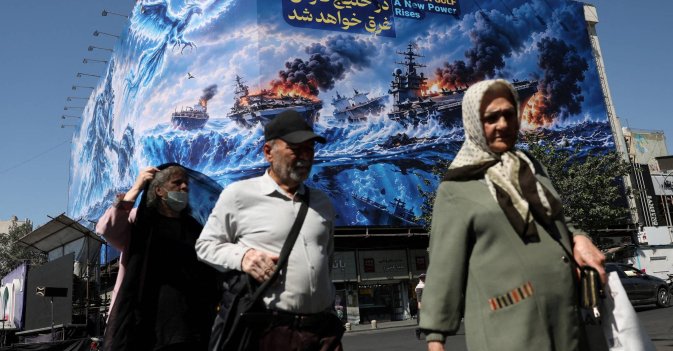
Reactions
Senate Majority Leader John Thune sought to downplay the political stakes of the vote and the broader unrest within his own conference, characterizing the discontent chiefly in economic terms. "It's an economic frustration," he said, adding that he would let vulnerable Republican candidates "run their own campaigns" on the issue rather than impose a unified party message.
That frustration has become impossible for Republican candidates in competitive races to ignore. In Michigan, Senate nominee and former congressman Mike Rogers said flatly that "the war with Iran needs to end, and end quickly," releasing a campaign ad set in a grocery store that ties the conflict directly to rising food and fuel costs for Michigan families. Gubernatorial nominee and current congressman John James told reporters this week that "we need to end this war quickly. Because war is terrible." In Iowa, Senate nominee Ashley Hinson said "the war needs to be brought to a successful and immediate end," arguing that Iowans should not have to keep paying for it at the pump and at the checkout counter. Her House colleagues Zach Nunn, an Air Force veteran with more than 700 combat hours in the Middle East, and Mariannette Miller-Meeks, a former Army officer, both said in similar terms that they would not support keeping American troops in what they described as an open-ended conflict. The economic backdrop driving those statements is stark: gasoline prices have risen roughly 52 percent and diesel prices roughly 71 percent since the war began, according to reporting on the vote's economic context, a squeeze that falls heavily on rural and working-class voters in both states.
Democrats, for their part, expressed frustration that even with polling showing rising public disapproval of the war and Republican candidates themselves calling publicly for an end to it, the resolution still failed to clear the Senate — and that it did so specifically because of a defection within their own ranks rather than because Republicans held firm.
What's Next
With this vote likely to be the Senate's final word on Iran war powers before the midterms, the war itself continues with no resolution in sight and no legislative mechanism currently positioned to force a change in course. Kaine and his allies are expected to continue introducing similar resolutions in future sessions regardless of Wednesday's outcome, consistent with the pattern of more than a dozen such votes since February, but the political calendar makes near-term Senate action unlikely. The campaign-trail dynamics set up by this vote are likely to sharpen in the weeks ahead: Republican candidates in Michigan, Iowa and other competitive states will continue distancing themselves rhetorically from the war's continuation even as most of their party's senators keep voting to preserve the administration's legal authority to wage it, while Democrats are expected to make both the war's economic toll and Fetterman's deciding vote points of contention in their own campaign messaging. Outside Congress, the most active path toward actually ending the conflict remains diplomatic rather than legislative: U.S. envoys Steve Witkoff and Jared Kushner met for roughly three hours with Iranian officials in New York earlier this week, the first direct U.S.-Iran contact in months, and further talks are expected in the coming days. Absent a breakthrough on that track, the war — and the political pressure it is generating within the Republican coalition ahead of November — appears set to continue unresolved.
Published By | News Editor