Written By | Business Experts
East Africa's smallest economy is stabilizing after a currency crisis, but poverty, refugee inflows and thin fiscal buffers keep the recovery precarious
BUSINESS
For most of the past three years, Burundi's economic story has been one of scarcity: queues at fuel stations, a black-market exchange rate that drifted far from the official peg, and a currency crisis that squeezed households and businesses alike. In 2026, that story is beginning to shift, if only modestly. The International Monetary Fund's Executive Board concluded its 2026 Article IV consultation with Burundi in June, describing an economy that grew an estimated 4.2 percent in 2025 and is expected to expand a further 3.9 percent this year, according to IMF staff, while the African Development Bank's most recent country outlook puts 2026 growth slightly higher at 4.3 percent, rising to 4.6 percent in 2027. The two institutions diverge on the precise number, but they agree on the underlying narrative: a landlocked, coffee-dependent economy of roughly 13 million people is climbing out of a deep hole, helped by an unlikely pair of exports — coffee and gold — and by a slow normalization of the foreign-exchange market that had strangled imports of fuel, medicine and fertilizer.
A Steep Descent in Inflation, But From a Painful Peak
The most striking number in Burundi's 2026 turnaround is inflation. Consumer prices were rising at roughly 45 percent year-on-year in April 2025, a rate that eroded real incomes and pushed many households toward subsistence. By April 2026, that figure had fallen to 8.6 percent, according to IMF data cited in the Fund's Article IV report — a decline of more than 36 percentage points in a single year. The African Development Bank's own forecast is less optimistic on the pace of disinflation, projecting inflation easing to 22.1 percent in 2026 and 13.7 percent in 2027, a reminder that estimates of Burundi's macroeconomic trajectory still vary widely because of the country's thin and sometimes contested statistical base. What both institutions agree on is the driver: a reduction in the central bank's monetization of the fiscal deficit — in plain terms, less reliance on printing money to cover government spending gaps — combined with an improving supply of foreign currency from higher export earnings.
That foreign-currency improvement matters because Burundi's crisis was never simply a story of prices; it was a story of physical scarcity. Persistent shortages of fuel and hard currency have been flagged repeatedly by the IMF as the country's central macroeconomic vulnerability, disrupting transport, agricultural input supply chains and basic commerce. The current account deficit, a rough proxy for how much foreign currency the economy needs from abroad relative to what it earns, is projected by the IMF to narrow to 6.3 percent of GDP in 2026 and 5.4 percent in 2027, an improvement credited directly to stronger coffee and gold exports rather than to any reduction in import needs.
Coffee and Gold: An Unlikely Pair of Export Engines
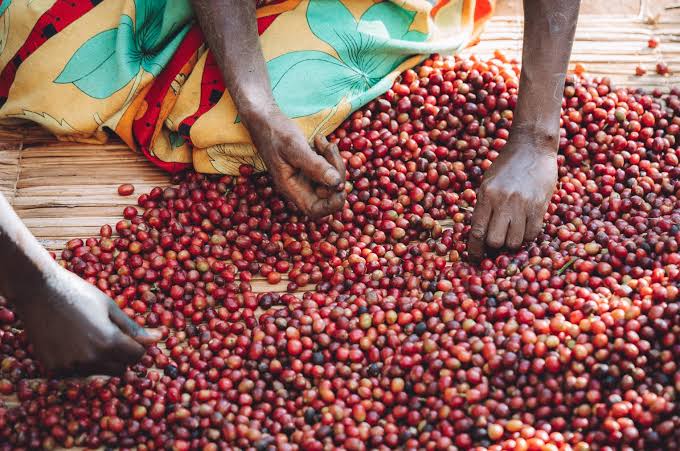
Coffee has long been Burundi's signature export and the backbone of rural livelihoods, with the great majority of the crop grown by smallholders on hillside plots. What has changed in the past two years is not the crop itself but how it reaches international buyers. Efforts to digitize traceability and certification — recording which cooperative and washing station a given lot passed through, and verifying compliance with buyer standards — have improved pricing transparency and pulled more of the harvest into the formal, taxed export channel rather than informal cross-border trade. The IMF explicitly credits rising coffee export volumes, alongside gold, with driving the projected improvement in the current account this year.
Gold, meanwhile, has gone from a marginal contributor to a genuine growth driver in a remarkably short period. Burundi's recorded gold exports rose from roughly 400 kilograms in 2024 to approximately 1.2 tonnes in 2025 — a threefold increase in a single year. In the fourth quarter of 2025 alone, just over 200 kilograms of gold were exported, generating more than $27 million in revenue. The government has moved to formalize artisanal and small-scale mining operations, a sector that historically operated largely outside the tax net, with the explicit goal of channeling more mineral revenue into treasury accounts rather than losing it to informal trade networks that often route Burundian gold through neighboring countries. The IMF has welcomed the revenue gains but has also urged further reforms to improve transparency and oversight of the sector, noting that a substantial share of actual production likely still escapes the formal fiscal framework. Mining-sector momentum has been strong enough that it has reportedly contributed to a roughly 30 percent rise in planned government spending in the 2026 budget, according to sector analysts tracking the country's public finances.
Rail Diplomacy: Betting on the Central Corridor
Landlocked and dependent on ports in Tanzania and Kenya for the vast majority of its trade, Burundi has pinned part of its longer-term growth strategy on a large regional infrastructure project: the Tanzania-Burundi-DR Congo Standard Gauge Railway. The African Development Bank approved a financing package worth $696.41 million for the project's second phase, structured as $98.62 million in grants to Burundi and $597.79 million in loans and guarantees to Tanzania. The scheme covers 651 kilometers of new electrified single-track line, split into three sections: the 411-kilometer Tabora-Kigoma and 156-kilometer Uvinza-Malagarasi stretches in Tanzania, and an 84-kilometer Malagarasi-Musongati section inside Burundi itself. The African Development Bank's own 2026 outlook for Burundi identifies this railway investment, alongside continued public investment and consumption, as one of the principal reasons growth is expected to accelerate in 2026 and 2027. For a country whose exports and imports alike are currently hostage to congested road corridors and Indian Ocean port bottlenecks, a functioning rail link to Dar es Salaam would represent one of the most consequential pieces of economic infrastructure in a generation, though completion of the full corridor remains a multi-year undertaking with construction still under way on connecting sections inside Tanzania.
Deeper Into the East African Community
Burundi's economic policy in 2026 has also leaned into regional financial integration as a tool for reducing its exposure to foreign-currency shocks. The country is set to join the East African Payment System by December 2026, a regional real-time settlement network designed to let banks and mobile money operators across EAC member states clear cross-border payments without routing transactions through correspondent banks abroad — a change that could meaningfully cut the cost and delay of intra-regional trade finance. In preparation, the Bank of the Republic of Burundi has modernized its real-time gross settlement infrastructure to the ISO 20022 international messaging standard and, since March 2026, has operated Burundi Pay, a national instant payment system intended to serve as the domestic backbone for the eventual regional linkage.
The timing is notable because the East African Community itself is in flux: with the accession of the Democratic Republic of Congo and Somalia, the bloc now comprises eight member states, and 2026 has been described by regional trade observers as a pivotal year for determining whether the EAC becomes a genuinely integrated market or remains, as intra-regional trade data suggests, a loose association. Trade between EAC partner states has been stuck at roughly 15 percent of members' total trade for more than a decade, well below an estimated potential of 30 to 50 percent or higher — a gap Burundi's payment-system integration is a small but concrete step toward closing.
The Human Cost Behind the Macro Numbers
Aggregate growth figures obscure a harder reality for most Burundian households. Extreme poverty remains extraordinarily widespread: an estimated 76 percent of the population was living on less than $1.90 a day as of 2025, a legacy of weak growth, high inflation and one of the lowest per-capita income levels on the continent. That burden has been compounded by a fresh humanitarian pressure: roughly 142,000 Congolese refugees fleeing insecurity in eastern Democratic Republic of Congo arrived in Burundi in 2025, straining public services and household resources in a country that already had limited fiscal space to absorb new demand for shelter, food and healthcare.
This is the tension running through Burundi's 2026 recovery: export earnings from coffee and gold are real, inflation is falling from a genuinely dangerous peak, and regional integration projects are advancing on schedule or ahead of it — yet none of this has yet translated into a broad-based improvement in living standards for a population where roughly three in four people remain in extreme poverty. The IMF's Article IV consultation and its accompanying five-year growth projection — an average of 4.3 percent annually between 2027 and 2031 — describe an economy that is stabilizing rather than transforming, with the World Bank and AfDB alike flagging persistent foreign-exchange and fuel-supply vulnerabilities as the key risks that could still derail the fragile recovery.
Outlook
Burundi's near-term trajectory will likely hinge on three variables converging or diverging: whether coffee and gold export growth continues at its recent pace, whether the Tanzania-Burundi railway's Burundian section advances on schedule, and whether the East African Payment System integration due by December 2026 delivers the reduction in foreign-currency friction that policymakers are counting on. None of these guarantees a rapid reduction in poverty, but together they represent the most coherent set of levers Burundi's government and its international partners have assembled in years to move the economy off its dependence on emergency currency management and toward a more durable growth model rooted in regional trade and formalized natural-resource revenue.



