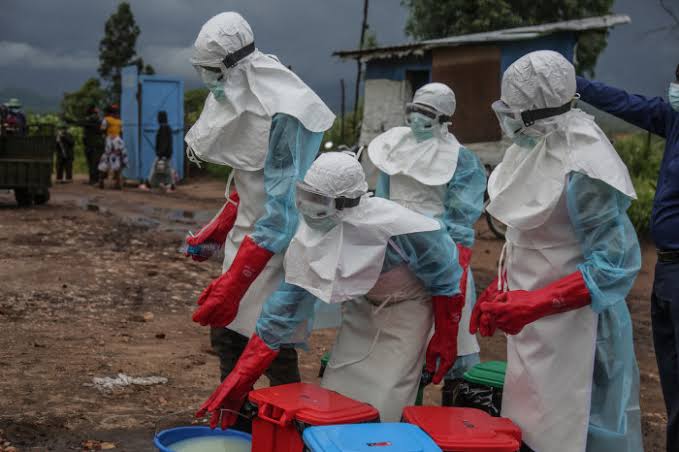
More than 1,150 confirmed cases, over 300 dead, and two patients evacuated to hospitals in Europe and the US: a rare, especially dangerous strain of Ebola is tearing through Central Africa while the world races to build a vaccine from scratch
KINSHASA / KAMPALA
Six weeks ago, almost nobody outside a handful of virologists had heard of Bundibugyo virus. Today it has a body count north of 300, a confirmed foothold in three provinces of the Democratic Republic of the Congo, a beachhead in Uganda's capital, and patients who have been medically evacuated as far away as Germany and France. The World Health Organization has done something it has done only a handful of times in its history: declared the outbreak a Public Health Emergency of International Concern, the agency's highest level of alarm.
And the most unsettling part may be this — there is still no licensed vaccine and no approved treatment anywhere on Earth for this particular strain of Ebola.
As of the latest tally from the DRC Ministry of Health on June 25, 2026, authorities have confirmed 1,155 cases and 304 deaths, with 385 people currently hospitalized in isolation wards. Health officials say that by June 22, confirmed cases had already topped 1,000, a grim milestone that makes this the third-largest Ebola outbreak ever recorded, trailing only the catastrophic 2014–2016 West African epidemic and the 2018–2020 outbreak in eastern DRC.
A virus that doesn't follow the old playbook
Most people who think they know Ebola are picturing Zaire ebolavirus, the strain behind the deadliest outbreaks in history and the one for which two vaccines — Ervebo and the Janssen two-dose regimen — already exist. Bundibugyo virus is a different, rarer species entirely, identified for the first time during a 2007–2008 outbreak in the Bundibugyo district of western Uganda, near the border with the DRC.
That original outbreak infected 149 people and killed 37, a case-fatality rate of roughly 25 to 34 percent depending on which case definition researchers use — lower than the up-to-90-percent fatality rate sometimes seen with Zaire ebolavirus, but still devastatingly high for a disease with no cure. Symptoms follow a similarly brutal arc: after an incubation period that can run anywhere from one to 21 days, patients spike a sudden fever, then develop chills, crushing headaches, and severe muscle pain. Within days, that progresses to rash, sore throat, vomiting, and relentless diarrhea — researchers studying the 2007 outbreak found non-bloody diarrhea in 81 percent of patients and severe headache in another 81 percent, with profound weakness, or asthenia, in 77 percent. Roughly half of patients go on to develop hemorrhagic signs: bleeding from the nose, blood in the urine, and gastrointestinal or vaginal bleeding. Investigators traced much of the original transmission to people handling the bodies of the dead without protective equipment — a pattern of risk that is repeating itself in this outbreak's hardest-hit communities.
Because Bundibugyo virus has caused only one prior recorded outbreak in nearly two decades, it has attracted a tiny fraction of the research funding and vaccine development poured into its more infamous cousin. That gap is now the single biggest obstacle standing between health authorities and control of the epidemic.
How it spiraled out of control
The outbreak was first confirmed on May 15, 2026, when laboratory tests came back positive for Bundibugyo virus in samples from patients in northeastern DRC and, almost simultaneously, in Uganda's capital, Kampala — a deeply worrying sign that the virus had already covered hundreds of miles before anyone realized what they were dealing with. At that early stage, the numbers looked almost manageable: eight laboratory-confirmed cases, 246 suspected cases, and 80 suspected deaths in DRC's Ituri Province, plus two confirmed cases and one death in Kampala.
It did not stay manageable. Within five weeks, confirmed cases had risen more than 140-fold. Ituri Province remains the epicenter, accounting for 1,054 of the 1,155 confirmed cases spread across 22 separate health zones — a sign of just how widely and quickly the virus has seeded itself into the region's villages and towns. North Kivu province has reported 98 confirmed cases across 11 health zones, and South Kivu has logged three cases in one health zone, suggesting the outbreak is creeping southward into new territory rather than burning out where it started.
The international dimension has made an already frightening situation feel genuinely global. A US citizen infected in the outbreak zone was medically evacuated to Germany for treatment on May 19. More recently, on June 24, a confirmed case turned up in France — another imported infection, not local transmission, but proof that in a world of international air travel, an outbreak in the Ituri rainforest is never truly contained to one continent.
A United Nations dispatch published roughly a month into the response did not sugarcoat the situation, describing a "scaled up response" that nonetheless "remains insufficient" given the scope of the spread. Containment efforts — contact tracing, isolation, safe burial practices, community engagement — are the same blunt-force tools that have worked against Ebola for decades, but they require enormous numbers of trained personnel, protective equipment, and trust from communities that have, in some cases, suffered through multiple outbreaks of various diseases in recent years.

WHO sounds the alarm — twice
The World Health Organization didn't wait long to escalate. On May 17, 2026, the Director-General formally determined that the outbreak constitutes a Public Health Emergency of International Concern — the same designation used for COVID-19, the 2022 mpox emergency, and the worst Ebola outbreaks of the past decade. Crucially, WHO clarified that the situation does not meet the bar for a "pandemic emergency," a newer, even more severe classification — but a PHEIC alone is enough to unlock emergency funding, coordinate cross-border surveillance, and put the world's public health infrastructure on high alert.
Two days later, on May 19, the WHO Director-General convened the first meeting of the International Health Regulations Emergency Committee, the body of independent experts tasked with advising on the appropriate global response. By May 22, that committee had issued a formal set of temporary recommendations to WHO member states — guidance covering everything from border screening protocols to information-sharing requirements.
On June 5, WHO went a step further, formally launching a continental strategic preparedness and response plan for the Bundibugyo outbreak, an effort to coordinate not just DRC and Uganda but the wider African region against a virus that has already shown it can cross borders with unsettling speed.
The vaccine race: $60 million and three different bets
Perhaps the most dramatic development in the entire crisis has nothing to do with case counts — it's happening in laboratories. Because no licensed vaccine exists for Bundibugyo virus, the global vaccine alliance CEPI (the Coalition for Epidemic Preparedness Innovations) announced in early June that it would simultaneously fast-track three separate, competing vaccine candidates rather than betting on just one and hoping it works.
The headline number is roughly $60 million in combined funding, with the US Department of State separately committing $50 million directly to CEPI to accelerate the effort. Moderna is getting the single largest award — up to $50 million — to adapt its mRNA vaccine platform, the same general technology behind its COVID-19 shots, to target Bundibugyo virus proteins. IAVI, a nonprofit vaccine research organization, received up to $3.2 million to advance a candidate built on a recombinant vesicular stomatitis virus (rVSV) platform — notably, the very same delivery technology used in Ervebo, the existing and successful vaccine against Zaire ebolavirus, giving researchers a reasonable head start on a proven approach. The University of Oxford rounds out the trio with a candidate built on its ChAdOx platform — a modified chimpanzee adenovirus delivery system, the same family of technology behind the Oxford-AstraZeneca COVID-19 vaccine, which will be manufactured at scale by the Serum Institute of India if it proves successful.
CEPI's strategy here is deliberately unconventional: rather than funding one candidate at a time and waiting years to see if it pans out before trying the next, all three platforms are advancing in parallel, compressing what would normally be a sequential, multi-year process into a single accelerated sprint. It's an expensive way to do vaccine development, but global health officials argue that with a virus already at 300-plus deaths and climbing, speed is worth almost any price.
What experts are saying
Scientific American, in coverage of the outbreak, noted that the Bundibugyo strain presents uniquely difficult treatment challenges compared to its better-studied relatives — clinicians simply have far less institutional experience managing this particular virus, and none of the monoclonal antibody treatments developed and proven against Zaire ebolavirus, like Inmazeb and Ebanga, have been shown to work against Bundibugyo virus. That leaves doctors largely dependent on supportive care: aggressive fluid and electrolyte replacement, treatment of secondary infections, and management of complications, rather than any drug that directly targets the virus itself.
Public health researchers tracking the outbreak have also pointed to a familiar and frustrating pattern: a rare, neglected pathogen attracts serious global investment only after it has already killed hundreds of people and crossed international borders. The same dynamic played out with mpox, with Zika, and arguably with Ebola itself in 2014, when the West African epidemic spiraled for months before the world mobilized at scale.
What this means for you
For the vast majority of people reading this outside Central Africa, the immediate personal risk remains very low. Ebola viruses, including Bundibugyo virus, spread through direct contact with the blood, bodily fluids, or contaminated surfaces of an infected person who is already symptomatic — not through casual contact, and not through the air like a respiratory virus. The two cases that reached Europe and the US were medically evacuated patients receiving specialized care under strict isolation protocols, not instances of community spread outside Africa.
That said, anyone with travel plans to affected regions of DRC or Uganda — particularly Ituri Province or North Kivu — should consult the CDC or WHO travel advisories before departing, and should be aware that some governments have implemented enhanced screening for travelers arriving from the region. Healthcare workers, aid workers, and missionaries operating in the outbreak zone face the highest risk and should follow strict infection-control guidance issued by their organizations.
The bottom line
This is, by the numbers, already the third-worst Ebola outbreak the world has ever recorded, and it is still actively growing five weeks after international alarm bells started ringing. The response now hinges on two parallel races: containing person-to-person transmission on the ground in DRC and Uganda through the same painstaking, resource-intensive methods that have worked before, and getting at least one of three experimental vaccines through trials fast enough to actually make a difference before the outbreak burns itself out on its own — the hard way, through sheer attrition of who is left to infect.
Health officials are cautiously optimistic that the unprecedented speed of the vaccine effort, paired with the world's accumulated experience fighting Ebola over the past decade, will bring this outbreak under control faster than the months-long disasters of 2014 or 2018. But for now, in the forests and towns of Ituri Province, the virus is still winning.
If you are concerned about Ebola risk related to travel or potential exposure, consult the CDC's Ebola situation summary or your national health authority for the latest guidance.
Published By | Features Editor