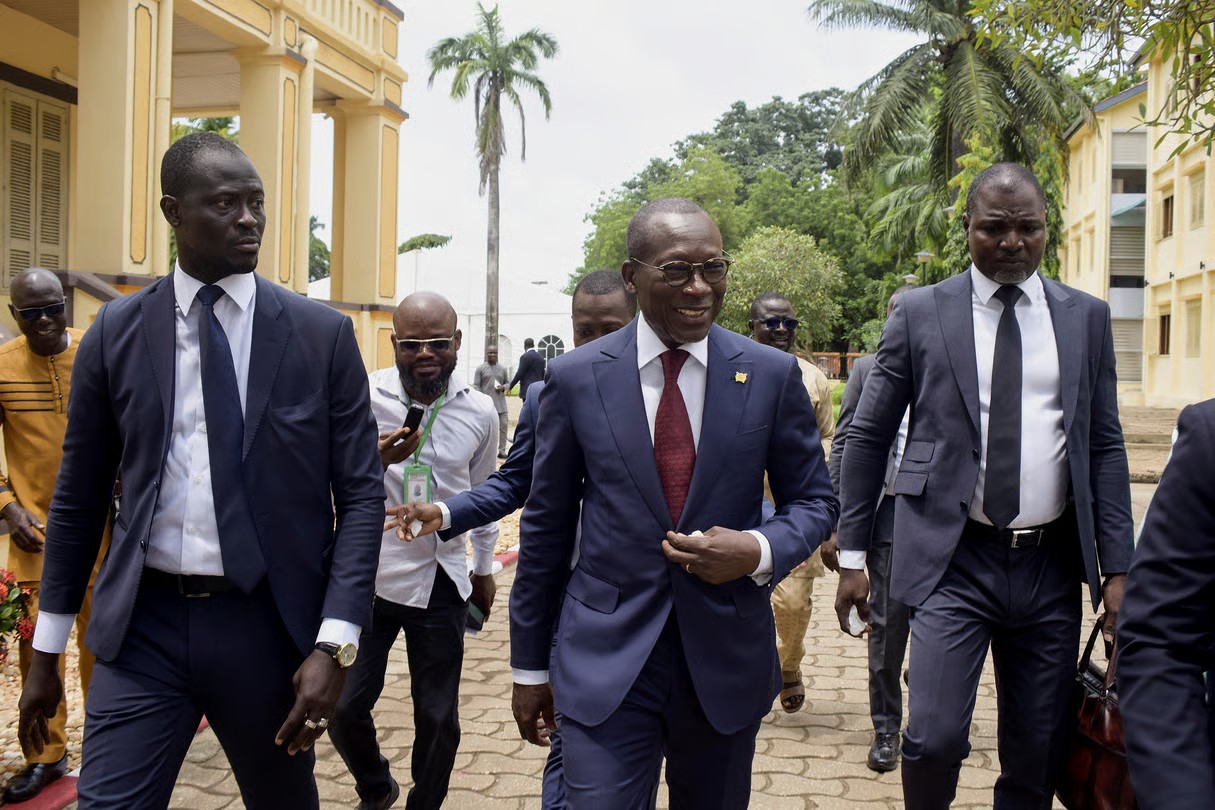
Porto-Novo, Benin
Patrice Talon, who stepped down in May as Benin's president after completing the two terms allowed him under the constitution, was elected six days earlier this month to lead the country's brand-new Senate — a body that did not exist a year ago, that he himself created, and that just handed him near-unanimous control of its top seat. The Aug. 6 vote, in which Talon won 24 of 25 ballots cast with none against and a single abstention, closes the loop on a maneuver critics have been warning about since the chamber was first proposed: an outgoing president leaving the palace while retaining a permanent, constitutionally entrenched platform inside the very institutions meant to check his successor.
The result puts Talon back at the center of Beninese political life just three months after voters elected his handpicked successor, Romuald Wadagni, to the presidency — and it has reopened a debate, both inside Benin and across a West Africa region already anxious about democratic backsliding, over whether a peaceful transfer of the presidency actually amounts to a genuine transfer of power.
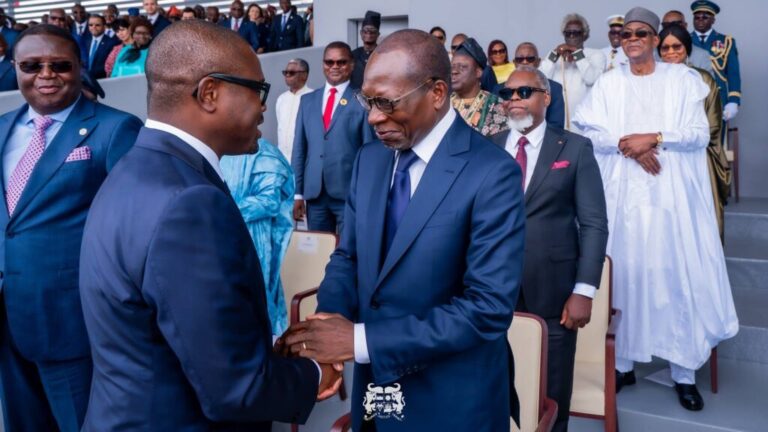
Patrice Talon, who stepped down in May as Benin's president after completing the two terms
From Cotton Fortune to Constitutional Architecture
Before he was Benin's president, Talon, now 68, was the country's most prominent businessman, known widely as the "king of cotton" for his dominance of Benin's cotton export trade and of port operations in Cotonou, the country's commercial capital. He won the presidency as an independent candidate in 2016 and was re-elected in 2021 for a second and, under the constitution, final term. Over that decade, his government delivered measurable gains in state capacity — Germany's Federal Ministry for Economic Cooperation and Development has credited his administration with higher domestic revenue collection and improvements to water, energy, education and transport infrastructure — while simultaneously, according to assessments from the Atlantic Council and the Africa Center for Strategic Studies, sharply strengthening executive power and narrowing the space for organized political opposition.
That dual legacy — a technocratic moderniser who also closed off political competition — set the stage for the events of the past year. In November 2025, Benin's National Assembly adopted a sweeping constitutional revision, promulgated on Dec. 17, that transformed the country's legislature from a single chamber into a bicameral system by creating, for the first time in Beninese history, a Senate. Barely two weeks after that revision passed, in early December, soldiers appeared on Benin's state television announcing what looked like an attempted coup; the attempt failed, but it briefly cast a shadow over the credibility of the constitutional order Talon had just finished rewriting. When parliamentary and municipal elections went ahead as scheduled in January 2026 despite the attempted takeover, the vote initially read as evidence that Benin's institutions had held. That reading did not survive close scrutiny: Talon's governing coalition won every single seat in the National Assembly, and opposition parties were barred outright from competing in the municipal elections. Analysts including those writing for Al Jazeera Opinion had already begun arguing, even before the Senate existed in practice, that "the real coup" in Benin had happened not on the night soldiers appeared on television, but gradually, over the preceding decade of Talon's own reforms.
Wadagni's Election, Talon's Exit — and Return
Talon kept his word on one score: he did not seek a third term, and Wadagni, his former minister of economy and finance and the technical architect of Talon's economic program, won the presidential election held on April 12, 2026, against an opposition candidate widely believed to be himself aligned with Talon's political network. Talon formally left the presidency on May 24, handing executive power to Wadagni. For a region that has watched leaders in Guinea, Togo, Ivory Coast, Chad and elsewhere find creative constitutional means of extending their time atop government, Benin's on-schedule transfer briefly looked like a reassuring counter-example.
The Senate complicated that reading almost immediately. The 25-member chamber was formally installed in Porto-Novo on July 30, and on Aug. 3 Benin's Constitutional Court ruled that its newly adopted rules of procedure conformed to the constitution, clearing the way for the leadership vote three days later. Under those rules, only what the chamber calls membres de droit — former heads of state, former presidents of the National Assembly, and former presidents of the Constitutional Court — are eligible to stand for the Senate presidency or vice presidency. That restriction, not a general election among all senators, is the specific mechanism that delivered Talon the seat: two other former presidents, Nicéphore Soglo and Boni Yayi, sit in the chamber on the same basis, and Yayi, who leads the opposition party Les Démocrates du Bénin, initially expressed interest in challenging Talon for the top post before concluding he lacked sufficient support among the appointed membership and declining to run. Talon was elected alongside Louis Vlavonou, a former National Assembly president, as vice president; former interior minister Alassane Seidou as rapporteur; and Adidjatou Mathys as deputy rapporteur, all for renewable five-year terms running through 2031.
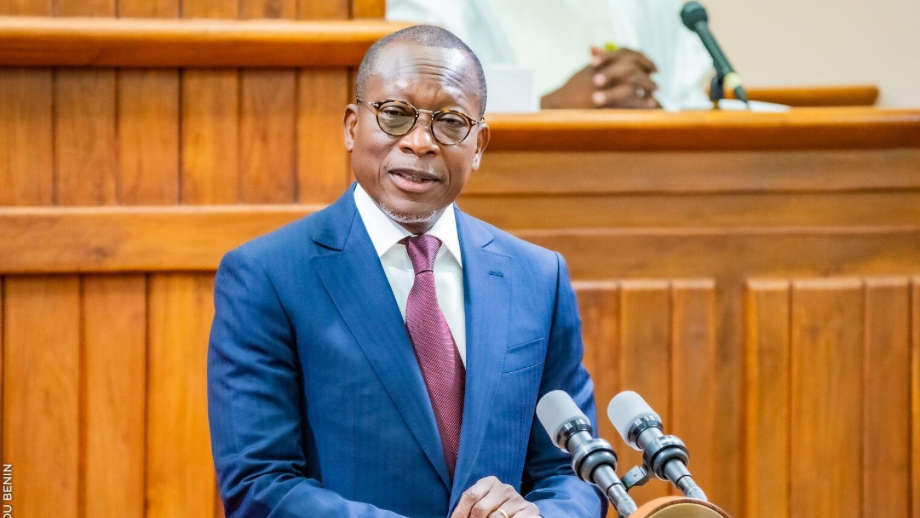
"Regulating Political Life," or Managing It?
The government's official framing of the Senate describes it as a tool to "regulate political life," strengthen national unity and support the stable functioning of the state — the kind of revising, stabilizing upper chamber found in many bicameral democracies. Talon, in his own public remarks, has argued his reforms place democracy "at the service of citizens and not at the exclusive service of political actors."
Critics read the chamber differently. Analyst David Asante-Darko, writing for Democracy in Africa, argued that the Senate's design — stacked with ex officio members drawn from the very political order Talon spent a decade building, and vested with powers he describes as rivaling the presidency's — raises "troubling questions about where power in Benin will actually lie after 2026," concluding that "Talon may be leaving the presidency without truly leaving power." A close adviser to Wadagni pushed back on that interpretation, telling reporters that "senators are not untouchable" and that a former president "already enjoys immunity by virtue of the office," meaning the Senate role grants Talon no legal protection he did not already possess — a rebuttal aimed narrowly at claims about personal legal shielding rather than at the broader argument about institutional influence.
The opposition's objections extend beyond Talon personally to the pattern his presidency established. Talon inherited a two-term, five-year limit that two of his own predecessors had unsuccessfully tried to revise in their own favor; rather than further entrenching himself, he instead extended both the presidential and National Assembly terms from five to seven years and packed key institutions with loyalists — while also making the National Assembly, in the words of French-language Beninese outlet Le Patriote, a body that will carry 25 ex officio Senate members "in perpetuity." Opposition parties currently hold no seats at all in the National Assembly, a product of election rules and candidate-vetting procedures adopted over Talon's decade in office. Benin's government has also revoked citizens' ability to petition the African Commission on Human and Peoples' Rights and the ECOWAS Court of Justice directly, after both bodies repeatedly ruled against Beninese state actions that the government proceeded to ignore.
Polling suggests this authoritarian drift runs against the grain of Beninese public opinion. Afrobarometer's most recent flagship survey found 71% of Beninese reject military rule outright, while 91% reject one-party rule and 90% reject one-man rule — figures broadly consistent with attitudes across West Africa. The gap between those preferences and the institutional trajectory Talon has constructed is, in the assessment of multiple regional analysts, precisely the tension likely to define Wadagni's presidency.
Analysis: A Region Watching Its Own Reflection
Benin's Senate maneuver does not exist in isolation. In neighboring Togo, President Faure Gnassingbé moved into a newly empowered role as president of the Council of Ministers after constitutional changes shifted executive authority away from the traditional presidency — a different mechanism aimed at a similar outcome: continuity of personal power through institutional redesign rather than open-ended incumbency. In Guinea-Bissau, President Umaro Sissoco Embaló has faced comparable accusations of engineering ways to retain influence beyond conventional constitutional limits. Regional analysts increasingly describe this as a pattern distinct from the coups that have swept Mali, Niger, Burkina Faso and Guinea since 2020: rather than soldiers seizing power outright, elected incumbents are redesigning the institutions around them so that power can outlive their formal tenure in office.
For the Economic Community of West African States, already strained by the breakaway Alliance of Sahel States and by diplomatic friction between Benin and some of its neighbors over cross-border security cooperation, another instance of an incumbent engineering a soft landing into permanent influence adds to a sense that the bloc's remaining constitutional democracies are converging, gradually, toward similar outcomes even where the specific legal instruments differ.
What to Watch
The Senate's opening legislative session, its first under Talon's leadership, will be the clearest early indicator of how the chamber intends to use its powers — whether as a genuine revising body that occasionally slows or amends National Assembly legislation, or as a more assertive check calibrated specifically to constrain Wadagni whenever his policy choices diverge from Talon's preferences. Investors and foreign partners are watching for the same signal for more practical reasons: Talon's economic record combined fiscal modernization with political centralization, and whether that model extends cleanly into this new institutional arrangement, or instead produces friction between an outgoing president's network and an incoming one's ambitions, will shape Benin's business and governance climate for the next five years. Wadagni, for his part, faces a choice other successors in similar positions have confronted before him — most visibly Félix Tshisekedi in the Democratic Republic of Congo, who eventually moved to distance himself politically from his own predecessor and patron. Whether Wadagni governs in Talon's mold or seeks to carve out independent political ground of his own is, at this early stage, the single most consequential open question in Beninese politics.
Published By | News Editor