As London Fashion Week runs its course, Burberry and the V&A are opening a free display that treats the trench not as a fashion object but as a piece of engineering that became a national costume.
LONDON
Every fashion house has a signature. Very few have a signature that outlived its inventor by more than a century, survived two world wars, got adopted by spies, detectives, newsreaders and Parisian students, and is still the single largest line item in the brand's commercial case.
On Monday, Burberry closes the main London Fashion Week programme with Daniel Lee's spring/summer 2027 collection. On Sunday, in a rarely opened room at the Victoria and Albert Museum, the house opens something quieter and arguably more revealing: 'The Burberry Trench: Crafting an Icon,' a free display running from 21 September 2026 to 3 January 2027 to mark the company's 170th anniversary.
It is not a retrospective of a designer. It is a retrospective of a coat.
The room matters
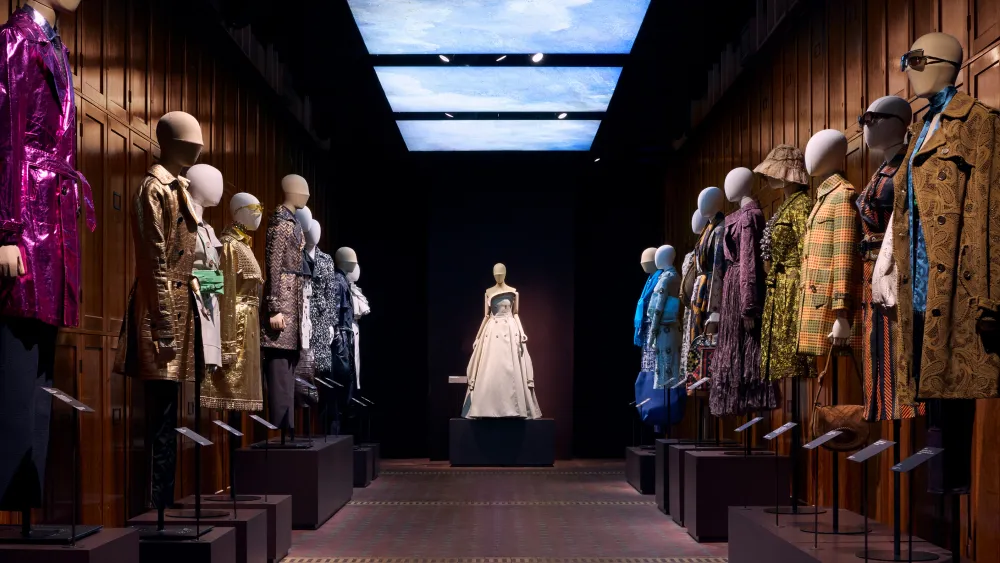
The display occupies the Prince Consort Gallery at V&A South Kensington - a space the public rarely sees, whose mahogany cabinets once held fabrics from the museum's textile collection. Putting a garment engineered for rain back into a room built to store cloth is the kind of curatorial joke that only works if the object can carry it.
The show is organised in three parts, and the sequence is the argument.
'Invention' begins in 1879, when Thomas Burberry developed cotton gabardine - a tightly woven, yarn-proofed fabric that repelled water while still allowing air through. This was not a styling decision. It was a materials-science one, and it solved a genuine problem: existing waterproof outerwear was rubberised, heavy and unbreathable. Gabardine made a coat you could work in.
'Craft' takes the garment apart. The hand-finished collar. The House Check lining. The storm flap. The detachable throat latch. Anyone who has ever wondered what the small buckled strap under a trench collar is actually for will find out here, and the answer is not decorative.
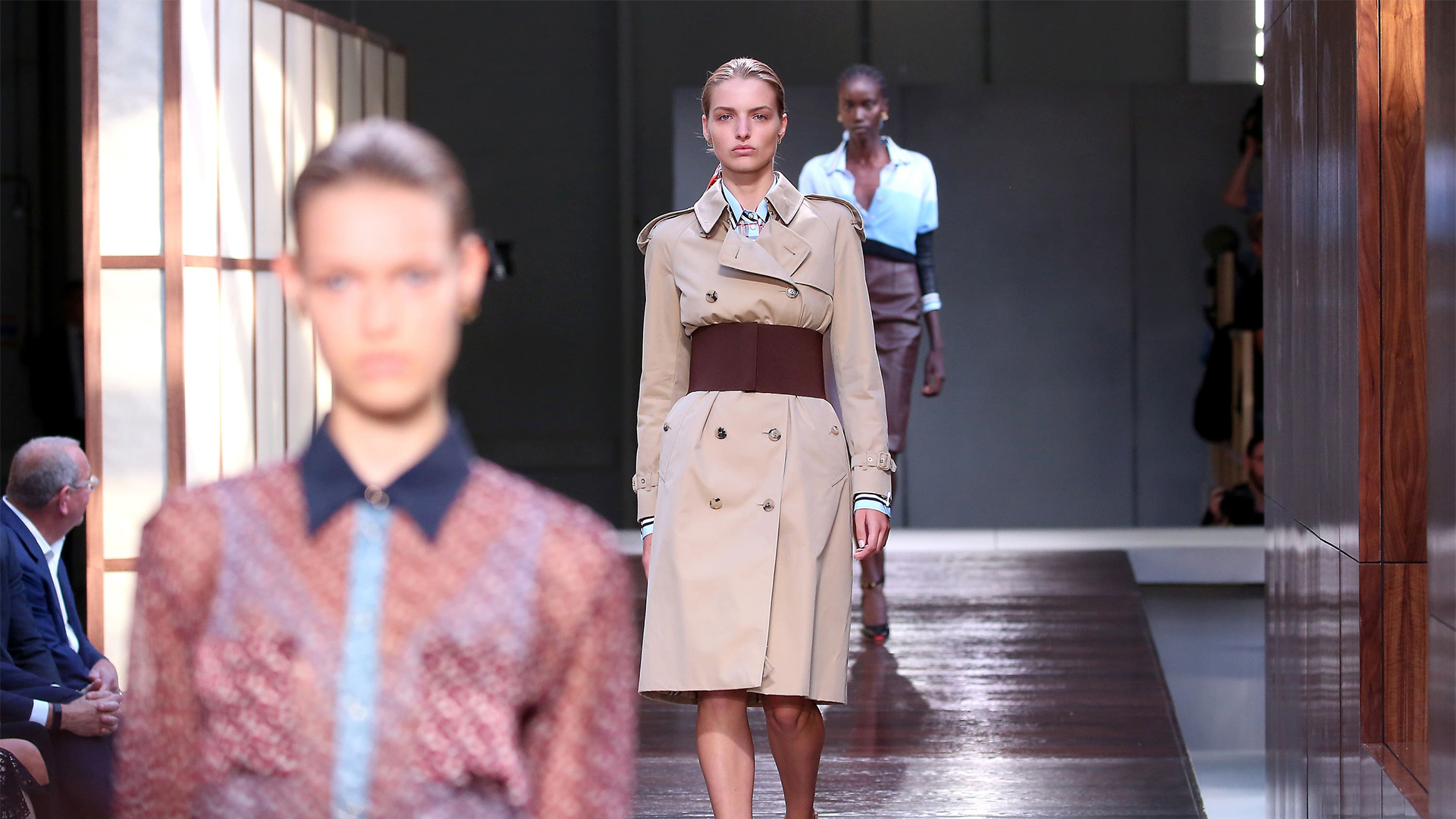
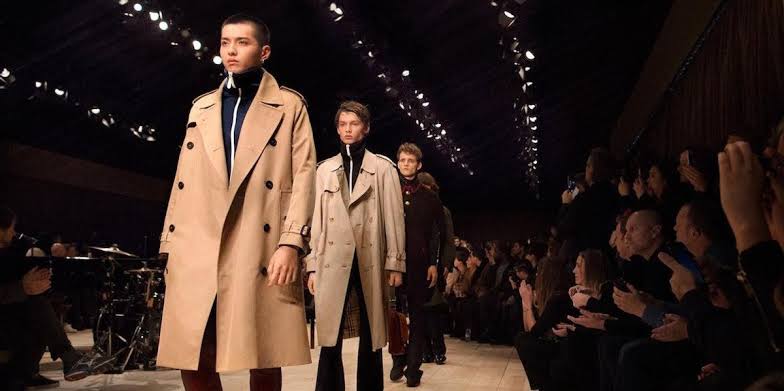
'Creativity' brings it to the present with 19 runway looks from the past 25 years, drawn from the work of current chief creative officer Daniel Lee and his predecessor Christopher Bailey. A number of archive objects go on public display for the first time, including early twentieth-century catalogues and a Burberry trench worn by the designer Hardy Amies.
'As we mark 170 years of the house, we are thrilled to partner with the V&A to celebrate the enduring legacy of the Burberry trench coat - a global design icon rooted in British craftsmanship,' said Carly Eck, the brand's curator.
Why now, and why free
Anniversaries are convenient, but the timing here is commercial as much as sentimental, and Burberry has not been coy about it. The brand's 'Portraits of an Icon' campaign has run through the year on the same theme, and the trench has been pushed back to the centre of the proposition under chief executive Joshua Schulman's Burberry Forward turnaround plan.
That plan is, on the evidence of the most recent results, working. In the 2025/26 financial year, revenue was down 2% to 2.42 billion pounds, but adjusted operating profit rose sharply to 160 million pounds, giving a margin of 6.6%. Gross margin expanded 530 basis points to 67.9%. Free cash flow more than doubled, to 141 million pounds from 65 million. The company delivered 80 million pounds of cost savings in the year, with annualised savings expected to reach 100 million by 2026/27. Retail sales grew in Greater China and the Americas.
Strip out the accounting and the strategy is legible: after a period of trying to reposition Burberry as a high-luxury runway house, it has gone back to selling the thing everybody already associates it with, at a price people will pay, in volume. A museum display that spends its first two rooms explaining why the coat is well made is not incidental to that. It is the argument, staged by a national institution, for free.
The coat that refuses to be dated
There is a reason the trench survives every cycle. Most fashion icons are silhouettes, and silhouettes go in and out. The trench is a set of solutions - epaulettes, a gun flap, D-rings, a storm shield, a belt - each of which existed for a reason, most of which no longer apply, and none of which anyone wants removed.
That accumulated redundancy is exactly what makes it read as timeless rather than retro. A garment designed entirely by function, whose functions have expired, becomes pure form without ever having been styled. You cannot date a trench coat the way you can date a lapel width or a shoulder line.
It also explains why the trench has been so unusually portable across class and politics. It has been military kit, journalistic uniform, film-noir shorthand, Parisian intellectual costume and suburban school-run outerwear, frequently within the same decade. Very few garments can be simultaneously establishment and anti-establishment. The trench manages it because the coat itself declines to take a position.

What this means if you own one - or want to
Three practical takeaways from a display that is, at heart, a lesson in buying well.
First, the construction details are the value. Gabardine, a properly finished collar, a genuine storm flap, and a throat latch that actually fastens are what separate a coat that lasts thirty years from one that lasts three seasons. The V&A has essentially built a free checklist.
Second, heritage is not automatically a premium worth paying. It is worth paying for when the heritage is technical - a fabric, a pattern, a method - rather than merely a logo. 'Invention' and 'Craft' occupy two-thirds of this display for a reason.
Third, this is a genuinely accessible way to see runway fashion up close. London Fashion Week is, for most people, something that happens behind a door. Nineteen runway looks from Lee and Bailey, standing still, at no cost, in South Kensington, until January is a considerably better offer.
Burberry will close the week on Monday evening with a new collection that will be reviewed, argued over and forgotten within a season, as collections are. The coat in the Prince Consort Gallery has already outlasted every review ever written about it.
Published By | Features Editor