Written By | International News Desk
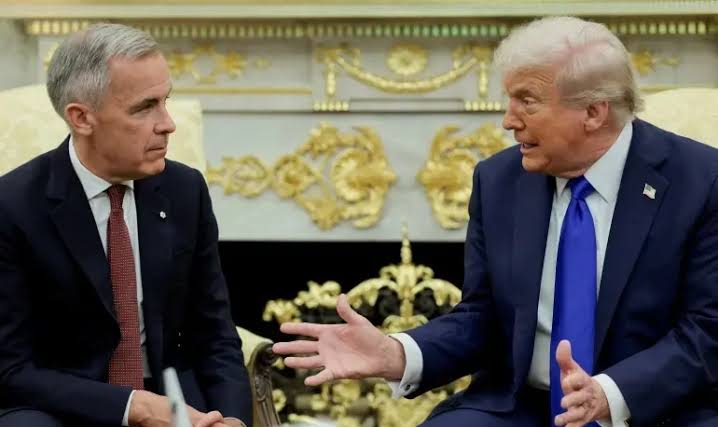
resident Donald Trump invoked emergency powers to impose sweeping tariffs on Canadian goods, initially citing fentanyl trafficking and illegal border crossings as justification
Background
The United States and Canada have spent much of the past year and a half locked in an escalating trade dispute that traces back to February 2025, when President Donald Trump invoked emergency powers to impose sweeping tariffs on Canadian goods, initially citing fentanyl trafficking and illegal border crossings as justification. That opening salvo — a 25% levy on most imports and a 10% tariff on energy products — triggered a tit-for-tat cycle that has defined the bilateral relationship ever since. Canada answered with retaliatory tariffs on roughly $30 billion of American goods, an amount that grew to as much as $155 billion within weeks, while both governments layered on sector-specific measures targeting steel, aluminum, automobiles and lumber.
The relationship has been volatile even by the standards of the first Trump administration. In early 2026, the U.S. Supreme Court struck down several of the tariffs that had been imposed under the International Emergency Economic Powers Act, forcing the White House to search for alternative legal authority to keep its trade agenda intact. That search led the administration back to Section 338 of the Tariff Act of 1930, a Depression-era statute that gives the president broad authority to penalize countries found to discriminate against U.S. commerce — a provision so obscure that trade lawyers have described its revival as unprecedented in the modern era.
Throughout 2025 and into 2026, Canadian provinces responded to the tariff pressure with countermeasures of their own, most notably a near-universal boycott of American beer, wine and spirits: every province except Alberta and Saskatchewan pulled U.S. alcohol from government liquor store shelves. Canadian households, meanwhile, have absorbed an estimated $2,300 to $2,700 in additional annual costs since the trade war began, with independent economists estimating the dispute has shaved 1.5 to 2 percentage points off Canada's GDP growth. The United States-Mexico-Canada Agreement (USMCA), the trade pact Trump himself negotiated during his first term and which is due for a mandated joint review in 2026, has increasingly become a background character in the story — repeatedly invoked by Ottawa as the framework being violated, even as Washington keeps finding new legal avenues to add tariffs outside it.
Key Developments
On Monday, July 20, President Trump signed three proclamations under Section 338 imposing an additional 50% tariff on a wide swath of Canadian goods, according to a White House fact sheet released alongside the announcement. The administration framed the move as a response to what it called Canada's 'continued discrimination' against three flagship American export categories: automobiles, alcohol and dairy. The new duties, set to take effect on August 19 — 30 days after signature — cover an eclectic list of products including wine, hockey sticks, cement, furniture, paper, plywood and a range of dairy inputs such as milk, cream, whey, lactose and molasses.
Notably, the new tariffs carve out exemptions for oil, gas, critical minerals and potash, and they do not stack on top of goods already covered by existing sector-specific tariffs on steel, aluminum and copper, which currently range from 15% to 50%, or the 35% tariff already in place on Canadian softwood lumber. The administration also opted not to grant an exemption for goods that qualify as USMCA-compliant, a decision trade analysts say broadens the economic reach of the measure considerably beyond earlier rounds, in which USMCA-compliant goods had often received carve-outs. In dollar terms, the newly tariffed products represent close to $20 billion in Canadian exports, or roughly 5% of everything Canada ships to the United States.
The dairy provision targets Canada's supply management system, a decades-old policy structure that uses production quotas and import controls to stabilize prices for Canadian dairy, egg and poultry farmers — a system Washington has long argued functions as a de facto trade barrier against American dairy exporters. On autos, the administration's complaint centers on Canadian content quotas that the U.S. alleges are designed to pressure manufacturers into shifting production north of the border; oddly, despite the auto-sector rhetoric framing the announcement, the actual list of newly tariffed goods released by the White House does not include finished motor vehicles or auto parts, a discrepancy several outlets flagged as unresolved as of this writing.
Speaking to reporters after signing the proclamations, Trump argued that Canada's economy remains fundamentally dependent on U.S. trade, telling reporters, in comments reported by BNN Bloomberg, that without American commerce 'there's no way they can survive.' The remark underscored the asymmetric framing the White House has used throughout the dispute — treating tariffs as leverage the U.S. can deploy with little risk to itself, a claim Canadian officials and independent economists dispute given the deep integration of supply chains, particularly in the auto sector, across the two countries.
Reactions
Canadian Prime Minister Mark Carney responded within hours, calling the new duties 'the latest in a series of tariffs in direct violation' of the USMCA. Carney's framing sought to reposition Canada as the aggrieved party bound by a rules-based agreement being ignored by its largest trading partner, rather than as an equal combatant in an open-ended trade war. Notably, Carney's government stopped short of announcing new retaliatory tariffs in immediate response, a departure from the pattern set in 2025, when Ottawa matched U.S. escalation step for step. Instead, Carney said he had spoken with Trump by phone the same morning and that the two leaders agreed to 'intensify' and accelerate ongoing trade negotiations over the coming weeks, according to accounts published by CBC News and Forbes.
That relatively restrained posture has drawn mixed reactions inside Canada. Some business groups have welcomed the emphasis on renewed talks as preferable to another cycle of matching tariffs that would raise costs for Canadian consumers and businesses alike. Others, including opposition politicians, have accused Carney of appearing to soften Canada's position at a moment when firmness might be more politically popular, particularly given that dairy supply management remains, in the government's own public statements, a redline it says it will not put on the negotiating table regardless of U.S. pressure.
Industry reaction inside Canada has been sharply sector-specific. Dairy groups have reiterated that supply management enjoys broad, near-consensus political support across Canadian parties and warned against any negotiating strategy that treats it as a bargaining chip. Wine, spirits and cement exporters, several of which are named specifically on the new tariff list according to reporting by The Globe and Mail, have warned of significant near-term revenue losses given how quickly the 30-day implementation window closes relative to the time needed to find alternative markets. On the American side, some business groups with cross-border supply chains have echoed longstanding concerns that broad, non-exempted tariffs raise costs for U.S. manufacturers and consumers just as much as for Canadian exporters, given how tightly integrated sectors like automotive manufacturing have become since the original USMCA and its predecessor NAFTA reshaped continental supply chains.
What's Next
The 30-day implementation clock, running until August 19, effectively sets the timetable for the next phase of negotiations. Both governments have signaled a preference for using that window to search for a negotiated de-escalation rather than allowing the tariffs to take effect and inviting another round of matching retaliation, though neither side has offered specifics on what a deal addressing autos, alcohol and dairy simultaneously might look like. Carney's government faces a difficult balancing act: maintaining its stated redline on dairy supply management, protecting the auto sector's integrated supply chains, and avoiding the domestic political cost of being seen as caving to Washington, all while trying to prevent further economic damage to a Canadian economy already estimated to have lost meaningful GDP growth to the trade war.
The dispute also lands at a moment when the USMCA itself is due for a formal joint review process in 2026, a mechanism built into the agreement that gives all three signatory governments — the U.S., Canada and Mexico — an opportunity to renegotiate or reaffirm the pact's terms. How this latest tariff round intersects with that broader review remains one of the more consequential open questions: trade lawyers and economists have suggested the administration's growing reliance on Section 338 and other tariff authorities outside the USMCA framework could be read either as pressure tactics ahead of that review, or as a sign Washington views the underlying agreement as increasingly optional. Markets, meanwhile, are likely to watch closely for any signs of retaliatory measures from Ottawa in the coming weeks, as well as for whether the administration extends similar treatment — invoking Section 338 over discrimination claims — to other trading partners, a precedent that trade attorneys have flagged as significant regardless of how the Canada dispute itself resolves.



