Economic & Social Transformation
A Landlocked Economy Reshaped by Two Bets
Niger, one of the poorest and most climate-exposed countries on earth, has spent the past three years betting its economic future on two extractive industries it does not fully control: uranium and crude oil. Both bets are now colliding with the harder politics of sovereignty, and the results — a nationalized uranium mine nobody will buy, and an oil pipeline whose profits are being renegotiated barrel by barrel — illustrate the peculiar shape of West African "resource nationalism" in 2026. The headline growth numbers look enviable. The International Monetary Fund projects Niger’s economy will expand by 6.7% in 2026, extending a run of oil-driven expansion that saw GDP rise from roughly $86 billion to about $92 billion year on year, according to World Bank and IMF country updates. Beneath that topline figure, however, sits a population where close to half still lives in extreme poverty, a security environment that is deteriorating rather than stabilizing, and a fiscal position propped up by a delicate sequence of IMF reviews rather than by broad-based domestic revenue.
The Uranium Mine Nobody Will Buy
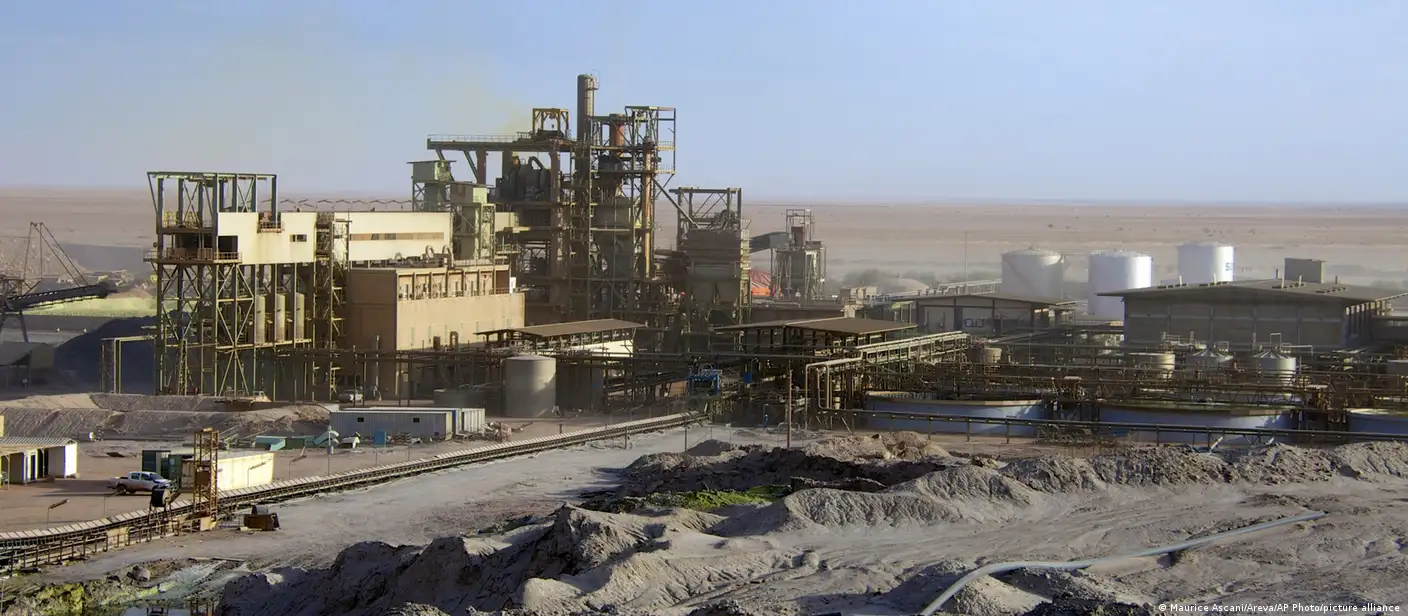
For half a century, Niger’s uranium — extracted mostly from the Arlit region in the country’s north — fed French nuclear reactors through the state-linked company Orano (formerly Areva). That relationship collapsed after the July 2023 coup. Niger’s military government revoked Orano’s license for the Imouraren deposit, one of the largest undeveloped uranium reserves in the world, and in December 2024 Orano announced it had "lost operational control" of its Somaïr mining subsidiary. In June 2025, the junta formally nationalized Somaïr outright.
The nationalization was framed domestically as reclaiming a resource that had "enriched others while impoverishing Niger," in the words of officials cited by regional outlets covering the dispute. But sovereignty over the mine has not translated into revenue. A tribunal at the World Bank’s International Centre for Settlement of Investment Disputes ordered Niger not to sell or transfer Somaïr’s stockpiled uranium while Orano’s compensation claims are pending — claims Orano values at hundreds of millions of dollars. Niger has periodically threatened to sell the stockpile anyway, asserting what officials call a "legitimate right" to dispose of national resources, and by November 2025 authorities said they were moving uranium onto the international market despite Orano calling the shipments illegal. Yet as 2026 has progressed, Niger has struggled to find buyers willing to risk the legal exposure, and reporting from The Africa Report and other outlets describes a mine that is nationalized in name but largely unable to monetize its own output. Niger is the world’s fourth-largest uranium producer by historical volume — 4,704 tonnes of uranium oxide in 2023, according to the World Nuclear Association, before coup-related disruptions cut output closer to 2,000 tonnes in leaner years — meaning the stalemate has real fiscal cost. Separately, Canadian junior miner Global Atomic’s Dasa project, unaffected by the Orano dispute, is on track to begin its own production in early 2026, with processing-plant commissioning targeted for the second half of the year — a reminder that Niger’s uranium sector is bifurcating between nationalized legacy assets in political limbo and newer private projects moving ahead largely on schedule.
In September 2025, Niger’s mining minister proposed that Russia help develop the country’s uranium deposits, a move consistent with the junta’s broader post-coup reorientation away from France and toward Moscow and, on security matters, toward its Sahel Alliance partners.
Oil: From Sanctions Casualty to Fiscal Lifeline
If uranium has been a story of stalled ambition, oil has been Niger’s genuine growth engine. The 1,950-kilometer Niger–Benin Oil Pipeline, built and operated by China National Petroleum Corporation (CNPC), links the Agadem basin in eastern Niger to the Atlantic port of Sèmè-Podji in Benin. Since its 2024 commissioning, the pipeline has allowed Niger’s crude production to stabilize near 110,000 barrels per day — a roughly five-fold jump from the roughly 20,000 barrels per day the country could process before export capacity existed, according to World Bank macroeconomic updates.
That capacity has not come without friction. Export flows were suspended for weeks in 2024 amid a border dispute between Niger and Benin over the junta’s ban on imported goods, and a June 2024 attack by an armed group opposed to the military government damaged the pipeline after just a single shipment had gone out. Exports resumed in August 2024 following Chinese mediation between Niamey and Cotonou. Since then, the relationship between Niger and its Chinese pipeline partner has evolved: under 2026 deals reported by regional energy outlets, Niger is set to acquire a 45% stake in the West African Oil Pipeline Company (WAPCO), CNPC’s local subsidiary, while the pipeline’s transport tariff is being cut from $27 to $15 per barrel — a change expected to generate roughly $106 million (60 billion CFA francs) in annual savings for the Nigerien treasury. The pipeline’s nameplate capacity is around 60,000 barrels of oil per day for export, meaning Niger is now selling internationally a volume that, alongside domestic refining, underpins the hydrocarbons-led growth the IMF and World Bank are forecasting for 2026 and 2027.
Fiscal Discipline Under an IMF Program, Amid Rising Insecurity
Niger’s macroeconomic story remains tightly bound to its IMF-supported program. The Fund completed the eighth review of Niger’s Extended Credit Facility (ECF) arrangement and the fourth review of its Resilience and Sustainability Facility (RSF) in March 2026, following staff-level agreement reached in February 2026, and a subsequent IMF mission in June 2026 opened discussions on a ninth ECF review. Niger’s fiscal deficit came in at 2.9% of GDP in 2025 — 0.4 percentage points better than projected and comfortably within the West African Economic and Monetary Union (WAEMU) convergence ceiling of 3% of GDP. For 2026, the deficit is projected to widen again, to somewhere between 3.4% and 3.7% of GDP, as the government absorbs reconstruction spending tied to last year’s natural disasters and extends support to households hit by commodity-price shocks. The IMF has generally credited Niamey with prioritizing concessional financing and extending domestic debt maturities to manage debt-service pressure, a posture that has kept Niger’s program broadly on track even as the political backdrop remains unusual for a Fund-supported country: a military government that took power by coup, was sanctioned by the Economic Community of West African States (ECOWAS), and has since exited that regional bloc altogether.
Security conditions are working against these fiscal gains. Niger, along with Sahel Alliance partners Mali and Burkina Faso, has seen conflict events rise by roughly 22% and fatalities by about 17% relative to 2024, according to World Bank monitoring, disrupting agriculture, transport corridors, and — periodically — the oil exports the budget now depends on. The United Nations and partner agencies estimate that 2.6 million people in Niger will require humanitarian assistance in 2026 because of the combined effect of insecurity and climate shocks, including recurrent flooding along the Niger River basin.
Poverty Falling, but From an Extremely High Base
The human development picture is one of genuine but slow improvement. World Bank projections show Niger’s extreme poverty rate declining from 52.9% in 2024 to 50.1% in 2025 — lifting roughly 310,000 people above the extreme-poverty line — and falling further to about 45.6% by 2027 if growth holds, a reduction of some 440,000 additional people. Even at that improved trajectory, more than 10 million Nigeriens — over 45% of the population as of 2024 — remain in extreme poverty, a reflection of how thin the country’s human-capital and infrastructure base still is relative to its 6-7% annual GDP growth rates. Niger’s population is also one of the youngest and fastest-growing in the world, with fertility rates among the highest globally, meaning that per-capita gains from oil and mining revenue are diluted even when aggregate GDP performs well.
The Sahel Alliance and the Question of a Common Currency
Niger’s economic policy increasingly cannot be separated from its membership in the Alliance of Sahel States (AES), the security and political pact it formed with Mali and Burkina Faso after all three experienced coups between 2020 and 2023. In August 2024 the AES evolved into the broader Confederation of Sahel States (CSS), formalizing cooperation on political, economic, and diplomatic sovereignty projects. In December 2025 the confederation inaugurated the Confederal Bank for Investment and Development (BCID-AES) with initial capital of 500 billion CFA francs (roughly $900 million), intended to fund regional infrastructure and import-substitution industry outside the existing WAEMU and Central Bank of West African States (BCEAO) architecture. Discussion of a common AES currency to eventually replace the CFA franc has intensified — proposals floated in research forums such as BRICS-focused economic journals envision a currency backed by the bloc’s combined gold, uranium, and hydrocarbon reserves — though officials have publicly denied that any near-term currency launch is imminent, and Niger has simultaneously reaffirmed its commitment to WAEMU fiscal convergence criteria, an awkward straddle between regional blocs that will likely define Nigerien economic policy for years to come.
Outlook
Niger’s 2026 story is one of genuine macroeconomic momentum built on genuinely fragile foundations. Oil has delivered the fivefold production increase and pipeline-equity gains that are driving headline GDP growth and funding a technically sound IMF program. Uranium, by contrast, illustrates the limits of resource nationalism when the nationalizing government lacks the buyers, legal standing, and processing capacity to monetize what it has seized. Layered on top of both is a security crisis that is worsening, a humanitarian caseload in the millions, and a poverty rate that, even on its best trajectory, will keep close to half the population below the extreme-poverty line through the end of the decade. Whether Niger converts its commodity windfalls into durable development — rather than into another chapter of extraction without broad-based benefit — will depend on decisions being made simultaneously in Niamey, Bamako, Ouagadougou, Paris, Beijing, and Washington over the next eighteen months.
Published By | Business News Editor