Written By | Our Reporter
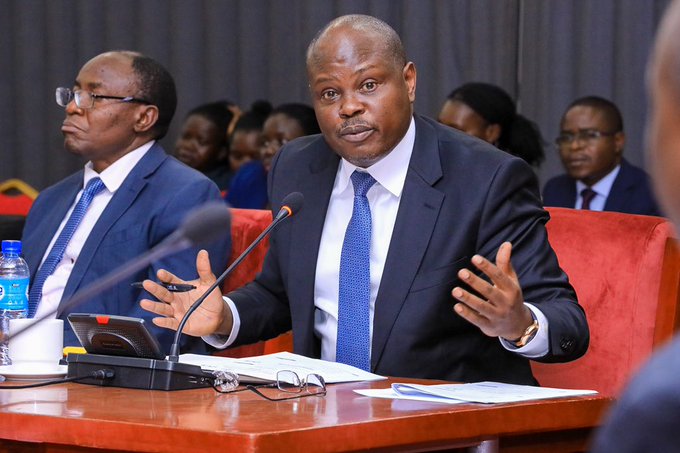
The Auditor General reported that despite substantial government investment in research through the Research and Innovation Fund (RIF), completion of funded projects remained extremely low
The Auditor General Edward Akol has raised concerns over low research output, poor utilisation of innovations and the continued operation of unaccredited academic programmes across public universities.
Presenting his findings, the Auditor General reported that despite substantial government investment in research through the Research and Innovation Fund (RIF), completion of funded projects remained extremely low.
“Research funds were frequently disbursed late, often in the second quarter of the financial year, disrupting project timelines. Eighty-eight per cent of researchers across universities were simultaneously engaged in multiple projects, which reduced focus and contributed to a large backlog of unfinished work,” he said.
He noted that some researchers at Makerere University, Mbarara University of Science and Technology (MUST) and Busitema University were listed on more than four concurrent projects but delivered no completed output within the planned timeframes.
Low Academic Participation
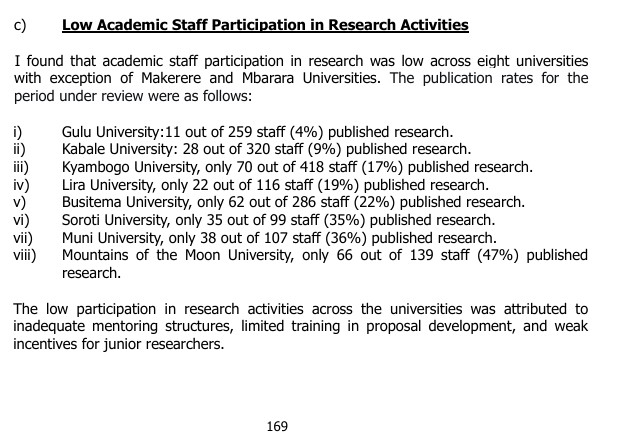
The report further revealed low academic staff participation in research across eight public universities, with only Makerere and Mbarara University recording comparatively better performance. At Gulu University, only 11 out of 259 staff (4%) published research. At Kabale University, 28 out of 320 staff (9%) published research, while at Kyambogo University, only 70 out of 418 staff (17%) published research.
The situation was similar at Lira University, where 22 out of 116 staff (19%) published research, and at Busitema University, where 62 out of 286 staff (22%) published research. At Soroti University, only 35 out of 99 staff (35%) published research.
At Muni University, 38 out of 107 staff (36%) published research, while Mountains of the Moon University recorded 66 out of 139 staff (47%).
“The low participation in research activities across the universities was attributed to inadequate mentoring structures, limited training in proposal development and weak incentives for junior researchers,” the Auditor General stated.
Weak Dissemination of Research
Beyond low participation, the Auditor General found that 13 public universities lacked standardised procedures to ensure that research outputs reached key stakeholders, including policymakers, local communities, industry partners and peer reviewers.
“For instance, mobile technology prototypes at Gulu University were demonstrated only once and never made accessible afterwards, and agricultural innovations at Busitema University were shared without adaptations for local farmers’ language or technical literacy,” he noted.
As a result, many innovations remained unutilised or underutilised, reducing research visibility and negatively affecting institutions’ Webometrics rankings.
Unaccredited Programmes and Weak Oversight
The report also revealed that several public universities were operating unaccredited programmes, campuses and study centres.
These included Makerere University study centres in Mbale and Lira; Gulu University study centres in Kotido, Hoima/Masindi and Kitgum; Busitema University’s Tororo study centre and Kabwangasi campus; and Kyambogo University study centres in Bushenyi, Paidha and Soroti.
Additionally, Mbarara, Busitema, Kabale, Muni, Mountains of the Moon, Lira and Soroti universities continued to admit students to 64 academic programmes with expired accreditations, which the Auditor General attributed to weak enforcement by the National Council for Higher Education (NCHE) and inadequate internal tracking systems.
The Office of the Auditor General further unearthed systemic weaknesses within NCHE’s accreditation processes, noting that some reports were not aligned with the council’s performance assessment tools for desk review, thereby affecting the soundness of conclusions reached.
“The accreditation process is ineffective, as evidenced by monitoring reports indicating significant non-compliance in critical areas such as staffing and infrastructure, including laboratories, within a short period after accreditation of programmes,” he explained.
He also cited the absence of records on follow-up or quality assurance checks by NCHE staff on reports submitted by reviewers to ensure the reliability and integrity of accreditation decisions.
The findings have renewed scrutiny on governance, quality assurance and accountability within Uganda’s public university system.
Torch Media Africa



