Written By | Fashion and Design Desk
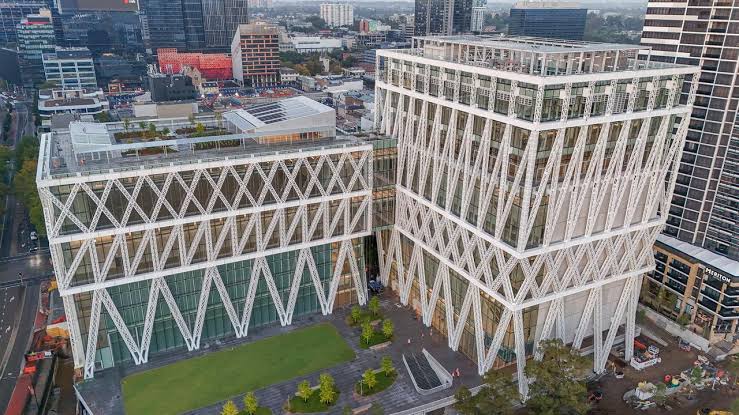
Powerhouse Parramatta, Australia's biggest cultural build since the Sydney Opera House, is nearing completion — and its exoskeleton design is unlike anything the country has seen.
SYDNEY, AUSTRALIA
Australia doesn't build cultural landmarks often, and it builds them on this scale almost never. But after years of construction, political back-and-forth, and a design that had to survive an international competition before a single brick was laid, Powerhouse Parramatta is entering its final stretch, with the AUD $915 million museum on track to open its doors to the public in late 2026. When it does, Western Sydney will have its first major state museum — and Australia will have its most significant piece of cultural infrastructure since the Sydney Opera House rose on the harbor more than fifty years ago.
That's not hyperbole so much as arithmetic. At roughly 30,000 square meters, funded directly by the New South Wales government and built by construction giant Lendlease, Powerhouse Parramatta isn't just another museum expansion — it's a deliberate, enormously expensive bet that culture belongs outside the postcard core of Sydney Harbour, in the fast-growing, historically underserved western suburbs where more than half of greater Sydney's population now actually lives.
A Design Born From Competition
The building's distinctive look — an intricate, exoskeleton-like facade that wraps the structure in a lattice of visible structural framing — comes from Moreau Kusunoki, a Franco-Japanese architecture practice based in Paris, working in partnership with Sydney firm Genton. The pairing won the commission unanimously in an international design competition held back in 2019, beating out proposals from architecture studios around the world for the right to define what a 21st-century Australian museum should look like.
The result splits the difference between monument and workspace. Rather than a single, self-contained showpiece, Powerhouse Parramatta has been designed as a working cultural campus: seven large-scale exhibition spaces for rotating and permanent collections, a 900-seat theatre built to host performance alongside static display, a full cinema, rooftop gardens intended as public green space as much as museum amenity, and — in an unusually hands-on touch for an institution this size — 30 residential artist studios and a 200-seat demonstration kitchen built directly into the program. It's a museum conceived to be occupied and worked in, not just walked through.
Why Parramatta, and Why Now
The choice of location is itself the story as much as the architecture. Parramatta, roughly 24 kilometers west of the Sydney CBD, has spent decades as one of the fastest-growing urban centers in Australia without a cultural institution to match its population growth. Placing a $915 million state museum there — rather than expanding an existing Sydney Harbour institution — signals a deliberate policy choice: that world-class culture shouldn't require a trip to the postcard skyline, and that a region home to one of the country's most ethnically diverse populations deserves a flagship institution built specifically for it, rather than an outpost of one built somewhere else.
That framing has made the project a genuine political football over the years, with cost overruns, relocation debates over the museum's original Ultimo site, and shifting completion timelines all generating headlines well before a single visitor walks through the doors. But with construction now reported complete and the museum's operators locking in a late-2026 public opening, the project appears to be entering its final, less contentious phase: the one where people actually get to see what all the debate was about.
What the Building Says About Australian Architecture
Architecturally, Powerhouse Parramatta arrives at an interesting moment for Australian design, which has spent the past decade increasingly looking outward — commissioning international practices, entering global competitions, and positioning its major civic buildings as world-stage statements rather than purely domestic projects. The Moreau Kusunoki and Genton pairing fits that pattern precisely: a Paris-based practice with no prior built work in Australia, teamed with a respected local firm, producing a building whose visible structural exoskeleton reads as much like a piece of engineered sculpture as a functional facade. Design critics who've toured the site describe the effect as simultaneously industrial and delicate — an intentional echo of Parramatta's own manufacturing history, reinterpreted for a cultural building rather than a factory.
It's also a striking counterpoint to the Sydney Opera House's sail-like, harborside silhouette. Where the Opera House was designed to be seen from the water, defining Sydney's skyline from a distance, Powerhouse Parramatta is designed to be entered, worked in, and inhabited — a museum built for a community rather than a coastline.
What This Means for Visitors
For Sydneysiders and visitors alike, the practical upshot is a genuinely new type of museum going up in a part of the city that's historically been treated as peripheral to its cultural map. The demonstration kitchen and artist studios suggest programming that will lean into live making and public workshops rather than purely static display, while the 900-seat theatre gives the institution flexibility to host performance, talks, and film alongside its exhibitions — closer in spirit to a genuine cultural campus than a traditional collecting museum.
For the broader design world, Powerhouse Parramatta is worth watching as a case study in what happens when a government commits nine figures and years of political capital to placing world-class architecture somewhere other than the obvious postcard location. Whether it succeeds in drawing visitors west, and in genuinely serving the community it was built for rather than simply decorating it, will be the real test once the doors finally open later this year.
Either way, when Powerhouse Parramatta welcomes its first visitors in the coming months, it will do so as proof that Australia's next great piece of architecture didn't need a harbor view to matter.



