Background
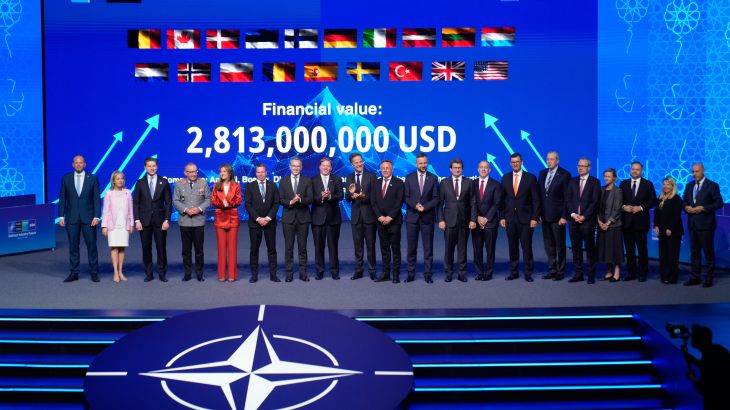
NATO's 32 heads of state and government convened in Ankara, Turkiye, on July 7 and 8, 2026, for the alliance's annual summit, hosted this year by Turkish President Recep Tayyip Erdogan. The gathering is the first major test of the landmark spending commitment NATO members made a year earlier at the 2025 summit in The Hague, where every ally except Spain, which secured an exemption, agreed to raise defense and security-related spending to 5 percent of GDP annually by 2035. That target — split between at least 3.5 percent of GDP on core military capability and up to 1.5 percent on broader resilience, infrastructure, and defense-industrial investment — represented a dramatic escalation from NATO's prior benchmark of 2 percent of GDP, first adopted at the 2014 Wales summit in response to Russia's annexation of Crimea and reaffirmed at the 2023 Vilnius summit.
The push toward 5 percent has been driven substantially by pressure from President Trump, who has argued since his return to office in January 2025 that European and Canadian allies have underinvested in their own defense for decades while relying on American security guarantees. The Hague summit, held only months into his second term, was widely read as a low-drama success in managing Trump's demands. Ankara is being watched as the moment when allies must start showing tangible evidence — new contracts, budget lines, procurement commitments — that the 5 percent pledge is more than rhetoric, with a formal compliance review not due until 2029.

Key Developments
NATO Secretary General Mark Rutte has framed the Ankara summit around three priorities: continuing to raise allied defense investment, expanding transatlantic defense-industrial production capacity, and sustaining support for Ukraine. Heading into the summit, reporting from the Washington Post and others described allies preparing a coordinated "big reveal" of new arms deals and defense-industrial contracts worth tens of billions of dollars, intended explicitly to demonstrate seriousness to Trump about the spending pledge rather than leaving him to simply take allies' word for it.
Trump traveled to Ankara with a packed bilateral schedule. He held a separate meeting with Erdogan, whom the White House describes as a close personal friend of the president and who is hosting the summit on Turkish soil for the first time. Trump also met with Ukrainian President Volodymyr Zelenskyy, who attended as a non-member head of state alongside South Korea's President Lee Jae-myung. According to Foreign Policy and RFE/RL reporting, Zelensky intended to use the meeting to press Trump for additional Patriot air-defense batteries, a request made more urgent by Russia's escalating missile and drone campaign against Ukrainian cities and by the fact that American Patriot interceptor stocks have been further strained by their diversion toward the ongoing Iran war. The Hill additionally reported that Trump was scheduled to meet Syrian transitional leader Ahmed al-Sharaa on the sidelines, reflecting how the Ankara gathering has become a broader venue for U.S. diplomacy well beyond NATO's traditional European core.
Substantively, the summit is also grappling with how to define compliance with the 5 percent target itself. Unlike the older 2 percent standard, which mapped relatively cleanly onto traditional defense budgets, the new target's 1.5-percent "broader security" category covers infrastructure, cyber defense, and industrial capacity spending that varies enormously in how individual governments categorize it, creating room for allies to claim progress using different accounting methods. Analysts covering the summit, including a Forbes column published the day the summit opened, have also noted that NATO has not resolved a more fundamental strategic question: with the alliance simultaneously supporting Ukraine against Russia and, indirectly, dealing with fallout from the U.S.-Israel war against Iran, it remains unclear which theater is meant to take priority when allocating the newly pledged resources.
Reactions
Allied leaders arrived in Ankara with visibly mixed feelings about managing another encounter with Trump. Canadian Prime Minister Mark Carney's trip was previewed in domestic Canadian coverage under the explicit framing of "managing Trump," reflecting a broader theme among NATO capitals: leaders are eager to be seen complying with the spending pledge, but wary of the summit becoming another venue for Trump to publicly criticize allies or threaten to condition U.S. commitments on further concessions, as he has at past gatherings. One expert quoted by Global News described the prevailing mood among diplomats bluntly, saying "the cost of drama is too high," capturing a general desire among European governments to keep the summit's public narrative focused on unity and deliverables rather than confrontation.
Ukraine's position going into the summit reflects both progress and continued anxiety. Kyiv has secured strong rhetorical backing from Rutte, who has made Ukraine support one of his three named summit priorities, and officials from Zelensky's team have used interviews, including with Foreign Policy, to lay out specific asks around air defense. But Ukrainian officials have also been candid that the diversion of U.S. military resources toward the Iran conflict has left Ukraine facing a more acute Patriot shortage than at almost any prior point in the war, a dynamic that adds urgency but also uncertainty to Zelensky's bilateral meeting with Trump.
Coverage from the Atlantic Council and the Congressional Research Service ahead of the summit similarly framed Ankara as a test of durability for the Hague consensus: whether the relatively smooth, low-conflict outcome of 2025 can be replicated a second year running once allies are asked not just to promise higher spending but to start actually delivering it, in a year when European economies are also absorbing higher energy and reconstruction costs tied to the wider regional conflicts.
The Ankara summit also unfolds against a tense regional backdrop that is impossible for attendees to ignore. Turkey itself has been engaged in a bitter diplomatic rupture with Israel since the Gaza war, and hosting a NATO summit focused partly on transatlantic unity places Erdogan in the position of managing his relationships with Washington, Jerusalem, and Moscow simultaneously. Meanwhile, Russia's intensifying missile and drone campaign against Ukrainian cities, which killed at least 22 people in strikes reported the same week as the summit, adds pressure on European governments to move beyond pledges and toward faster delivery of air-defense systems, even as many of those same governments are still finalizing the budget mechanics needed to hit the new 5 percent target domestically.
What's Next
In the near term, the clearest deliverable to watch for is the scale and specificity of the defense-industrial contracts allies unveil during the two-day summit — the tens of billions of dollars in announcements previewed by the Washington Post will be the most concrete evidence of whether the 5 percent pledge is translating into real procurement rather than budgetary reclassification. Trump's own public commentary immediately following his bilateral meetings with Erdogan and Zelensky is likely to shape how the summit is remembered, given his history of using summit-adjacent remarks to praise or admonish specific allies.
Ukraine's Patriot request will be an important undercurrent to track, both because of what it signals about the state of U.S. air-defense stockpiles after months of simultaneous commitments to Ukraine and to the Iran war, and because any additional systems pledged in Ankara would have immediate operational significance for Ukrainian cities facing intensified Russian strikes. Longer term, NATO's formal review of progress toward the 5 percent target is not scheduled until 2029, leaving years of ambiguity about enforcement; how allies choose to define and report their "broader security" spending between now and then will determine whether the Hague-to-Ankara framework becomes a credible new baseline for alliance burden-sharing or a repeat of the frequently-missed 2 percent target that preceded it. Turkey's own role as host, and Erdogan's parallel bilateral relationship with Trump, will also be watched for signs of how Ankara is positioning itself within the alliance at a moment of unusually intense American diplomatic attention on Turkey.
Published By | News Editor