LUSAKA, Zambia
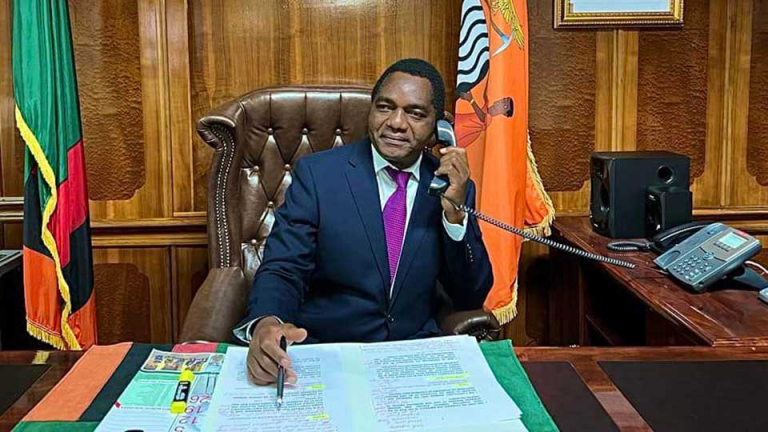
With four days remaining before Zambians cast ballots in a general election that will double as a referendum on one of Africa's most closely watched sovereign-debt turnarounds, President Hakainde Hichilema is seeking a second term against a hastily assembled opposition coalition, even as his government leans on costly emergency power imports to keep the lights on through the campaign's final stretch. The Aug. 13 vote for president, National Assembly, and local councils will test whether five years of austerity-driven debt restructuring have won Hichilema enough public patience to survive a newly reshaped electoral map, or whether economic fatigue among ordinary Zambians hands the opposition a legislative check on his agenda even if he wins the presidency outright.
Background
Hichilema, leader of the United Party for National Development, was elected in 2021 on a wave of frustration with the Patriotic Front government of Edgar Lungu, inheriting a country reeling from a 2020 sovereign default. Since taking office, his administration has focused on debt restructuring and energy-sector reform, working through roughly $13 billion in default-era debt and completing a $1.7 billion International Monetary Fund extended credit facility that concluded in January. Zambia, Africa's second-biggest copper producer, has drawn praise from international investors for the discipline of that recovery — a sentiment reflected in a rally in the country's local-currency bonds ahead of the vote.
But the macroeconomic turnaround has not fully translated into relief at the household level. Rising food costs and squeezed budgets have tested public patience, and the state utility ZESCO has been forced to rely on costly emergency power imports from regional neighbors to stave off blackouts that have run more than 20 hours a day at their worst. According to Ministry of Energy data, domestic generation has fallen well short of peak needs, and the price of plugging that gap is steep: roughly $50 million a month, at rates more than twice the cost of domestic hydropower, with ZESCO still selling electricity to consumers at heavily subsidized retail prices.
Key developments
Hichilema faces Brian Mundubile, a first-time presidential contender running under the National Reconciliation for Unity and Prosperity, a coalition of opposition parties assembled after the historic Patriotic Front splintered. Mundubile's running mate is Makebi Zulu. In all, 14 presidential candidates from 13 parties, plus one independent, are on the ballot, according to Zambian media tallies, alongside 969 National Assembly candidates and 437 mayoral and council-chair candidates.
The election is Zambia's first under a mixed-member majoritarian system enacted through 2025 constitutional changes. Under the new framework, 226 National Assembly members are elected by first-past-the-post in single-member constituencies, while 40 additional seats are allocated by proportional representation tied directly to the presidential vote — 20 reserved for women, 15 for youth, and five for candidates with disabilities — with up to 11 more members appointed by the president. The presidency itself is decided by a two-round system requiring more than 50% of valid votes to win outright in the first round.
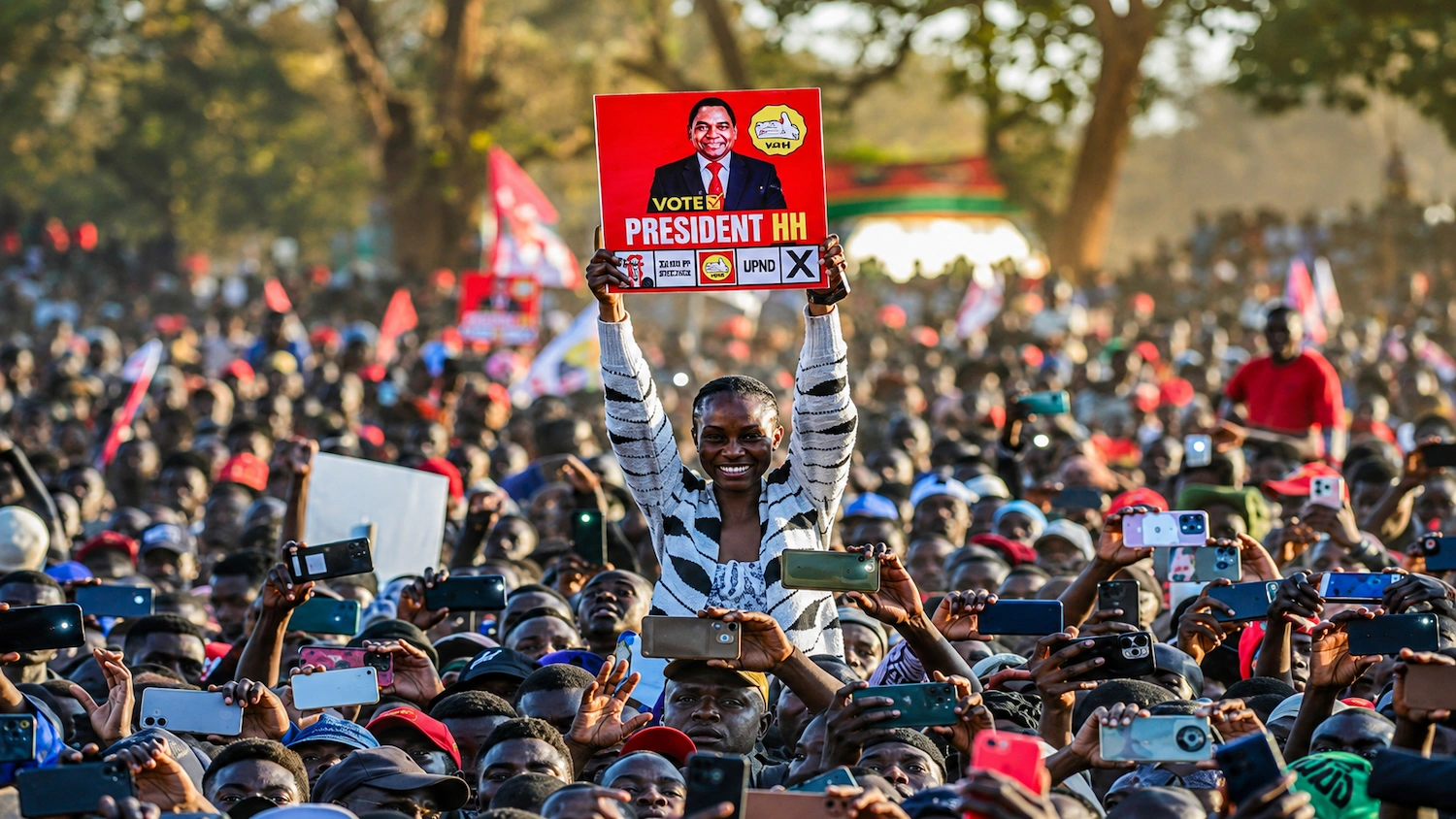
Hichilema has spent the campaign's closing weeks revisiting selectively chosen districts after becoming the first candidate to physically campaign in all ten provinces. He returned to Central Province for a fresh round of meetings, and with less than two weeks before the vote, his campaign caravan swept through Eastern Province — including the towns of Katete, Chadiza and Vubwi — in what strategists on both sides now regard as one of the race's defining battlegrounds. His UPND campaign has anchored its pitch on macroeconomic stability, pointing to universal free education and investor confidence as the foundation for long-term growth, and warning voters, in Hichilema's words, against "going back" to the instability of the Patriotic Front era.
Mundubile's coalition, by contrast, is campaigning on grassroots discontent over the cost of living and IMF-mandated austerity, casting itself as the defender of ordinary Zambians being "punished" by the ruling party's economic program. "The UPND thought the constitutional amendment was an advantage for them. They forgot the elections are about the people and they are being punished on the ground," Mundubile told Semafor in comments published July 29. PF aspirant Joseph Mudolo has separately argued that Zambia does not need further IMF borrowing at all, contending the country's mineral wealth could raise between $12 billion and $15 billion without new debt — a claim that underscores how central the debt question has become to the campaign, even among candidates who did not make the ballot as the PF's official nominee.
Energy Minister Makozo Chikote has defended the government's reliance on expensive imported power as a necessary bridge. "In the short to medium term, this gap is expected to narrow progressively as additional generation capacity comes on stream," he said, framing the outlay as protection for core economic drivers such as mining.
Analysis
Market analysts see little threat to Hichilema's hold on the presidency itself. "There was effectively no meaningful electoral opposition until a month ago, and this recent development seems unlikely to alter the electoral arithmetic, with our base case in line with recent reporting that the incumbent President remains relatively well-positioned for re-election," said Katie Kironde, an emerging-market and frontier strategist at Citibank in London. The more consequential fight, analysts say, is unfolding down-ballot. "The parliamentary election is where we're likely to see a shift," said Marisa Lourenco, an independent risk adviser based in Johannesburg. "If the ruling party fails to secure a majority, the presidency will need to negotiate with opposition parties, which could slow policy implementation."
That risk is compounded by Zambia's concurrent voting system, which allows split-ticket balloting, and by internal UPND fractures: according to the risk advisory firm Signal Risk, party members who missed out on official nomination are running as independents in multiple constituencies, meaning voters who back Hichilema at the top of the ticket may nonetheless choose a familiar local independent over the official UPND parliamentary nominee. Polling from the Zambia Elections Research Network shows only about a third of respondents plan to vote for their sitting member of parliament, with a similar share undecided or declining to state a preference — evidence, analysts say, of volatility at the constituency level even amid presidential-race stability.
The stakes of a fragmented legislature go beyond parliamentary arithmetic. Lusaka and the IMF are due to negotiate a successor extended credit facility, talks that have been placed on hold until after the vote. Whichever government emerges will have to reconcile ZESCO's expensive regional power purchases with the spending caps built into Zambia's post-default debt agreements — a balancing act Lourenco warns will be difficult regardless of who wins the presidency. "Importing power puts pressure on a budget that is already strained," she said. "The current spending level is difficult to sustain, and load-shedding is likely to return after the elections." John Mukum Mbaku, a senior fellow at the Brookings Institution, described the vote more broadly as "a referendum on how Zambians feel about the country's debt restructuring and the accompanying austerity measures."

Outlook
Zambia's Electoral Commission has said results from the Aug. 13 vote are expected to be announced by Aug. 17 at the earliest. The most immediate question is whether Hichilema clears the 50% threshold needed to avoid a runoff — a outcome most analysts consider likely given the fragmented opposition field. The more consequential question, for markets and for governance alike, is whether UPND retains a working majority in the reshaped National Assembly. A split outcome — a re-elected president facing a fragmented or opposition-leaning legislature — could complicate the very reforms that have won Zambia investor confidence, delay the next IMF program, and force Hichilema into the kind of legislative horse-trading his first term largely avoided. Whatever the composition of the new parliament, the government will confront ZESCO's power-import bill and the IMF's spending ceilings within weeks of the results being certified, ensuring the economic pressures that defined this campaign will not disappear once the ballots are counted.
Published By | News Editor