LOUISVILLE, Ky.
For more than fifty years, the Belvedere has occupied one of the best pieces of real estate in Louisville — a five-and-a-half-acre elevated plaza overlooking the Ohio River, built in the early 1970s as the city's grand civic gesture toward its waterfront. And for much of the last two decades, it has sat there doing very little, a vast expanse of concrete that longtime residents describe less as a park than as a very scenic parking lot for foot traffic. This week, Mayor Craig Greenberg and London-based Heatherwick Studio released the latest — and most detailed yet — vision for changing that.
A Design That's Already Been Redesigned
The renderings unveiled this month are not, technically, the first attempt at reimagining the Belvedere. Heatherwick Studio, working alongside local firm KNBA Architects, first floated concepts for the site back in January 2025 and again in September of that year, when the practice announced it would revise the plan after initial feedback. What's notable about the current iteration, according to reporting from Dezeen, is that the studio has explicitly adjusted the design to "restore buzz" to a site that Thomas Heatherwick himself has described as having become "barren and disconnected from the energy of the city around it."
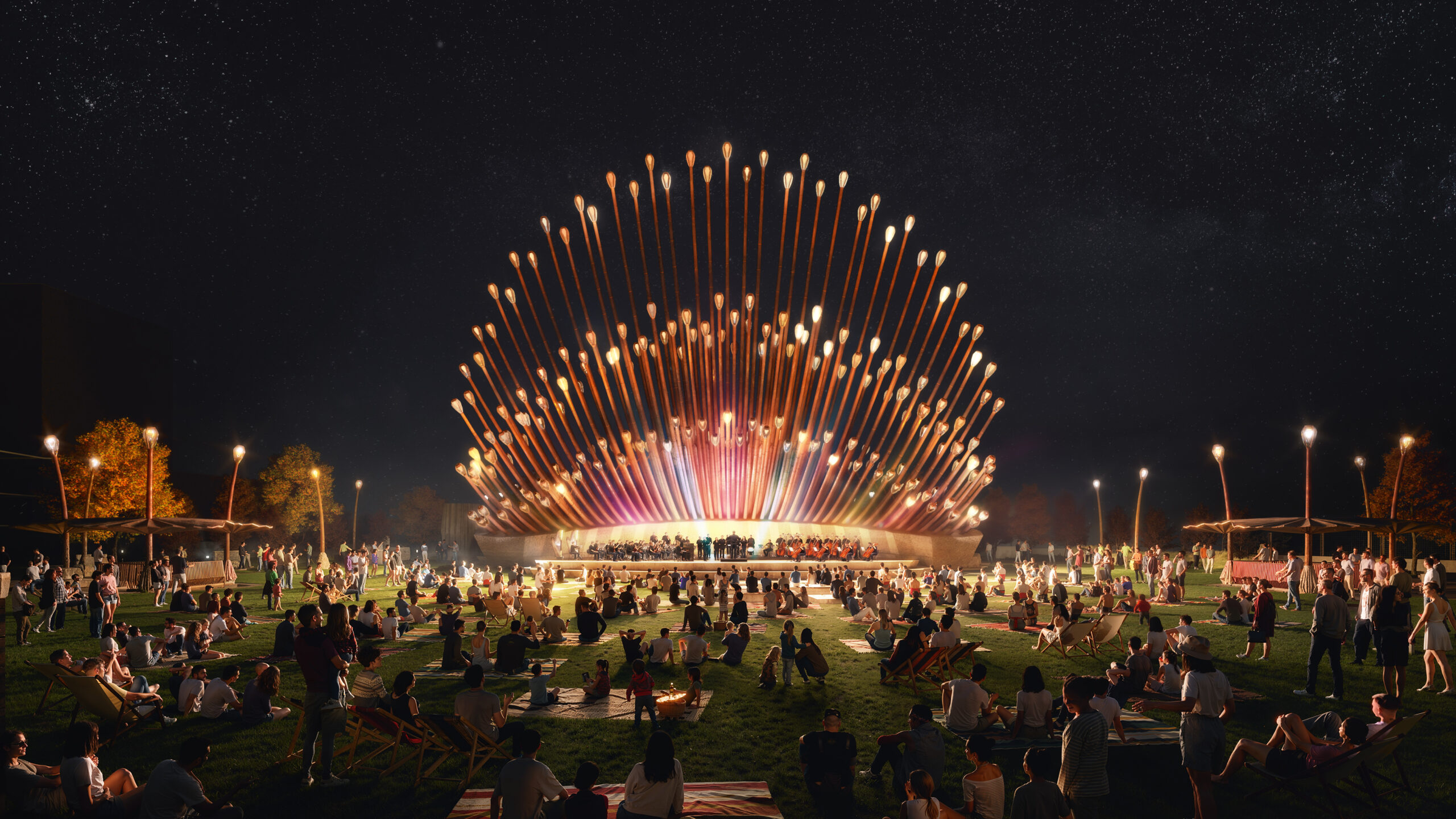
The centerpiece of the new scheme is what the design team is calling the Firefly Pavilion — a civic structure composed of dozens of slender steel rods, each topped with a glowing orb, arranged behind a large performance stage. The name is a direct reference to Kentucky's fireflies, and the effect the design team is chasing is closer to folklore than architecture: a field of small lights that, from a distance, might read as swarming insects rather than a fixed structure. Building Design's coverage of the unveiling described it as a "firefly-themed" overhaul intended to give the park a distinctive nighttime identity it has never really had.
Wrapping around the pavilion is a looping, textured pathway spanning roughly 365 meters — about 400 yards — that winds through newly introduced green space before connecting directly into Louisville's Riverwalk trail system. Renderings show small tented market stalls strung with string lights along portions of the route, suggesting a design brief less interested in monumental civic grandeur and more interested in the kind of everyday, low-stakes public life that makes a park feel used rather than merely visited.
Solving for "Wow" Within a Budget
Big civic ambitions have collided with fiscal reality at least once already in this project's history. According to WDRB's in-depth coverage, an earlier iteration of the plan had proposed a dramatic cantilevered overlook extending out toward the Ohio River — a literal "wow moment" meant to be the plaza's signature photo opportunity. That element has since been scaled back over cost concerns, illustrating a tension that runs through nearly every high-profile public redesign: the gap between what a starchitecture-caliber firm can imagine and what a mid-sized American city's budget can actually fund.
That budget, as it currently stands, is substantial but not unlimited. City officials are targeting a total construction cost of roughly $125 million, of which about $10 million has been secured to date. Mayor Greenberg has said he intends to formally request state funding when the Kentucky General Assembly convenes for its biennial budget session in January, while also pursuing philanthropic and private-sector contributions to close the remaining gap — a funding strategy that leaves the project's full financing, and by extension its final timeline, still very much in motion.

Why Heatherwick, and Why Now
Heatherwick Studio has built its reputation, for better and occasionally for worse, on designs that prioritize sculptural spectacle: London's now-shuttered Garden Bridge proposal, New York's much-debated Vessel at Hudson Yards, and Google's headquarters campuses among them. Bringing that sensibility to a mid-size Southern city's riverfront plaza is, in itself, a statement about how American cities are increasingly competing for the kind of "starchitecture" attention that used to be reserved for global capitals.
For Louisville specifically, the stakes extend beyond aesthetics. City officials have framed the Belvedere overhaul as central to a broader downtown revitalization push, aimed at drawing residents and visitors back to a riverfront corridor that has struggled, like many American downtowns, to fully recover its pre-pandemic foot traffic. A plaza built for civic pageantry in the 1970s — designed for occasional parades and formal gatherings rather than daily use — is, by design intent, being converted into something closer to what planners now call a "neighborhood backyard": a space meant to accommodate children's play and casual lingering as comfortably as festivals and performances.
Expert Perspective
"It's become barren and disconnected from the energy of the city around it," Heatherwick has said of the existing plaza, framing the firm's task less as building something new than as repairing a broken relationship between a landmark and the people who live around it. Architecture critics covering the reveal have generally been receptive to the revised concept, with Wallpaper describing the ambition as creating a "greener, more welcoming urban heart" for the city, even as some local commentary — reflected in WDRB's cost-focused reporting — has kept a more skeptical eye on whether the vision as rendered will survive contact with the city's actual funding constraints.
What This Means for Louisville — and Cities Like It
Construction is slated to begin this autumn, with completion projected for 2030 — a multi-year runway that will test both the durability of the design vision and the city's ability to secure the remaining roughly $115 million needed to build it as rendered. For readers outside Louisville, the project is a useful bellwether for a trend playing out in mid-size cities across the country: the recruitment of globally recognized design studios to reimagine underused civic infrastructure as a tool for downtown revival, even when — perhaps especially when — the budget realities force real compromises along the way.
Whether the Firefly Pavilion ends up looking anything like its renderings by 2030 remains an open question. But the ambition on display this week suggests Louisville, at minimum, is not interested in settling for another five decades of concrete.
Published By | Features Editor