Tripoli/New York
More than a decade after Libyans last cast a ballot in a national election, the country's long-divided political factions have signed a deal that commits them to holding presidential and parliamentary elections within two years under a single, unified executive authority — a breakthrough the United Nations Security Council formally welcomed this month as "an important step" toward reunifying a nation that has been split since the 2011 fall of Muammar Gaddafi. Yet even as diplomats hail the agreement as historic, the UN's own envoy is cautioning that the hardest part — turning a signed document into an actual vote — still lies ahead.
The deal, formally signed Aug. 30 at the headquarters of the UN Support Mission in Libya (UNSMIL) in Tripoli, caps five months of negotiations that began in Rome on April 29 and ground through seven subsequent rounds of talks in Tunis. It resolves, at least on paper, two disputes that had sunk every previous attempt to organize Libyan elections since 2021: how to ensure Libya's three historical regions — Tripolitania in the west, Cyrenaica in the east and Fezzan in the south — are fairly represented on the body overseeing the vote, and how to structure the relationship between the presidential and legislative races so that neither side feared the other would use one election to lock in permanent control.

What the agreement actually does
Negotiated through a format known as the "4+4 committee" — two representatives each from the Tripoli-based Government of National Unity (GNU), the High Council of State, the House of Representatives and the Libyan National Army (LNA) commanded by eastern strongman Khalifa Haftar — the agreement was initialed in draft form in Tunis on Aug. 20 before the formal signing 10 days later. It commits Libya to holding legislative and presidential elections within "a period not exceeding 24 months," overseen by a single executive authority rather than the competing administrations that have governed Tripoli and the east separately for years.
Among its more specific provisions: presidential candidates who hold dual nationality may run if they renounce their non-Libyan citizenship before taking the oath of office; military personnel are permitted both to stand as candidates and to vote, ending years of debate over whether Libya's armed factions should be excluded from electoral politics; and would-be presidents must collect 20,000 endorsements from registered voters nationwide to qualify for the ballot. The agreement also stipulates that a permanent constitution — Libya has operated for years under transitional legal arrangements — will be drafted and completed by the newly elected parliament, and that future legislative sessions will rotate among Tripoli, Benghazi and Sabha, a symbolic and practical nod to the country's three regions. Notably, the deal contains a built-in enforcement mechanism: if it is not formally approved within one month of signing, it automatically becomes a binding constitutional document backed by the UN Security Council, and an implementation framework is due to be finalized within that same one-month window.
The reconstituted High National Elections Commission will be chaired by Dhaou Ibrahim Attia, with Sana al-Lishani as his deputy — a leadership structure UNSMIL negotiators say was itself one of the thorniest points of the talks, given how much control over the electoral process, and therefore over the country's political future, rides on who runs the commission.
Who signed, and who is claiming credit
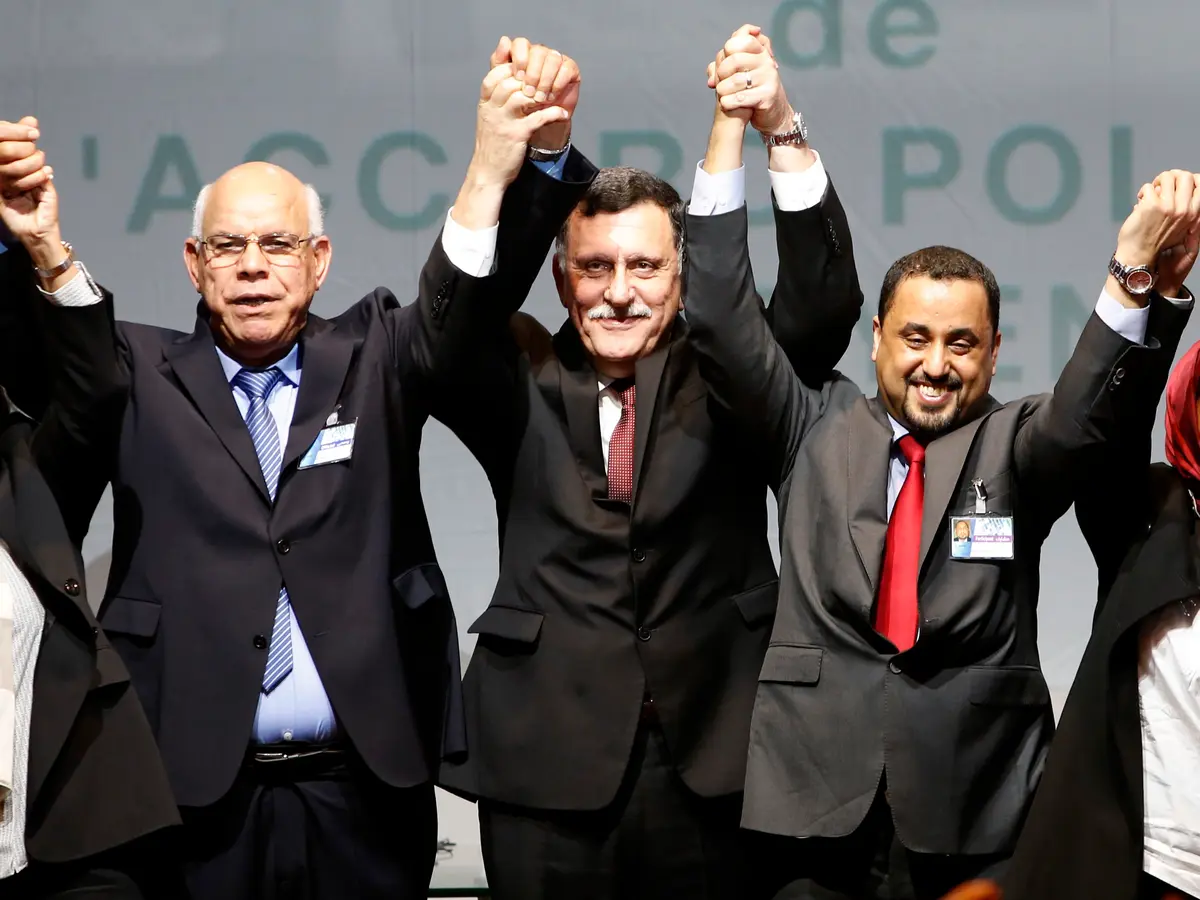
The signatories reflect Libya's fractured power structure: the House of Representatives, based in the east and aligned with Haftar, sent four delegates; the High Council of State, based in Tripoli and linked to the GNU, sent four of its own. Haftar's forces were represented by Shibani AbuHamoud, while Walid Ellafi, the GNU's State Minister of Political Affairs and Communications, signed on behalf of Prime Minister Abdulhamid al-Dbeibah's government.
Reaction from Libya's fractured leadership was, unusually, unified in its praise. Haftar, the 82-year-old commander who has dominated eastern Libya militarily for a decade and whose forces laid deadly siege to Tripoli as recently as 2019-2020, issued a statement saying the deal addressed "issues that have remained unresolved for years and have obstructed the will of Libyans to move toward holding presidential and parliamentary elections," and reaffirmed his "commitment to working toward the unification of the Libyan state." His son and deputy, Saddam Haftar, who has increasingly positioned himself as the next generation of the family's political-military dynasty, also endorsed the agreement. Prime Minister Dbeibah welcomed the signing, as did Osama Hammad, who heads the rival, eastern-based parallel government that has long contested Dbeibah's legitimacy in Tripoli.
The European Union called the deal "a meaningful milestone" and urged the parties to move swiftly to implementation — a pointed choice of words given Libya's history of signed agreements that were never carried out.
A UN envoy's note of caution
Hanna Tetteh, the UN Secretary-General's Special Representative for Libya and head of UNSMIL, has been the most consistent voice tempering the celebratory tone surrounding the deal. Briefing the Security Council this month, Tetteh described the agreement as "another important milestone" but warned that "trust remains fragile — not just between political actors, but among Libyan people themselves." That caveat matters: Libya's factions have signed political roadmaps before, including a 2021 framework that was supposed to produce elections in December of that year, only to see the vote collapse amid disputes over candidacy rules and control of state institutions — some of the very issues this new deal is designed to settle.
Tetteh also used her briefing to raise a less-discussed dimension of the electoral process: online harassment targeting women in Libyan public life, which she said was designed to "intimidate them and prevent them from exercising their rights." UNSMIL's own structured dialogue, conducted between December 2025 and June 2026 and drawing on consultations with 120 Libyans, found that women made up 35% of participants — a figure UN officials have cited as evidence of broadening civic engagement, even as they acknowledge the intimidation campaigns working against it.

Why this matters beyond Libya's borders
Libya's fracture has never been a purely domestic affair. Since 2011, the country has become a transit hub for migration toward Europe, a battleground for proxy competition involving Turkey, Russia, the United Arab Emirates, Egypt and others, and a source of instability that has rippled across the Sahel, where mercenary networks and arms flows tied to Libya's conflict have fed crises from Mali to Sudan. A genuinely unified Libyan government, controlling a single national army and a single set of oil revenues, would represent one of the more significant realignments in North African geopolitics in years — which is precisely why previous efforts to engineer one have drawn in, and repeatedly been undermined by, competing foreign patrons.
What to watch next
The one-month implementation clock is the immediate marker to watch: if the framework detailing how the elections commission will function, how candidate vetting will work and how security will be provided at polling sites is not finalized on schedule, it will be an early signal that the political will behind the August signing is softening. Beyond that, analysts and diplomats will be watching whether Haftar's endorsement translates into genuine cooperation from LNA-aligned officials on the ground in the east, whether Dbeibah's government follows through given that a unified executive authority could ultimately cost him his current position, and whether the promised 24-month timeline holds or becomes, like so many Libyan deadlines before it, aspirational rather than binding.
The question of foreign involvement also looms over implementation. Turkey has backed the Tripoli-based government militarily since 2019, while Russia, the United Arab Emirates and Egypt have at various points supported Haftar's forces in the east; any of those patrons could complicate a unification process that would, if successful, reduce their individual leverage over Libyan territory and resources. Oil revenue distribution is another unresolved flashpoint: Libya's National Oil Corporation has nominally remained unified even through years of political division, but a single executive authority would for the first time centralize control over both security forces and the oil wealth that funds them, raising the stakes of the transition considerably for factions on both sides who have benefited from the current fragmented arrangement.
For a country that has not held a national election in more than ten years, the gap between signing a roadmap and walking it remains the story's real center of gravity. Libyans who lived through the collapse of the 2021 electoral process — when candidacy disputes involving Gaddafi's son Saif al-Islam Gaddafi and Haftar himself contributed to the vote's indefinite postponement — are likely to withhold full confidence in the new framework until they see the elections commission functioning, candidate rules being applied without last-minute disputes, and, ultimately, a date on the calendar that does not slip.
Published By | News Editor