Written By |
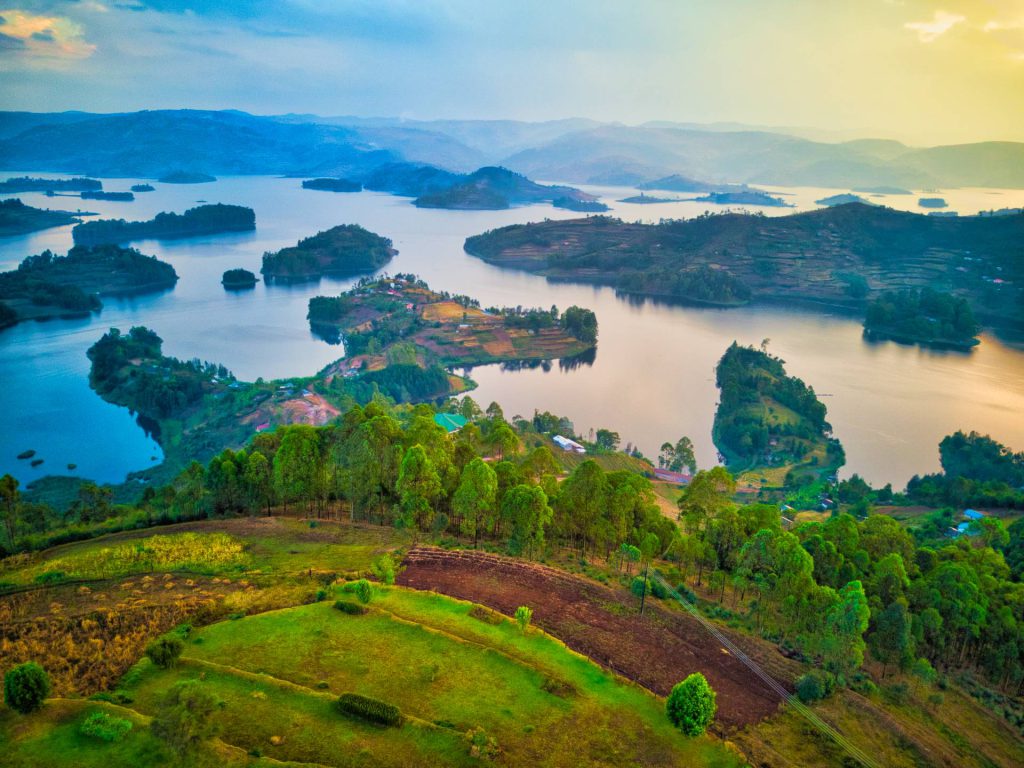
Bunyonyi means “place of little birds” in the local Rukiga language, and the name is earned
TOURISM
Before the sun clears the terraced ridges above Kabale, a dugout canoe slips from a muddy landing and the lake goes silent. Mist lifts off the water in slow threads. A pied kingfisher hovers, drops, rises. The paddler, who learned the stroke from his father, says nothing at all, and nothing needs saying. This is Lake Bunyonyi at six in the morning, and it is easy to see why travellers who come for gorillas so often stay for the water.
The Lake of Many Little Birds
Bunyonyi means “place of little birds” in the local Rukiga language, and the name is earned. Tucked in the far south-west of Uganda, about seven kilometres from Kabale town and a short hop from the Rwandan border, the lake sits at roughly 1,960 metres above sea level. Sources describe a surface area of around 46 square kilometres, a length of about 25 kilometres, and a winding, fjord-like shoreline pinched into dozens of fingers by the steep hills. Estimates of its depth run as high as 900 metres, a figure that circulates widely in travel literature though it deserves a measure of caution; what is certain is that the water drops away quickly close to shore, and that it is among the deepest in the country.
The lake is dotted with about 29 islands, each with its own story. Hillsides around it are stitched into terraces by Bakiga farmers growing sorghum, beans and potatoes, so that even the walk to a canoe landing is a lesson in highland agriculture. Locals and guides will tell you that the lake is free of bilharzia, hippos and crocodiles, which is why swimming here, unusually for Uganda, is a standard part of the itinerary rather than a dare.
Islands With Long Memories
Some of the islands are pure leisure. Bushara Island is favoured by birders and walkers, and Kyahugye Island offers a gentle wildlife experience with introduced impala and zebra, plus a zipline of roughly 300 metres that carries the brave from island to mainland. Others carry weight. Akampene, known as Punishment Island, is remembered in Bakiga oral history as the place where unmarried pregnant girls were once abandoned, a grim custom that guides recount with care and that is best visited with someone who can offer context. Bwama Island housed a leprosy hospital founded in 1921 by the missionary doctor Leonard Sharp, whose name lives on in neighbouring Njuyeera, or Sharp Island. Today Bwama operates as a health facility and a quiet reminder of the lake’s unexpected role in medical history.
What to Do on, Around and Above the Water
The signature activity is the dugout canoe. Early-morning paddles catch the mist and the birds; sunset trips suit couples and photographers. Operators describe hourly canoe hire in a broad range of roughly five to fifteen US dollars, and motorised boat cruises at about thirty to sixty dollars per boat, though prices vary by lodge and season and should be confirmed locally. Birdwatching is the lake’s other great draw: more than 200 species are reported, including grey crowned cranes, weavers, cormorants and kingfishers, with early boat rides and guided shore walks working best.
On land, trails climb through terraced slopes to viewpoints over the islands, and community walks introduce visitors to Bakiga farming life, with Batwa cultural experiences offered by some operators. Cyclists can link village routes along the shore, and a market day in Rutinda gives a window into local trade. Many travellers simply use Bunyonyi as a recovery stop after gorilla trekking in Bwindi or Mgahinga, which are both within a few hours’ drive.
Getting There and Planning Your Stay
By road, Bunyonyi lies roughly 10 to 12 hours from Kampala or Entebbe, about 489 kilometres via the Mbarara–Kabale highway, so many visitors break the journey at Lake Mburo or Mbarara. From Bwindi it is a two-to-three-hour drive, and from Kigali about the same via the Katuna border. Those short on time can fly to the Kisoro airstrip and drive about two hours. Accommodation spans every budget, from simple lakeside campsites and backpacker bandas at roughly ten to forty dollars per person per night, through mid-range lodges at about sixty to 150 dollars, to island retreats that can exceed 400 dollars. Typical lake-area names include Bunyonyi Overland Resort, Birds Nest Bunyonyi and Bunyonyi Safaris Resort.
Temperatures hover between about 16 and 25 degrees Celsius all year. June to August is the clearest and driest stretch, December to February is peak birding with comfortable days, and the rainy months of March to May and September to November bring slippery trails and quieter, cheaper stays, though mornings are often clear. Book a dawn canoe, ask your lodge about designated swimming spots, wear a life jacket if you are not a confident swimmer, and hire a guide for the historical islands. There is no general national-park entry fee for the lake itself; costs are charged by individual operators and lodges.
This Week in Ugandan Tourism
The most important story for Bunyonyi is the road. In early August 2026, Finance Minister Henry Musasizi convened an urgent meeting in Kampala on the troubled Kabale–Lake Bunyonyi and Kisoro–Mgahinga upgrading project, a roughly Shs112 billion programme awarded to Samcrete Egypt Engineers and Contractors and co-funded with the African Development Bank. The contractor had reportedly abandoned the Kabale–Bunyonyi section for about three months, and the works minister told Parliament that termination was under consideration. The package also includes ferry landing sites, roadside markets and an electricity extension to Bwama Island, so its fate matters well beyond tarmac. I could not find a newer update on the contract in this week’s coverage.
On 21 October, the Uganda Wildlife Authority met the Inter-Religious Council of Uganda in Kampala to discuss a draft memorandum of understanding on conservation, tourism and human–wildlife coexistence. UWA approved the draft in principle, with board approval and signing to follow, and recalled that 20 percent of gate revenue is shared with neighbouring communities, including about Shs9 billion set aside for communities around Murchison Falls National Park.
On 16 October, at the Uganda Marketers Society’s UMS Ignite event in Kampala, Uganda Tourism Board CEO Juliana Kagwa said the country is “at ground zero” in building its tourism brand and called for better access, including domestic air links, and more hospitality investment. Panellists urged Ugandans to travel their own country. The same coverage cited international arrivals up 19.7 percent in 2025 to about 1.64 million, and tourism receipts of US$1.7 billion in the 2025/26 financial year.
On 8 October, the Association of Uganda Tour Operators signed a memorandum of understanding with Mozambique’s travel agents’ association in Maputo, aiming to pair Bwindi gorilla trekking with Bazaruto Archipelago beach stays in combined itineraries. Reporting on the deal also put first-half 2026 arrivals at 739,815, up 3.7 percent year on year, a notably slower pace than 2025.
The Last Word
Bunyonyi rewards slowness. It is a place for the hour after the gorillas, for the paddle before breakfast, for the guide who points at a bare islet and tells you a story you will not forget. If the road upgrade is finally delivered, getting here will become easier. The mist, thankfully, will go on arriving on its own schedule.



