Written By | International News Agencies
The vendors say they are not going. The country's largest labour federation says the government is treating a symptom and calling it a disease.
HARARE
Zimbabwe's street vendors have until Wednesday to leave. On Sept. 9, according to a directive issued last week by Local Government and Public Works Minister Daniel Garwe, government ministries, departments and agencies will begin what the minister called a "comprehensive, zero-tolerance clean-up operation" across Harare and the wider Harare Metropolitan Province. Illegal vending structures, stalls and sites will be "completely disbanded." Municipal police will be stationed at cleared areas to prevent traders returning. The operation will then move systematically to every other city, town and urban settlement in the country.
The vendors say they are not going. The country's largest labour federation says the government is treating a symptom and calling it a disease. And the numbers underlying the dispute suggest that what the minister has framed as an urban-hygiene measure is in fact a confrontation with the sector that employs more Zimbabweans than any other.
What the Directive Says
Garwe's statement, issued in the first days of September, gave traders a seven-day grace period. "All vendors engaging in illegal street and night trading have until Wednesday, September 9, 2026, to immediately vacate these unauthorised sites and relocate to lawful, designated vending markets provided by the local authority," he said.
His justification rested on public order. Illegal vending, he said, had contributed to poor sanitation, blocked public pathways, disrupted formal businesses and increased congestion in the capital. "The current state of disorderliness on the streets is not tolerable," he said. "The conduct of illegal vendors has become a threat to the health and security of our nation, creating a home for drug and substance abuse, among other ills." He tied the operation to two government frameworks: National Development Strategy 2 and the Vision 2030 upper-middle-income-status target.
Garwe was careful to acknowledge the obvious. "Whilst the Government of the Republic of Zimbabwe acknowledges the existence of informal trading as a recognised avenue of livelihood, this, however, should be within the bounds of municipal by-laws and at legally designated marketplaces," he said. He instructed local authorities to facilitate the immediate registration and orderly placement of compliant traders into designated structures, and urged informal traders to use the window and comply voluntarily "to avoid loss of their merchandise."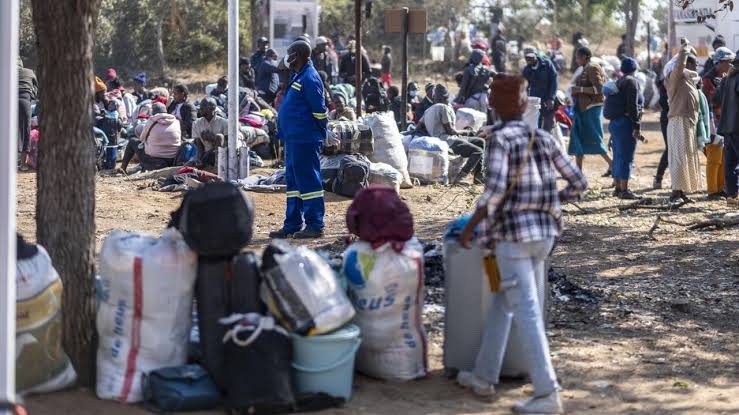
The Scale of the Problem the Directive Creates
Zimbabwe's informal economy is not a fringe. According to ZIMSTAT, the national statistics agency, about 1.36 million people are engaged in informal non-agricultural employment, accounting for 41.3 percent of total employment. Recent studies estimate that more than 30,000 street traders operate in Harare's central business district alone. During a previous registration exercise, the City of Harare registered more than 100,000 street vendors, each reportedly paying US$10.
That registration exercise is itself now contested. Vendors say it was not followed by the provision of adequate or suitable spaces from which to trade. Harare Mayor Jacob Mafume said in a recent interview with a local outlet that the city would investigate how much money the exercise collected and how the funds were used.
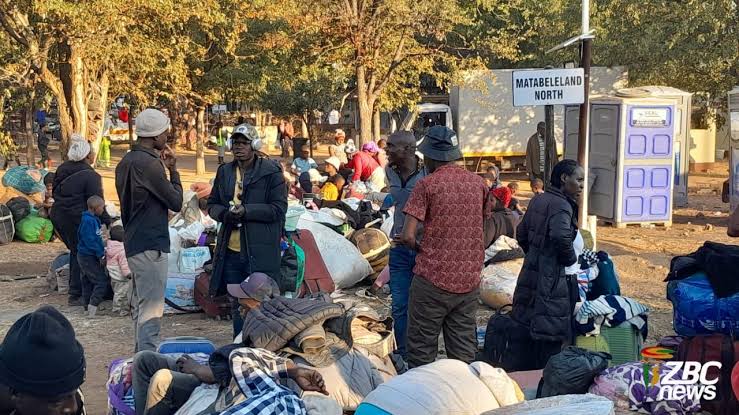
The population on the streets has also been growing for reasons unconnected to municipal by-laws. Thousands of Zimbabweans have returned from South Africa following xenophobic attacks there. Many of the returnees are unemployed, and some are understood to have joined the ranks of street vendors in Harare and other cities.
The Backlash
The Zimbabwe Congress of Trade Unions responded on Sept. 6 with a statement that shifted the argument from sanitation to economic policy. Secretary-General Tirivanhu Marimo rejected the premise that vendors are the problem.
"We reiterate that people who are into street vending are not into it for their liking but are being forced due to the unemployment levels largely blamed on bad economic policies," Marimo said. "Instead of harassing vendors, the government must first of all restore economic growth and create the promised millions of jobs and by doing so, all vendors will vanish overnight."
If that does not happen, he argued, the state should stop pretending the sector is temporary. "Without that the government and councils must accept the fact that the informal economy is here to stay and that it has become the biggest employer in the country and therefore it needs to be carefully treated."
Marimo called the directive heavy-handed and knee-jerk, said it was insensitive to people whose survival depends on street trading, and criticised the government for issuing an ultimatum without offering any alternative or permanent solution through local authorities. He also accused politicians across the spectrum of exploiting the sector. "During election seasons, these hypocrites have been encouraging people to go into 'self-help' projects, particularly vending, only [to] declare them an eyesore once elections are over," he said.
The Vendors Initiative for Social and Economic Transformation took a narrower line, accepting the state's responsibility for orderly urban environments but insisting the operation be conducted under an existing policy the government itself adopted. Executive Director Samuel Wadzai pointed to the National Informal Economy Formalisation Strategy, adopted in April 2026. "Formalisation cannot mean simply removing people from where they currently earn a living," Wadzai said. "It must create pathways for informal traders to transition into safer, more secure and sustainable forms of economic activity." He called for meaningful participation by traders in relocation decisions, adequate alternative trading spaces before any displacement, and protection against harassment and confiscation of goods during enforcement.
Precious Shumba, director of the Harare Residents Trust, described Garwe's statement as ill-thought-out and lacking evidence. "Vending is a symptom of a dysfunctional economy," he said, noting that people were on the streets because companies had closed and formal employment was scarce, including for university graduates. Disrupting their efforts to survive, he said, amounted to "cruelty of the highest order" and had no place in a democratic society. He cited World Bank findings from 2023 that high inflation, exchange rate distortions and a difficult business environment had raised the cost of doing business for the formal sector, contributing to the growth of informal activity.
The vendors themselves have been blunter. "The minister is insensitive. Our survival is in the streets. We will not go anywhere. There are no jobs in the industry. We have graduates at home," said Cephas Muchegwa, who has traded on Harare's streets for a decade. "So what can we do to survive?"
Analysis: An Operation With a Known Ending
Zimbabwe has run this operation before, and the outcome is a matter of record: previous attempts to remove vendors from Harare's streets have largely failed, with traders returning soon after enforcement ended. The reason is structural. A clean-up operation removes stalls; it does not remove the arithmetic that puts 1.36 million people into informal non-agricultural work. Unless the alternative sites exist, are commercially viable and are located where customers actually walk, clearance produces displacement followed by return — at the cost of confiscated stock and destroyed structures in the interval.
The politics are more interesting than the policy. ZANU-PF has drawn heavily on the informal sector at election time, a point Marimo made explicitly and one that constrains how far enforcement can go without generating durable resentment in urban constituencies the party already struggles to win. Set against that is a governing frame — NDS2 and Vision 2030 — that treats visible informality as evidence of failure rather than as an adaptation to it. Garwe's directive resolves that tension by asserting both things at once: informal trading is a legitimate livelihood, and it must disappear from where it currently occurs.
The existence of the National Informal Economy Formalisation Strategy, adopted only five months ago, sharpens the contradiction. VISET's argument is not that the government lacks a policy for the informal economy; it is that the government has one and is not using it. An enforcement operation launched without the relocation, consultation and protection provisions that strategy contemplates invites the conclusion that the strategy was a document rather than a plan.
Three things to watch this week. First, whether Sept. 9 produces actual demolitions in Harare's CBD or a quieter, phased enforcement — the difference between a confrontation and a negotiation. Second, whether vendors' organisations go to court; the gap between the formalisation strategy and the directive is the kind of gap Zimbabwean litigants have used before. Third, how far the operation travels. Garwe has promised a nationwide rollout, and Bulawayo, Mutare and Gweru have informal economies proportionally as significant as Harare's and local authorities with less capacity to absorb the displaced. A clearance that works in the capital and fails everywhere else would be its own kind of answer.



