Written By | International News Desk
The Doha round brought President Trump’s special envoys, Steve Witkoff and Jared Kushner, into the Qatari capital for a two-day diplomatic mission.
Daily World Politics
Four months after a devastating war that reshaped the Middle East, the United States and Iran are engaged in a wary, halting attempt at diplomacy — and this week that effort ran into some of its hardest limits. Negotiators from both sides concluded two days of indirect talks in Doha on Wednesday, mediated jointly by Qatar and Pakistan, aimed at giving substance to a memorandum of understanding meant to consolidate the ceasefire that ended the 2026 Iran war. Qatar reported “positive progress,” and both sides agreed to keep talking. But the central disputes — the fate of roughly $6 billion in frozen Iranian assets and control over the strategically vital Strait of Hormuz — remained unresolved, and the process is now set to pause as Iran embarks on days of funeral ceremonies for the supreme leader killed in the opening hours of the conflict.
Background
The talks are the diplomatic afterlife of a war that erupted on February 28, 2026, when U.S. and Israeli forces launched nearly 900 strikes in roughly twelve hours against Iranian missiles, air defences, military infrastructure and leadership. That opening barrage killed Supreme Leader Ali Khamenei along with dozens of senior officials, decapitating the Islamic Republic’s leadership in a single night. In the chaotic aftermath, Ali Larijani, a senior figure serving as secretary of the Supreme National Security Council, was widely seen as the de facto leader before Mojtaba Khamenei — the late supreme leader’s son, regarded as more hawkish than his father — was elevated to the position in early March. 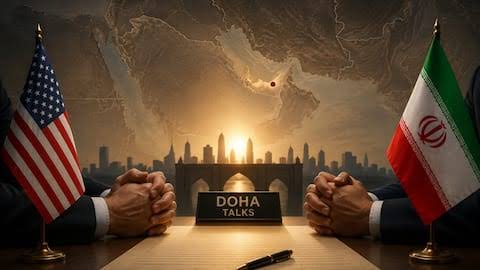
The fighting lasted more than five weeks and inflicted enormous damage across the region, killing thousands in Iran and Lebanon, causing dozens of deaths in Israel and the Gulf Arab states, and displacing millions, including more than a sixth of Lebanon’s population after the war reignited the Israel-Hezbollah conflict. On April 7-8, the United States and Iran agreed to a ceasefire that also encompassed Israel, and on June 17 Trump and Iranian President Masoud Pezeshkian signed a memorandum of understanding formally ending the war. That MOU is now the framework the Doha talks are attempting to implement — a fragile scaffolding repeatedly tested by incidents in the Strait of Hormuz and by deep mutual distrust.
Key Developments
The Doha round brought President Trump’s special envoys, Steve Witkoff and Jared Kushner, into the Qatari capital for a two-day diplomatic mission. Rather than meeting Iranian officials face to face, the American and Iranian delegations engaged in indirect, working-level talks, with Qatari and Pakistani mediators shuttling between them. Qatar said the separate meetings made “positive progress” on issues tied to the memorandum of understanding, and both sides agreed to continue. Yet Qatari officials were careful to note that no direct or high-level meetings had taken place, and that none were currently scheduled — a signal of how tentative the engagement remains.
At the heart of the negotiations sit two thorny issues. The first is the roughly $6 billion in Iranian assets held in Qatar, which Tehran has demanded be released as a priority. Washington has held firm: a U.S. administration official stated bluntly that “no frozen funds have been released, and no frozen funds will be released unless Iran meets the requirements outlined in the MOU,” adding that any future disbursements would be incremental and paid directly to vendors for humanitarian goods rather than handed to Tehran. The second issue is the Strait of Hormuz, the narrow chokepoint through which a large share of the world’s oil passes. Iran has sought recognition of its control over the strait, even as it issued fresh warnings about the waterway, while talks continue over its future management, with traffic reportedly continuing on the Omani side at below-normal levels.
The discussions also touched on implementing a ceasefire in Lebanon, reflecting how the war’s consequences radiate outward from the core U.S.-Iran relationship into Hezbollah, Israel and the broader region. Progress on any one strand is entangled with the others, and the mediators’ challenge is to keep a multi-front negotiation moving without allowing a single sticking point to collapse the whole edifice.
The choice of Qatar and Pakistan as joint mediators is itself telling. Qatar has spent years cultivating a role as a diplomatic broker between Washington and adversaries it does not formally recognize, hosting talks that range from Afghanistan to Gaza, and it holds the frozen Iranian assets at the center of this dispute. Pakistan, a nuclear-armed neighbor of Iran with its own complex ties to both Tehran and Washington, brings additional weight to the Iranian side of the ledger. That two intermediaries are required at all — rather than direct talks between American and Iranian officials — is a measure of how thoroughly the war shattered what little trust existed, and of how carefully each government must manage domestic constituencies that view any dealings with the other as capitulation. 
Reactions
Public signals from the two capitals have been sharply divergent, underscoring how far apart they remain even as they talk. President Trump struck an optimistic note, and Vice President JD Vance said the talks were “going well.” Iranian officials, by contrast, projected coldness: reporting from the talks suggested Tehran effectively rebuffed the overtures of Witkoff and Kushner and, crucially, did not secure the release of its frozen billions. Iran indicated it would open a “communication channel” on the MOU following the Doha meetings, a modest step that fell well short of the breakthrough Tehran had sought and that hardliners at home are likely to scrutinize.
Qatar and Pakistan, the mediators, have emphasized the incremental gains while managing expectations. By stressing “positive progress” and a commitment to continue, they sought to keep the diplomatic track alive without overstating its momentum. Their careful framing — acknowledging that no high-level meetings occurred — reflects the reality that both Washington and Tehran have domestic audiences skeptical of concessions, and that a premature claim of success could backfire. For the Gulf states hosting and facilitating the talks, the stakes are immediate: any renewed disruption in the Strait of Hormuz would threaten the region’s economic lifeline.
What’s Next
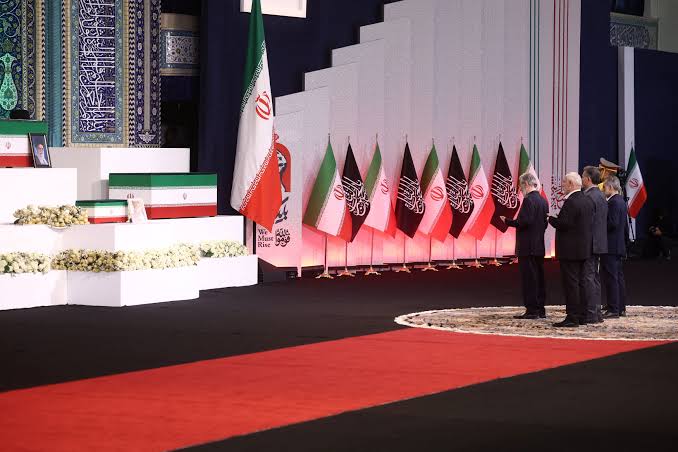
The most concrete near-term development is a pause. The next meeting is expected to be scheduled “at the earliest possible time” after Iran completes funeral processions for its former supreme leader. Those ceremonies for Ali Khamenei, whose coffin has been placed on public display, are scheduled to run between roughly July 4 and July 9 across multiple locations in Iran and Iraq, and are expected to temporarily delay the next phase of negotiations. The elaborate mourning — coming four months after Khamenei’s death in the opening strikes — is both a moment of national grief and a test of the new leadership’s authority under Mojtaba Khamenei and President Pezeshkian.
When talks resume, the same core questions will await: whether Washington will release any portion of the frozen $6 billion and under what conditions, and how the two sides can reach a workable understanding over the Strait of Hormuz. The U.S. insistence on tying any disbursement to strict compliance and vendor-direct humanitarian payments leaves little room for the quick cash infusion Tehran wants, while Iran’s demands over Hormuz touch on questions of sovereignty and prestige that its leadership can hardly abandon. The indirect format, reliant on mediators, makes progress slow and fragile.
The broader risk is that the diplomacy stalls long enough for the ceasefire itself to fray. The 2026 war demonstrated how quickly the region can tip into catastrophic violence, and the memorandum of understanding remains more a framework than a settled peace. For now, the fact that the two sides are still willing to talk — even at arm’s length, through intermediaries, over deep disagreements — is itself a fragile achievement. Whether it holds through Iran’s period of mourning and into the next round of negotiations will be among the most consequential questions in the Middle East this summer.



