Written By | Staff Writer
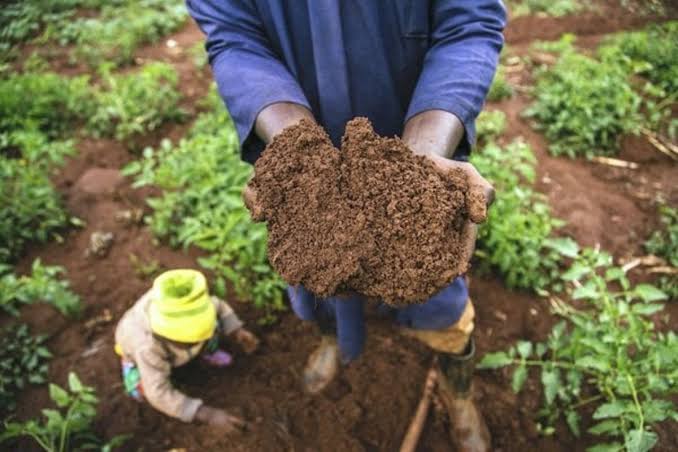
Agricultural economists and soil scientists have been warning about this imbalance for years, describing it in terms that go well beyond ordinary farm economics
Agriculture
In Ntungamo District this week, a truck rolled into the district headquarters carrying 900 bags of organic fertiliser, each weighing 50 kilogrammes. District officials, local leaders and a handful of farmers gathered to receive the consignment, delivered under a co-funding arrangement in which government covers 70 percent of the cost and farmers contribute the remaining 30 percent. It was, on its face, a modest local event — the kind of input-distribution ceremony that plays out in districts across Uganda every month. But it is also the visible tip of a much larger and more urgent story: Uganda's soils are being stripped of nutrients faster than they can be replenished, and the country is only now beginning to confront the scale of the problem.
The numbers are stark. Ugandan farmers apply, on average, somewhere between 1 and 2.4 kilogrammes of fertiliser per hectare each year, according to government and research estimates. Compare that to Kenya, where farmers apply roughly 32 kilogrammes per hectare, or Rwanda, at around 29 kilogrammes per hectare. The global average is approximately 140 kilogrammes per hectare. By nearly every measure, Uganda sits at the bottom of the fertiliser-use table, not just in Africa but worldwide.
That would be a manageable problem if Uganda's soils were naturally rich and slow to deplete. They are not. The country loses an estimated 80 kilogrammes of nutrients per hectare every year through topsoil erosion and the export of nutrients embedded in harvested crops — maize cobs, banana bunches, coffee cherries and cassava tubers that are grown, harvested and sold without anything being returned to the ground they came from. Farmers are replacing barely 1 to 1.5 kilogrammes of what is lost. The arithmetic is unforgiving: for every hectare of Ugandan farmland, roughly 78 kilogrammes of nutrients disappear into the ledger each year, drawn down like a bank account with no deposits.
Agricultural economists and soil scientists have been warning about this imbalance for years, describing it in terms that go well beyond ordinary farm economics. One recent commentary, published under the headline "The Thin Green Line," framed Uganda's soil depletion as nothing less than a national security threat — arguing that a country whose economy and food supply depend on smallholder agriculture cannot indefinitely mine its own soil without eventually facing a production collapse. Research from the International Food Policy Research Institute has placed Uganda among the countries with the highest soil nutrient depletion rates in the world, a distinction made worse by the fact that it simultaneously has one of the lowest rates of fertiliser replacement on the continent.
The reasons behind this gap are layered. Chemical fertiliser in Uganda has historically been expensive relative to farmers' incomes, at times costing as much as ten times international prices once transport, taxes and distribution margins are factored in. Critics have long pointed to Uganda's tax treatment of agricultural inputs as part of the problem, arguing that duties and value-added tax applied in the name of widening the country's tax base end up pricing smallholders out of the very inputs that would raise their yields and, ultimately, their taxable incomes. Poor rural road networks add further cost by the time a bag of fertiliser reaches a village input dealer. And for many subsistence farmers cultivating one or two acres, spending scarce cash on fertiliser competes directly with paying school fees or buying food — a trade-off that, in a bad season, is easily decided in favour of the immediate need.
It is against this backdrop that the government's organic fertiliser co-funding programme, administered through the Ministry of Agriculture, Animal Industry and Fisheries (MAAIF), takes on more significance than the modest scale of any single district delivery might suggest. Officials have set a target of scaling organic fertiliser production to 20 million bags annually by 2040 — a figure that, if achieved, would represent a fundamental shift in how Ugandan farmers manage soil fertility, moving away from a near-total reliance on natural fallow and manure towards a structured, subsidised input system.
In Ntungamo, the mechanics of the programme were laid out plainly by officials at the handover. Dr Yake Basulila, the district production officer, said the district intended to "increase manure consumption and usage" as a matter of policy, tying soil health directly to productivity gains. Deus Mutabatina, representing MAAIF at the event, confirmed the 2040 target and described the initiative as part of a broader strategy to lift both production and farmer incomes. The fertiliser itself was supplied under contract by DEI BioPharma, whose principal consultant, Kalembe Mbabazi, said the company had fulfilled its delivery obligation and noted that government was shifting away from direct free distribution of agricultural inputs — subsidised co-funding, rather than outright handouts, appears to be the new model, with subsidised seedlings expected to follow a similar structure.
That shift towards co-funding is not incidental. It reflects lessons — some learned the hard way — from previous Ugandan input-subsidy efforts, which researchers and government auditors have repeatedly found vulnerable to poor targeting, weak supervision and outright diversion. Studies of past programmes have documented cases where subsidised inputs were "round-tripped" — resold by beneficiaries back to agro-dealers or middlemen rather than used on farms — or where distribution favoured better-connected medium- and large-scale farmers over the smallholders the programmes were ostensibly designed to reach. Uganda's parallel struggle with counterfeit agricultural inputs compounds the risk: researchers describe a well-organised counterfeit market in which licensed companies, wholesalers, retailers and, in some cases, compromised enforcement officials all play a role in circulating fake or adulterated fertilisers and pesticides alongside genuine ones, making it harder for both farmers and regulators to be confident that subsidised inputs are what they claim to be.
Local leaders in Ntungamo were alive to this risk even as they welcomed the delivery. Vice Chairperson Asuman Kigongo thanked the government for the intervention but stressed the importance of getting distribution right, while Resident District Commissioner Miriam Kagaiga was blunt with the technical officers tasked with selecting beneficiaries: give the fertiliser to farmers who have "crops and gardens," she instructed, rather than to those who might simply hold onto it without applying it to their land. "For those who might not get it now, your turn is coming," she added — an acknowledgement that 900 bags, however welcome, will not come close to meeting district-wide demand, and that rationing decisions inevitably create winners and losers among farmers with equally genuine need.
The stakes of getting this right extend well beyond any single district. Soil fertility sits underneath almost every other ambition Uganda has articulated for its agricultural sector — from the government's push to grow horticulture exports to Shs7 trillion by 2030, to coffee's target of 20 million bags of production, to the broader agro-industrialisation agenda that has attracted billions of shillings in recent investment commitments from partners including the European Investment Bank, Egypt and China. None of those targets are achievable on soils that are steadily losing their productive capacity. A coffee tree or a banana mat planted in exhausted soil will underperform regardless of how much irrigation infrastructure, seed technology or export financing is layered on top of it.
There is also a climate dimension. As Uganda's Ministry of Water and Environment has warned of a warmer, drier June-to-August season this year, with below-normal rainfall stressing crops and water resources across much of the country, healthier soils — richer in organic matter and better able to retain moisture — offer one of the few practical buffers available to smallholder farmers who cannot afford irrigation. Organic fertiliser, in particular, is often credited by agronomists with improving soil structure and water-holding capacity in ways that chemical fertiliser alone does not, making the government's organic-first approach potentially well suited to a country facing more frequent dry spells.
For now, the test of the programme will be in its execution rather than its ambition. Whether the shift to co-funded organic fertiliser distribution can avoid the targeting failures and diversion problems that undermined earlier subsidy schemes will determine whether Uganda's 20-million-bag target by 2040 becomes a turning point for the country's soils — or another well-intentioned policy that struggles to outrun the scale of the problem it was designed to solve. In Ntungamo, at least, the first 900 bags have been delivered. Multiplying that effort across more than 140 other districts, year after year, for the next decade and a half, is the harder task that lies ahead.



