Written By | Fashion Experts

As CPHFW kicks off four days of Spring/Summer 2027 shows, Northern Europe’s largest fashion week is betting that stricter environmental standards — not looser ones — are what keeps it relevant.
Copenhagen, Denmark
While much of the global fashion industry has spent the past year quietly walking back sustainability commitments made in more optimistic times, Copenhagen Fashion Week is doing the opposite. CPHFW opens its Spring/Summer 2027 season today, running through August 7, with 36 shows and presentations staged across unconventional venues around the Danish capital — and, notably, under the strictest set of mandatory sustainability requirements the event has ever enforced.
The timing carries symbolic weight. This edition falls within Copenhagen Fashion Week’s 20th anniversary year, a milestone the organization has used not for a victory lap but for a recommitment to the environmental framework that has defined its identity since long before "sustainable fashion" became an industry buzzword. Every brand on the official SS27 schedule must meet binding requirements, including sourcing at least 50 percent sustainable materials, never destroying unsold stock, and producing runway sets that are entirely zero-waste — rules that go well beyond what most major fashion weeks require, or even encourage, of their participants.
Raising the Bar While Others Lower It
That stance puts Copenhagen at odds with a broader industry mood. Trade coverage in the run-up to this season has explicitly framed CPHFW’s posture as "defying the sustainability pullback" seen elsewhere, as several major fashion capitals and brands have scaled back public environmental commitments amid cost pressures, shifting consumer priorities and, in some cases, political backlash against corporate sustainability messaging. Copenhagen’s organizers have instead tightened their framework further, building on a first round of updated requirements introduced in 2024 and piloted over the past two seasons.
"With this strengthened and more stringent version, we continue to raise the bar — which is essential if we want to keep driving progress among our brands," said Cecilie Thorsmark, CEO of Copenhagen Fashion Week, of the updated standards. "As we look ahead, our focus remains on how fashion can continue to develop responsibly, creatively and collaboratively."
"With this strengthened and more stringent version, we continue to raise the bar — which is essential if we want to keep driving progress among our brands." — Cecilie Thorsmark, CEO, Copenhagen Fashion Week
Who’s on the Runway
The SS27 lineup blends CPHFW mainstays with a handful of notable debuts. Returning names include By Malene Birger, Stine Goya, Mfpen, Alectra Rothschild/Masculina and Marimekko, brands that have helped define what industry press has long shorthanded as "Nordic cool" — a design language built on relaxed tailoring, functional layering and a materials-first sensibility that maps naturally onto the week’s sustainability mandates rather than fighting against them.
Joining them on the official schedule for the first time are Almada Label and Yours Truly, the label from designer Peter Jensen, both stepping into CPHFW’s formal show calendar for the coming season. The most closely watched newcomer, however, is not Scandinavian at all: New York-based label Collina Strada will present a one-off runway show through a newly introduced International Guest Slot, supported by The Climate Pledge, marking one of the clearest signals yet that Copenhagen’s organizers see their sustainability framework as an export model rather than a regional quirk.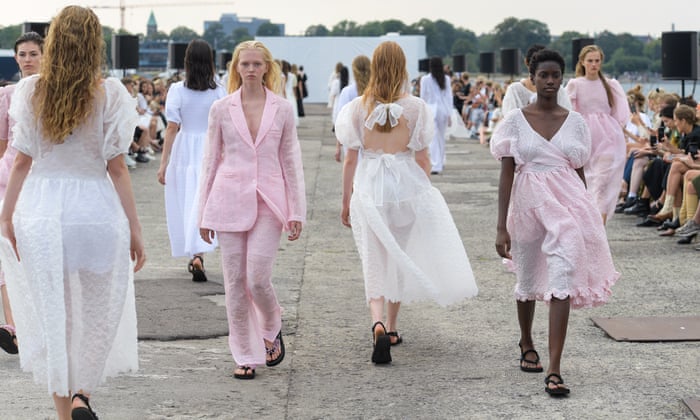
A Model Under Pressure — and Still Growing
Copenhagen Fashion Week’s rise from a mid-size regional showcase to a genuine fixture on the global fashion calendar has been gradual but steady over its two decades, built in large part on a reputation for being more accessible, less exclusionary and more design-forward than the traditional "Big Four" weeks in New York, London, Milan and Paris. That reputation has made it an attractive testing ground for brands and buyers looking for something distinct from the increasingly homogenized aesthetic that critics say has crept into larger fashion capitals.
Enforcing sustainability requirements at scale is not without friction, however. Smaller and independent labels have previously voiced concerns, echoed in trade press over the past several seasons, that compliance costs — sourcing verified sustainable materials, redesigning production timelines to avoid overstock, building zero-waste sets — fall disproportionately hard on brands without the resources of larger houses. CPHFW’s organizers have responded by framing the requirements as a graduated, multi-year process rather than an overnight mandate, with support resources built into the qualification process for brands applying to the official schedule.
What This Means for Shoppers and the Industry
For readers who follow fashion mainly through what eventually lands on store shelves, Copenhagen’s approach is worth watching less for the runway spectacle than for what it signals about where supply chains may be headed. As other major fashion weeks continue to debate whether sustainability commitments are commercially viable, CPHFW is functioning as a real-world test case at meaningful scale — one where consumer-facing brands are proving, season after season, that binding environmental standards and creative ambition are not mutually exclusive.
Whether that model spreads meaningfully beyond Denmark remains an open question the industry will be watching closely over the next several seasons, particularly as Collina Strada’s guest appearance tests whether an American label can absorb Copenhagen’s standards and bring elements of them home. For now, as the SS27 shows unfold across the Danish capital this week, Copenhagen Fashion Week is making its most direct statement yet: two decades in, sustainability is not a phase the event is prepared to be talked out of.



