Written By | Staff Writer

Banana Bunchy Top Disease (BBTD), a viral infection with no cure, and it is spreading steadily through a region that grows more than two-thirds of Uganda's entire banana crop
Agriculture
In the rolling banana gardens of Bwera, Isango, Karambi, Nyakiyumbu and Kitholhu sub-counties in Kasese District, a slow-motion crisis is unfolding one stunted plant at a time. Farmers describe watching healthy matooke stools — some planted decades ago — collapse into tangled, choked clumps of narrow, yellow-edged leaves that never again produce a usable bunch. The culprit is Banana Bunchy Top Disease (BBTD), a viral infection with no cure, and it is spreading steadily through a region that grows more than two-thirds of Uganda's entire banana crop.
The disease was first confirmed in Uganda around 2020, but it is only in the past two years that its economic toll has become impossible to ignore. The Ministry of Agriculture, Animal Industry and Fisheries (MAAIF) has publicly flagged outbreaks across the West Nile, Rwenzori and Tooro regions, and researchers tracking its spread have since documented new infections reaching further into Uganda's Ankole sub-region — including Mbarara, Sheema, Rwampara, Isingiro, Kazo, Mitooma and Ibanda districts, according to survey data cited by international crop-health researchers. That geographic spread matters enormously: Uganda is among the world's largest banana producers per capita, and matooke — steamed green banana — is not a cash crop grown for export so much as the literal staple food and cultural anchor of tens of millions of Ugandans, particularly across the western and central regions.
What the disease does
Banana Bunchy Top Virus produces a distinctive and devastating set of symptoms. Infected plants become severely stunted, their leaves narrow and crowd together into a "bunchy," rosette-like cluster at the top of a shortened stem — the appearance that gives the disease its name. Leaf margins turn chlorotic, or pale yellow, and dark green streaks appear along the petioles and midribs, a diagnostic sign that extension workers are now being trained to spot early. Critically, infected plants rarely fruit at all, and when they do, the bunches that form are stunted, twisted and commercially worthless. Once a stool is infected, there is no treatment that restores it to productivity; the only recognised control measure is uprooting and destroying the plant before the virus, which is spread by a small sap-sucking insect called the banana aphid as well as through infected planting material, can move to neighbouring stools.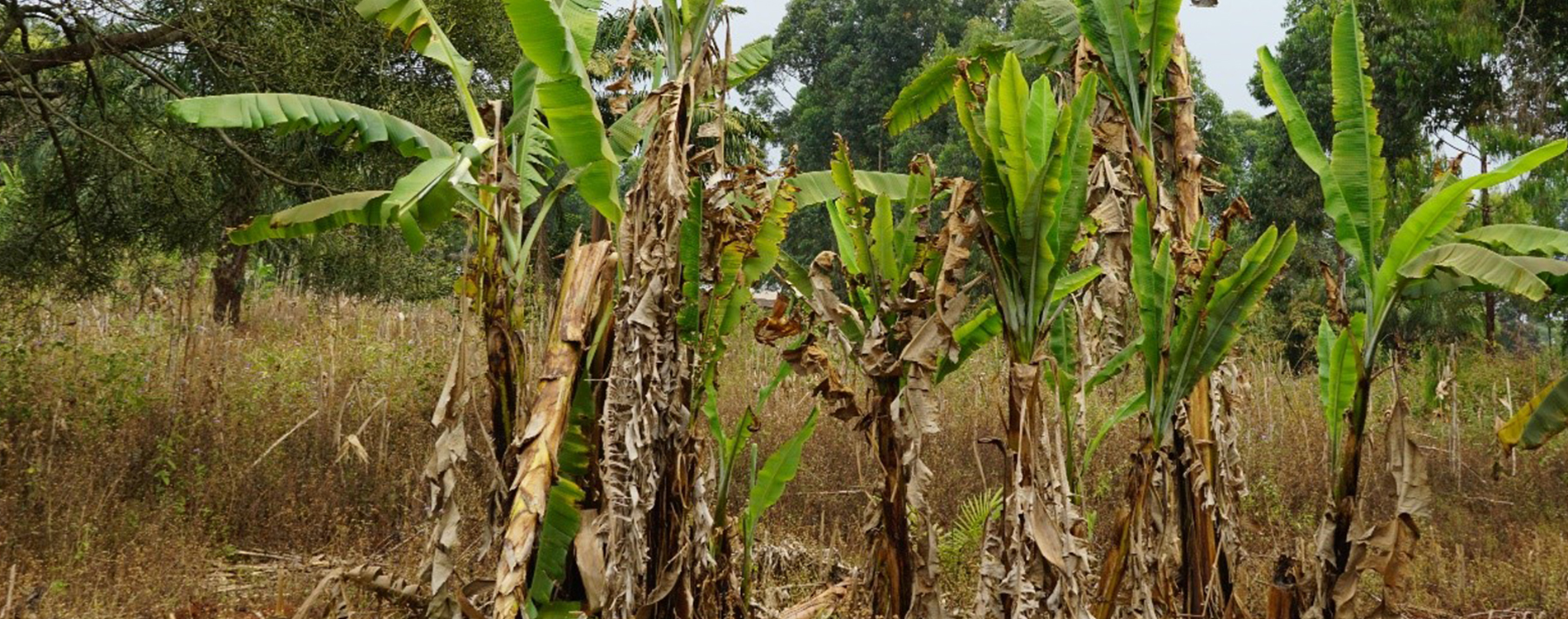
That last point — transmission through planting material — is a major part of why the disease has proven so difficult to contain. Smallholder farmers routinely propagate new banana gardens by transplanting suckers taken from existing plants, often shared or sold informally between neighbouring farms and even across district and national borders. Investigators suspect the current Ugandan outbreak entered from the Democratic Republic of Congo and Rwanda, both of which have also battled the disease, and the same informal seed-sharing networks that have sustained banana farming in the region for generations are now the primary vector carrying the virus deeper into the country's most productive banana districts.
Farmers describe collapsing incomes
The human cost is stark and immediate. Anatos Bwambale, a farmer in Karambi Sub-County in Kasese, told local reporters he was earning roughly 600,000 shillings a month from his plantation as recently as 2018, before the disease reached his garden. His income from the same plot has since fallen to around 20,000 shillings a month — a collapse of more than 96 percent. Other farmers in the district describe similar trajectories: gardens that once fed their households and paid school fees now produce little more than diseased, unsellable stems. Mbambu Deniza, another affected farmer, said her family ran out of food entirely after a half-acre plantation was completely destroyed.
Moris Mohindo, an agricultural extension worker covering Karambi and Ihandiro sub-counties, said the disease poses a direct threat to food security in the area, and that while officials are advising farmers to uproot and destroy infected plantations as the only viable containment measure, many farmers resist doing so — understandably reluctant to sacrifice a garden that, however diminished, still represents years of accumulated household investment and their most immediate source of food. That resistance, extension workers warn, allows infected stools to keep serving as a source of new infections for surrounding farms, undermining containment efforts even where they are attempted.
A coordinated but uneven response
Uganda is not fighting the outbreak alone or without institutional backing. MAAIF, the National Agricultural Research Organisation (NARO), the International Institute of Tropical Agriculture (IITA) and the Association for Strengthening Agricultural Research in Eastern and Central Africa (ASARECA) have jointly run farmer sensitisation campaigns, including a study tour in Kasese District that brought affected farmers together with researchers to review surveillance and control techniques. The response strategy leans on three pillars: plant quarantine and restrictions on moving planting material out of affected zones, aphid control to slow the vector responsible for field-to-field spread, and public awareness campaigns aimed at persuading farmers to remove infected stools quickly rather than nursing them along.
Uganda has also begun investing in more modern detection tools. A digital surveillance training programme reported in late 2025 aims to help plant health inspectors identify and map invasive pests and diseases — including BBTD — more quickly than traditional field reporting allows, part of a broader push to modernise Uganda's phytosanitary systems that has also touched the coffee sector's export compliance work this year. Joab Tugume, a senior agriculture inspector for quarantine and import regulation at MAAIF, has said the ministry is actively raising awareness about the disease's spread and the control measures farmers need to adopt.
Even so, the fight remains fundamentally under-resourced relative to the scale of the threat. Extension coverage in rural Uganda is thin, and farmers in the hardest-hit sub-counties say they still lack reliable access to certified, disease-free planting material — tissue-culture plantlets produced in sterile laboratory conditions are far less likely to carry the virus than field-propagated suckers, but they are more expensive and not widely available to smallholders. A regional project backed by the UN Industrial Development Organisation has supplied tissue-culture plantlets to farmers across eight western districts, including several now grappling with BBTD, but such interventions remain a fraction of what would be needed to re-plant the region's banana gardens with clean stock at scale.
Why it matters beyond the farm gate
The stakes extend well past individual households. Uganda's western region, according to national statistics agency figures, produces roughly 68 percent of the country's total banana output, and matooke remains one of the most important sources of both calories and cash income for rural communities in that part of the country — grown on small plots alongside coffee, beans and other food crops rather than on the large plantations associated with export bananas elsewhere in the world. A sustained, uncontrolled spread of BBTD through this region would represent not just a crop-disease problem but a food security and rural poverty problem, compounding a set of pressures — including the recurring banana bacterial (Xanthomonas) wilt that has never fully disappeared from the same districts — that already strain the resilience of west Uganda's farming households.
Agricultural economists note that the region has weathered banana disease shocks before, most notably the Xanthomonas wilt epidemic of the 2000s, which took years of coordinated public health messaging and replanting support to bring under control without ever being fully eradicated. BBTD's trajectory so far — quiet initial detection, gradual district-by-district spread, and a scramble to scale up surveillance and farmer awareness after the fact — echoes that earlier crisis closely enough that researchers and extension officers are urging a faster, better-funded response this time, before matooke output and prices in Uganda's markets feel the disease's full weight.