Written By | International News Agencies
"Civil society groups in Tunisia play a key role in holding power to account, delivering essential services, and advocating for people's human rights"
TUNIS
Fifteen years after Tunisians toppled Zine El Abidine Ben Ali and built what became the Arab world's most crowded landscape of independent associations, Human Rights Watch said Wednesday that the machinery of that civic life has been largely dismantled — not by a single decree, but by a slow accumulation of prosecutions, tax investigations, frozen bank accounts and administrative suspensions that has left surviving groups operating, in the words of one of the report's interviewees, on borrowed time.
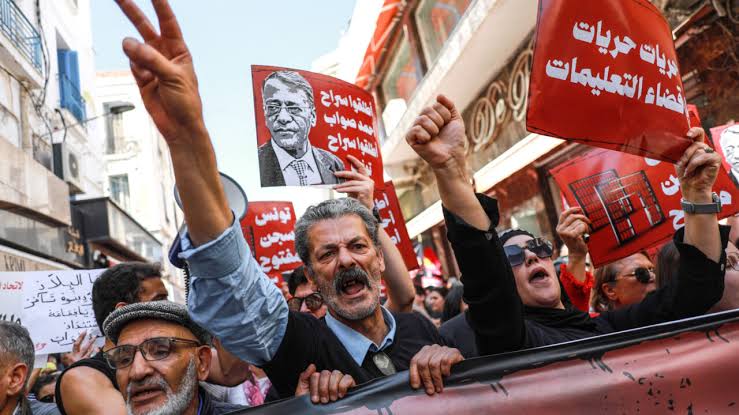
The 49-page report, titled "'We Are Living on Borrowed Time': Repression of Civil Society in Tunisia," documents what the organization describes as a systematic campaign against local and international nongovernmental groups, their staff and their affiliates since 2024. Its release lands at a politically charged moment: antigovernment protests have run through Tunisian cities for a second consecutive month, driven as much by power cuts, water shortages and the price of basic goods as by the constitutional question of how President Kais Saied governs.
"Civil society groups in Tunisia play a key role in holding power to account, delivering essential services, and advocating for people's human rights," said Bassam Khawaja, deputy Middle East and North Africa director at Human Rights Watch. "It is clear that the authorities are abusing every tool at their disposal to close the space for civil society in Tunisia and shut these organizations down."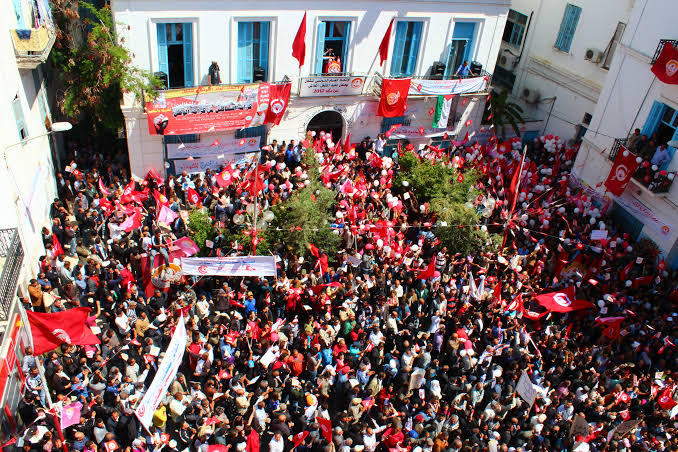
The numbers behind the claim
The report's central finding is cumulative rather than dramatic. Human Rights Watch says authorities have prosecuted at least 47 people connected to nongovernmental organizations, and have held at least 10 people in preventive detention for longer than 14 months — beyond the maximum period permitted under Tunisian law. Following trials in 2025 and 2026, at least 14 people connected to civil society have been convicted and sentenced to prison.
The most prominent of those is Saadia Mosbah, the president of the antiracism association Mnemty and one of Tunisia's best-known campaigners against discrimination toward Black Tunisians and sub-Saharan migrants. She was sentenced on March 19, 2026, to eight years in prison and a heavy fine on what Human Rights Watch characterizes as abusive charges of financial crimes. Five employees of organizations assisting asylum seekers have also been convicted on charges tied to work that fell within the mandates of their legally registered associations, the report says. Those organizations have since ceased operating.
The prosecutions rest, according to the report, on two legal instruments that were not written for this purpose: laws criminalizing assistance to foreigners with irregular immigration status, and Tunisia's 2015 counterterrorism and money-laundering law.
Finance as a pressure point
Alongside the criminal cases runs a quieter track. At the end of 2024, shortly before the presidential election, the Tax Evasion Investigation and Prevention Brigade notified at least a dozen associations that they were under investigation. Among them were the regional office of Amnesty International and the domestic anti-corruption watchdog I Watch. Human Rights Watch says the investigations imposed a heavy administrative and operational burden and resulted in the freezing of at least two associations' bank accounts.
Private banks have added a further layer of constraint, according to the report, by revoking associations' access to hard-currency or convertible-dinar accounts, blocking or returning foreign funds sent to Tunisian accounts, or closing accounts outright. For organizations whose funding is largely international, the effect is straightforward: money that cannot be received cannot be spent on salaries, legal defense or programs.
The organization argues that the breadth of these financial and criminal inquiries — spread across a wide cross-section of the sector rather than concentrated on a few groups — raises serious concerns that the processes are being weaponized to intimidate.
Suspension by administrative fiat
The third instrument is Decree-Law 2011-88 on associations, one of the signature liberalizing texts of the post-revolution period, which the authorities have used to suspend organizations en masse. Human Rights Watch identified at least 20 suspended civil society associations across two waves — from July to October 2025, and again from April to May 2026 — while cautioning that the exact number cannot be established without official data.
The suspensions were marked by procedural irregularities, the report says. Some associations never received the formal warnings the law requires, which would have allowed them to respond to or remedy the alleged violations. Others attempted to respond and received no reply. Lawyers supporting suspended groups told Human Rights Watch that officials dismissed appeals from approximately 30 associations. Once appeals are exhausted, the groups face dissolution. Two are already in dissolution proceedings: Al Khatt, which publishes the independent investigative outlet Inkyfada, and Mosbah's Mnemty.
Because the judiciary orders the suspensions, the identity of the judiciary matters. Human Rights Watch notes that the courts have been under executive control since 2022, when Saied took expansive measures against judicial independence — a point that turns the suspension process from an adversarial procedure into something closer to an administrative one.
What activists describe
The report's statistics are matched by accounts of self-censorship that arrives before any official action does.
"Today, an activist or anyone interested in public affairs in Tunisia thinks twice before speaking, writing or organising an activity," Rabie Kacem, a member of the Nafas civic collective, told Al Jazeera. "We are talking about an environment where civic and human rights work itself has become linked to the possibility of being prosecuted, defamed or pressured."
Journalists describe a parallel narrowing. Noureddine Ahmed, a photojournalist and president of the photojournalists committee within Tunisia's National Journalists Union, said reporters are increasingly stopped in the street, asked for professional identification or permits before speaking to citizens, and sometimes taken to police stations for questioning; in some cases equipment has been damaged or confiscated. He estimated that the number of working photojournalists has fallen by about half, as some lost work and some foreign outlets became less willing to take responsibility for local correspondents facing the risk of arrest. Migration coverage, he said, has become particularly sensitive. "There is no freedom of the press in Tunisia now," Ahmed said.
Wissem Sghaier, spokesperson for the Al-Jomhouri Party, framed the prosecutions as a symptom of a structural problem rather than a discrete policy. The concentration of political decision-making in Saied's hands, he told Al Jazeera, has weakened the separation of powers and allowed state institutions to be used to enforce political decisions. "When there is an environment characterised by attacks on freedoms, arrests, persecution and targeting every different voice, it is normal that some voices do not want to put themselves in prison," he said.
How Tunisia got here
The trajectory is well documented. Saied, a 68-year-old independent and former constitutional law professor who helped advise on the drafting of the 2014 constitution, was elected in 2019 on an anti-corruption platform, running a campaign that refused donations and relied on volunteers. He described his victory at the time as "like a revolution."
On July 25, 2021, he dismissed the government and suspended parliament, later assuming rule by decree and dissolving parliament in 2022. Since 2022, according to Human Rights Watch, he has publicly portrayed civil society and NGOs as a threat to national sovereignty. In February 2023 he said the presence of sub-Saharan refugees and migrants was part of a "criminal plan" to change Tunisia's demographic composition, describing it as a form of "occupation" — remarks that preceded the wave of arrests of migrant-aid and antiracism workers between May and December 2024.
Saied and his government have consistently defended these measures as necessary to fight corruption and to protect Tunisia from what they describe as conspiracies and destabilization attempts, and have rejected accusations of authoritarianism.
The economic backdrop
The crackdown is unfolding against real material strain. Tunisia's inflation rate stands at 5.2 percent, according to the World Bank, and Saied's government has adopted cost-saving measures including a halt to public-sector hiring and reduced imports. Public services have deteriorated, with shortages of some basic goods and medicines.
Hundreds of protesters marched in Tunis on Aug. 20, rejecting what they called "one-man rule" and "a slide towards dictatorship" and demanding the release of jailed opposition figures, activists and journalists. That demonstration followed a July 25 protest timed to the fifth anniversary of Saied's 2021 intervention. Separate protests have broken out across the country over water and electricity cuts and environmental grievances — a sign that public anger is broadening beyond the constitutional dispute into the texture of daily life.
What to watch
Two legislative texts remain the sector's central medium-term threat. A bill leaked in early 2022 and another submitted to parliament in October 2023 would give the government substantial control over the establishment, activities, operations and funding of independent groups. Neither has been enacted; Human Rights Watch has urged parliament to withdraw both.
The nearer-term test is the dissolution docket. Al Khatt and Mnemty are the first cases to reach that stage, and their outcomes will indicate whether suspension is a pressure tactic or a route to permanent closure — and whether the roughly 30 dismissed appeals represent the end of the domestic legal road.
The third variable is external. Human Rights Watch called on the European Union and its member states to press Tunis privately and publicly to release detained NGO workers and overturn convictions. Brussels has substantial leverage through migration cooperation and financial support, and has been reluctant to use it. Tunisia is a state party to the International Covenant on Civil and Political Rights and the African Charter on Human and Peoples' Rights, both of which guarantee freedom of association, assembly and expression, protection from arbitrary detention and the right to a fair trial.
"By dismantling the space for civil society, the authorities are trying to ensure no one is left to hold them accountable," Khawaja said.



