Written By | Fashion and Design Desk
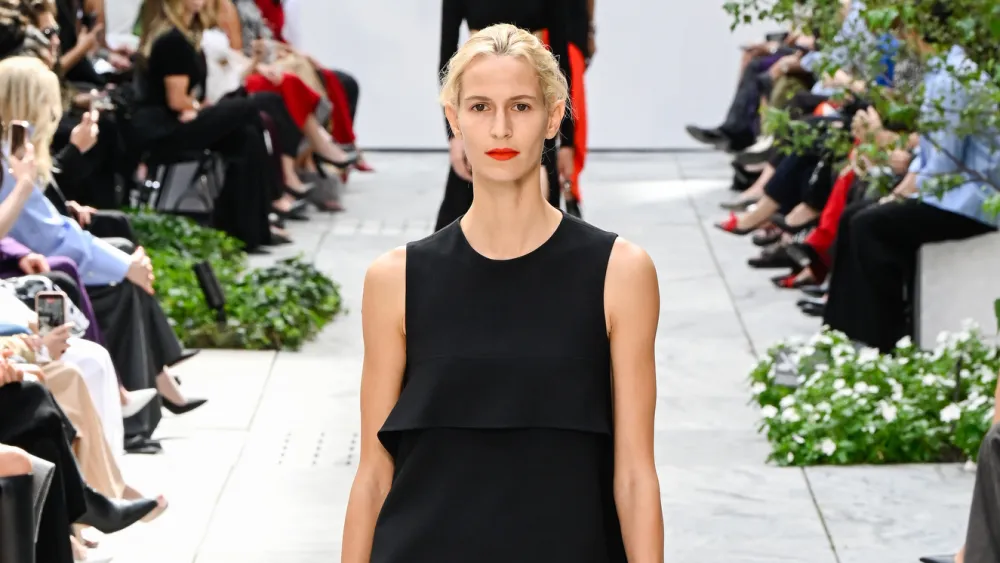
Michael Kors staged his Spring 2027 Collection show in the Museum of Modern Art's sculpture garden
NEW YORK
There is a risk in showing clothes inside a museum, and everyone in fashion knows what it is. Put a dress next to a Calder and the dress usually loses. It becomes a costume in a room designed for permanence, and the comparison it invites is one it cannot win.
Michael Kors staged his Spring 2027 Collection show in the Museum of Modern Art's sculpture garden on Thursday morning and took the risk on purpose. He called the collection "the fine art of fashion." What he showed, over roughly fifteen minutes on a runway threaded between some of the most looked-at objects in New York, was the narrowest, most deliberately drawn silhouette of the season — and an argument that American sportswear has always been a modernist project, whether or not it hangs in this building.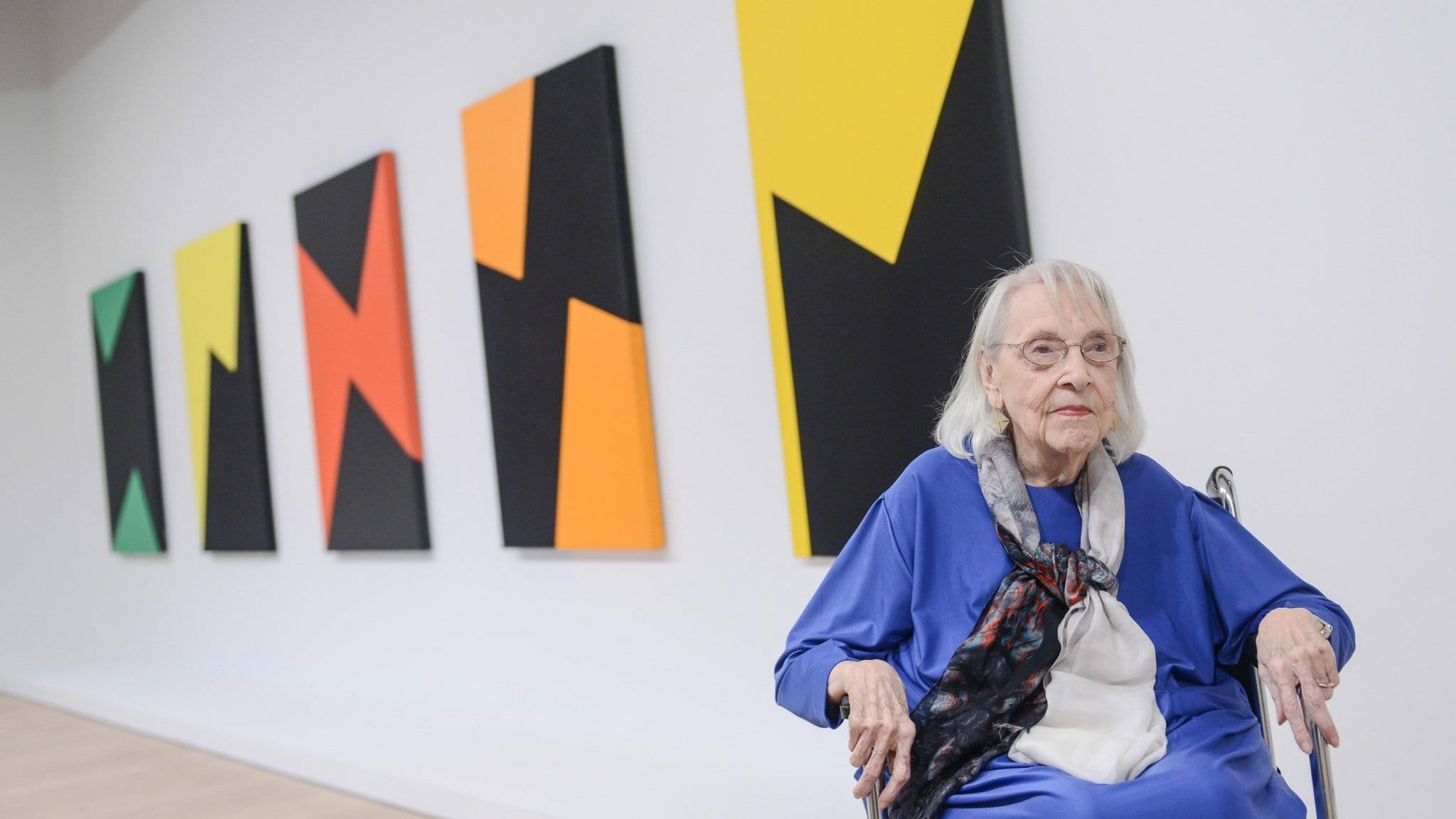
Anti-oversized, and unapologetic about it
The headline of the collection was proportion. After several seasons in which volume was the default setting across the international calendar — the enormous coat, the dropped shoulder, the deliberately swallowed body — Kors sent out narrow, shrunken tailored suits, lean topcoats and miniskirt suits cut close enough to read as a statement rather than a fit.
The internal description doing the rounds afterwards was "anti-oversized, but chic, sharp, neat," and as a piece of trend signalling it is worth taking seriously. Kors is not a designer who reverses proportion for the pleasure of the reversal; his commercial machine depends on being roughly six months ahead of what a large number of women will actually want to buy. A narrow shoulder and a short, sharp skirt suit at MoMA in September is a fairly explicit forecast.
Herrera, Calder, Kelly — and Edie Sedgwick
The art references were specific rather than decorative. Kors named Carmen Herrera, Alexander Calder and Ellsworth Kelly as the collection's touchstones, and the influence read clearly: minimalist colour-blocking as a structural device rather than a print, hard geometric divisions running down a body, and a palette pitched at mid-century Pop — Kelly green, tomato red, sunshine yellow, built up through layering rather than applied flat.
Herrera in particular is a telling choice. The Cuban-American painter spent decades making rigorously reduced, hard-edged abstractions in near-total obscurity before the art world caught up with her in her nineties, and her work is essentially about the emotional force of an exactly placed line. Translated into a coat, that means a seam doing the job a print would normally do.
Alongside the painters sat a more louche set of references — Edie Sedgwick, the singer Nico, a Wassily chair — which is where the collection got its looseness. The most fanciful pieces were body-conscious crepe dresses covered in hand-melted paillettes, one of which Kors reportedly framed as being "for every martini drinker in the world": the artful little black dress with curved cutouts, sold without irony.
Elsewhere, abstraction turned literal in the best sense — a floral appliqué coat, a ballooning midi-skirt that provided the one deliberate exception to the narrow rule, and a sleeveless tulip-shaped dress that owed more to Matisse's cut-outs than to any garment reference.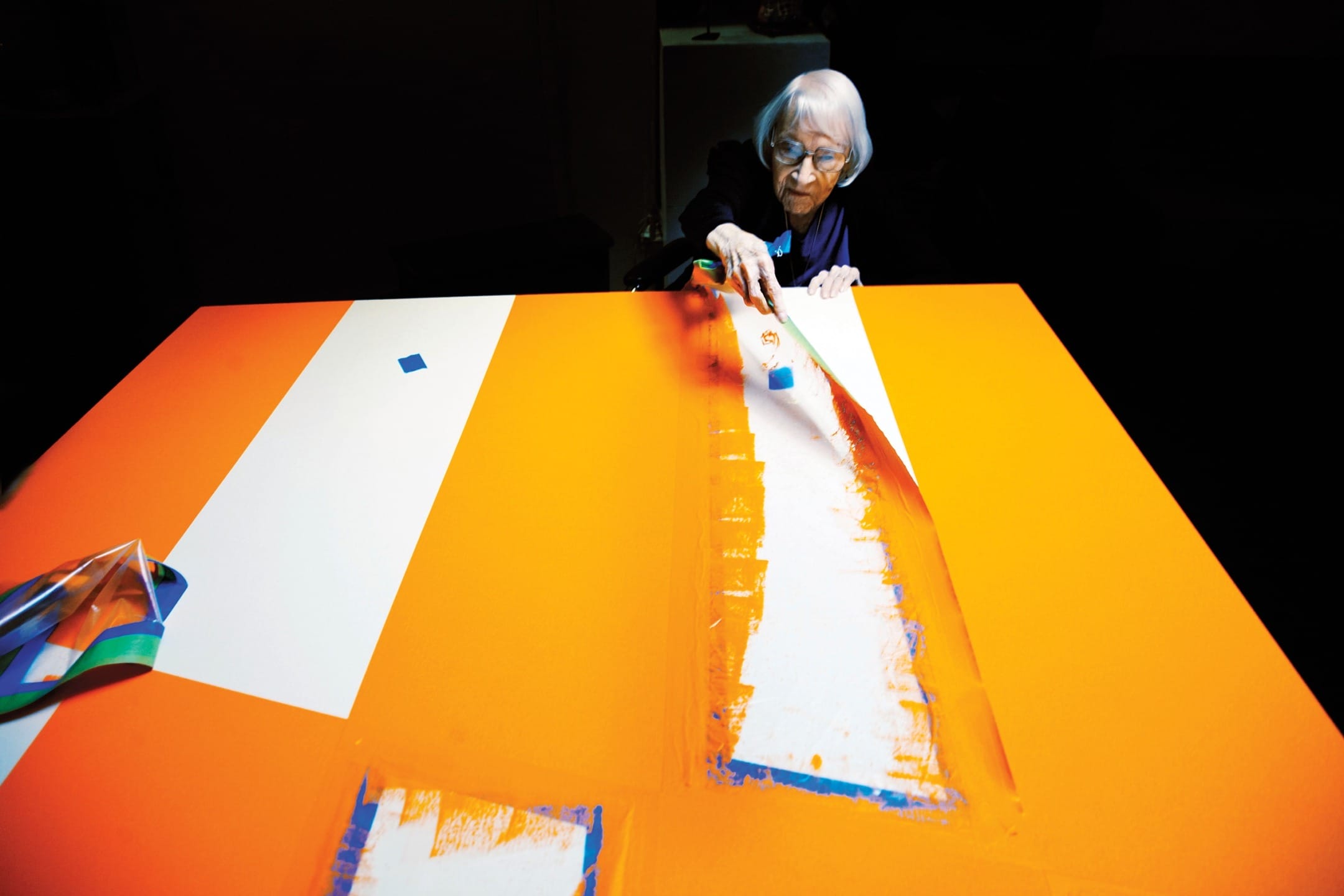
The accessories did the heaviest lifting
As is often the case at Kors, the commercial engine was on the arm. Sculptural bags held by rigid silver hoops were the show's most photographed object, and leather coin purses were restyled as layered necklaces — a genuinely new idea in a category that rarely produces them. Outsize bauble rings recurred throughout, doing something close to what a Calder mobile does: introducing a single unbalanced element that makes everything around it look composed.
Beauty was kept almost aggressively plain — clean skin, no contour — punctuated by the occasional red lip or a flash of neon-yellow eyeshadow. In a garden full of sculpture, faces were treated as another surface to leave alone.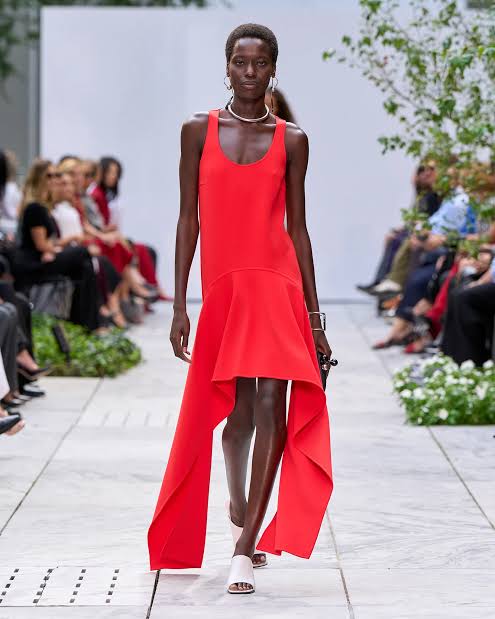
The room
The front row read as a fairly precise map of who the brand is speaking to: Gabrielle Union, Olivia Munn, Lea Michele, Jordyn Woods, Chloe Fineman, Grace Van Patten, Jackson White and brand ambassador Danny Ramirez. It is a list that spans network television, film, comedy and social platforms, which is roughly the coalition an American megabrand now needs to assemble in order to be seen.
The show sat in the middle of a New York Fashion Week running September 10 to 15 with around seventy runway shows and presentations on the official CFDA calendar — a compressed week carrying a lot of institutional weight, including the first season in which fur is prohibited from the official schedule.
What this means for you
Three things are worth taking from this show if you buy clothes rather than write about them.
First: the silhouette is turning. If you have spent three years buying deliberately oversized tailoring, the next cycle is going to be narrower and shorter, and the pieces that will look most dated soonest are the ones whose entire identity was volume. That is not a reason to replace a wardrobe — it is a reason to buy the next jacket closer to the body.
Second: colour-blocking is returning as construction rather than decoration. The difference matters practically. A garment where the colour division follows a seam ages far better than one where it is printed on, and it flatters more reliably because it is working with the body's structure instead of across it.
Third: the jewellery-as-accessory idea — the coin purse worn as a necklace, the bag suspended from a hard hoop — is the most immediately copyable thing in the collection, and it will be everywhere by spring at every price point.
As for the museum: the clothes did not lose. Standing among Calders and Rodins, a narrow yellow suit read as exactly what Kors said it was — an object designed with intent, meant to be looked at, and then, unlike everything else in that garden, meant to be worn out of the building.



