TECH NEWS
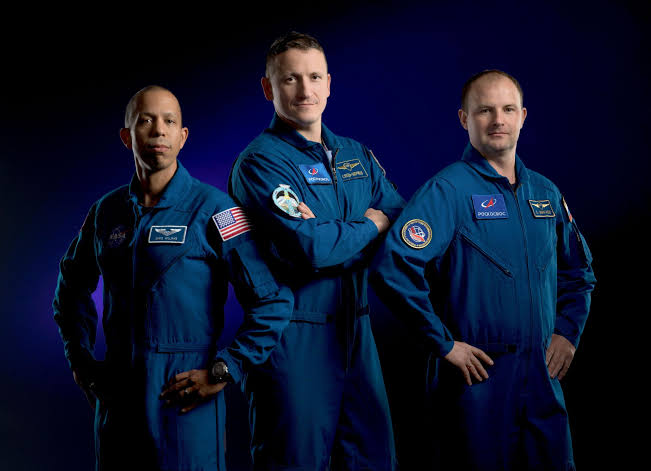
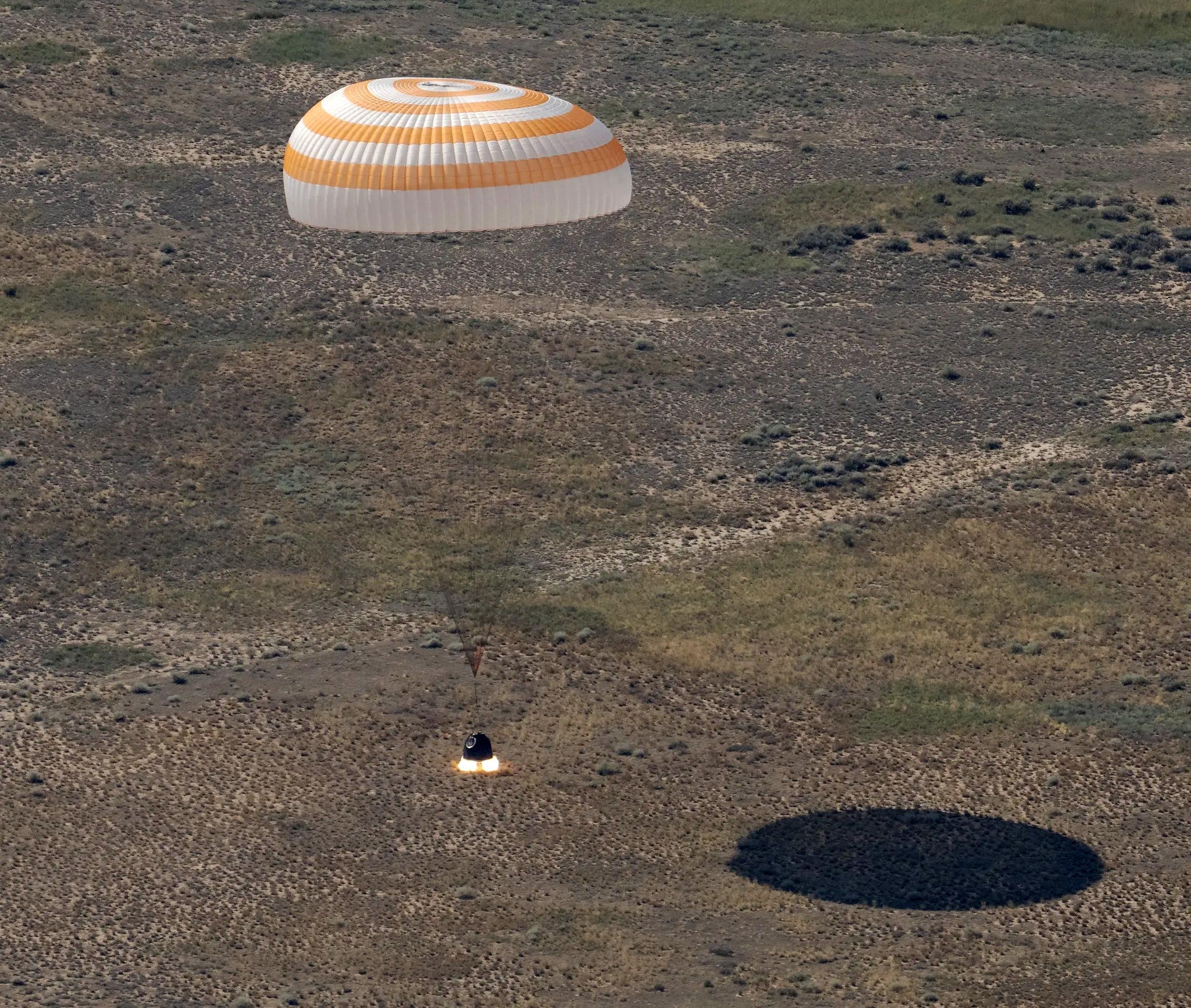
The parachutes came first — three enormous orange-and-white canopies blooming against a pale steppe sky — and then, seconds later, the scorched, soot-blackened capsule itself, thumping down onto the grass of central Kazakhstan like a meteorite that had somehow remembered how to fly a spacecraft. Inside were three people who had not felt the pull of true gravity in eight months: NASA astronaut Chris Williams and Russian cosmonauts Sergey Kud-Sverchkov and Sergei Mikaev, home at last after 241 days aboard the International Space Station.
It was 5:27 a.m. Central Daylight Time on July 26 — 3:27 p.m. local Kazakhstan time — when the Soyuz MS-28 capsule slammed into the atmosphere and, moments later, into the earth itself, southeast of the town of Dzhezkazgan. Recovery teams already fanned out across the landing zone had the hatch open within minutes. All three crew members were pulled from the capsule and handed to waiting medical staff within half an hour, blinking in sunlight their bodies hadn't processed in eight months, their inner ears scrambling to remember which way was up.
It is a scene that has played out dozens of times since the Soyuz program began, and yet it never quite loses its strangeness: human beings returning from a 102-million-mile round trip, not to a hero's parade, but to a folding chair set up in a field, a blanket, and a bowl of soup.

THE NUMBERS BEHIND THE MISSION
The statistics alone are dizzying. Over 241 days, the Expedition 74 crew orbited Earth 3,856 times, racking up more than 102 million miles — enough distance to make the round trip to the sun and most of the way back again. They launched together on November 27, 2025, meaning Williams effectively skipped an entire Earth winter, spring, and half of summer while circling the planet roughly every 90 minutes, watching 16 sunrises and 16 sunsets a day.
For Kud-Sverchkov, it was his second long-duration flight. For Mikaev, and notably for Williams, it was their first. And Williams's path to the hatch of that capsule was anything but a straight line.
FROM CANCER WARDS TO ORBIT
Unlike the fighter-pilot-to-astronaut pipeline that produced so many of NASA's early spacefarers, Chris Williams arrived at the space program by way of hospital radiology suites. Born in New York City in 1983, Williams earned a physics degree from Stanford in 2005 before heading to MIT, where he completed a PhD in astrophysics in 2012 — work that included helping build the Murchison Widefield Array, a sprawling radio telescope now operating in the Australian outback that studies the earliest light in the universe, from the so-called Epoch of Reionization.
But Williams didn't stay pointed at the stars. He pivoted into medicine, training as a board-certified medical physicist at Harvard Medical School, then working at Brigham and Women's Hospital and the Dana-Farber Cancer Institute, where he helped lead efforts in MRI-guided radiation therapy — a technique that lets doctors aim cancer-killing radiation with far more precision by watching tumors move in real time under a scanner. It's the kind of résumé line that sounds almost incongruous next to "astronaut," and yet it's exactly the sort of hybrid expertise NASA has been actively recruiting: scientists who can also serve as human test subjects, technicians, and engineers on missions bristling with medical and materials-science experiments.
NASA selected Williams as an astronaut candidate in December 2021. He reported to Johnson Space Center the following January to begin two years of basic training — a program that turns physicists and doctors and geologists into people who can also fly a Soyuz-adjacent emergency procedure, operate a robotic arm, and survive a spacewalk. By November 2025, he was strapped into a rocket.
EIGHT MONTHS OF SCIENCE, TWO SPACEWALKS, AND A LOT OF WORKOUTS
Expedition 74 wasn't a joyride. Over the course of 241 days, Williams contributed to a packed research docket that read like a highlight reel of where space science is actually headed in 2026. He helped install and test a new modular workout system designed specifically for long-duration missions — the kind of hardware that will matter enormously once crews are spending years, not months, in transit to Mars, since muscle and bone loss remain one of spaceflight's most stubborn unsolved problems.
He also supported experiments aimed at improving cryogenic fuel efficiency — critical groundwork for any future mission that needs to store super-cold rocket propellant for long stretches without it boiling away — and worked on growing semiconductor crystals in microgravity, where the absence of convection currents lets crystals form with far fewer defects than anything grown on Earth. That research feeds directly into next-generation computer chips and electronics, an area where even tiny purity gains translate into real performance jumps.
Perhaps most strikingly, given his oncology background, Williams contributed to research aimed at new cancer treatments conducted aboard the station — continuing, in orbit, a version of the work he'd been doing in Boston hospitals. He also helped NASA test new re-entry safety protocols intended to protect future crews, and ventured outside the station twice for spacewalks, tasks that remain among the most physically demanding and genuinely dangerous things a human being can do.
THE HANDOVER
The crew's exit from the station wasn't casual. Saturday morning — the day before landing — began with a formal change-of-command ceremony aboard the ISS, during which Kud-Sverchkov handed control of the station over to NASA astronaut Jessica Meir, officially closing out Expedition 74 and opening Expedition 75. It's a ritual with real teeth: for the hours until the next crew is fully staffed and settled, a single person is formally accountable for the station's operations, a floating laboratory the size of a football field worth tens of billions of dollars.
Only after that handover did the trio climb into the Soyuz MS-28 capsule, seal the hatch, and begin the slow, carefully choreographed process of undocking, orbital repositioning, and the final deorbit burn that commits a spacecraft to falling back to Earth whether everything goes right or not.
THE LANDING, MINUTE BY MINUTE
Soyuz landings are simultaneously the most routine and most violent moments of modern human spaceflight. The capsule undocked at 2:03 a.m. Central Daylight Time. What follows is a sequence that hasn't changed much in structure since the 1960s: a period of free-drift, a precisely timed engine burn that pins the capsule's fall into a corridor over Kazakhstan, then the fireball of re-entry as the vehicle's heat shield takes the brunt of friction against the thickening atmosphere, glowing orange-white and shedding charred material as it goes.
Parachutes deploy in stages — a small pilot chute, then a larger drogue, then the massive main canopy — slowing a capsule that was moments earlier traveling at orbital velocity down to a relatively survivable few meters per second. Just above the ground, solid-fuel retrorockets fire in a final braking pulse a fraction of a second before touchdown. Even done perfectly, it feels less like landing and more like a controlled car crash, which is part of why recovery teams and medical staff are already on-site and moving before the capsule has stopped rocking.
Within 30 minutes, all three crew members were out and in medical care. Standard post-landing checks followed before the crew boarded a helicopter to nearby Karaganda, where recovery teams were headquartered. From there, Williams boarded a NASA aircraft bound for Johnson Space Center in Houston, beginning the long, deliberately unhurried process of physical rehabilitation that every long-duration astronaut goes through — relearning how to walk without stumbling, how to stand without swaying, how to let gravity pull blood back down into legs that spent eight months forgetting it existed.

EXPERT PERSPECTIVE
Spaceflight physicians have spent decades documenting what happens to a body after 241 days without weight: bone density drops, particularly in the hips and spine, at a rate that can rival osteoporosis in the elderly if left unmanaged. Fluid that would normally pool in the legs redistributes toward the head, puffing faces and straining eyes — a phenomenon researchers call Spaceflight-Associated Neuro-ocular Syndrome, which can produce lasting changes in vision. Muscle mass, especially in the legs and core, atrophies without gravity's constant resistance, which is exactly why the modular workout system Williams helped install and test matters so much: NASA's long-term bet is that better in-flight exercise hardware is one of the few tools that meaningfully blunts these effects, and every long-duration mission is effectively a live experiment refining that hardware for the Mars-class missions still to come.
The medical physics angle matters too. Researchers studying MRI-guided radiation therapy — Williams's specialty before NASA — have increasingly pointed to microgravity research as a source of unexpected insight into imaging and radiation biology, since the same real-time tracking challenges that matter for tumors on Earth show up, in different form, when trying to monitor astronaut health during long flights.
WHAT THIS MEANS FOR YOU
It's tempting to file stories like this under "nice, but irrelevant" — three people came home from space, life goes on. But the specific science packed into Expedition 74 has a way of trickling down faster than people expect. Semiconductor crystals grown in microgravity have historically informed manufacturing techniques used in the chips inside phones and laptops. MRI-guided cancer therapy, the exact discipline Williams practiced before launch, is already reshaping radiation oncology in hospitals well beyond NASA's orbit. And the re-entry safety protocols tested on this mission are direct inputs into how NASA plans to bring crews home safely from the Moon and, eventually, Mars — missions that will need re-entry systems working far more reliably than a single Soyuz capsule thumping into a Kazakh field.
There's also a simpler, more human takeaway. Williams represents a growing category of astronaut: not a test pilot first, but a working scientist and clinician who spent a career treating cancer patients before spending eight months as a human research subject and construction worker in orbit. As NASA and its partners plan longer, more ambitious missions — a return to the Moon under Artemis, and eventually crewed trips to Mars — that hybrid profile, half scientist, half endurance athlete, is likely to become the norm rather than the exception.
CONCLUSION
For now, Chris Williams, Sergey Kud-Sverchkov, and Sergei Mikaev are back on solid ground, beginning weeks of physical therapy to reverse eight months of adaptation to weightlessness. Expedition 75 has already begun without them, under the command of Jessica Meir. But the 3,856 orbits, the two spacewalks, the cryogenic fuel tests, the semiconductor crystals, and the cancer research they leave behind on the station will keep paying dividends long after the bruises from a Kazakh-steppe landing have faded — a reminder that the unglamorous, workmanlike middle of a space mission is very often where the real value gets made.
Published By | Tech Wiz