Background
Russia's full-scale invasion of Ukraine, now in its fifth year, has settled into a grinding, attritional fight along a roughly 1,000-kilometer front line, with neither side achieving a decisive breakthrough despite periodic shifts in momentum. Russian forces captured the eastern city of Pokrovsk and neighboring Myrnohrad in December 2025 after a prolonged siege, but have struggled since to translate that gain into further territorial advances; Russia's spring-summer 2026 offensive seized roughly 30 square kilometers of territory in June alone, advancing at an average pace of about one square kilometer per day, according to open-source military analysts tracking the front.
Diplomatically, the year has brought a string of short-lived truces — including ones in April and May 2026 — none of which held for long, alongside repeated rounds of talks between senior American and Russian officials. The war has also been marked by domestic upheaval in Kyiv: a corruption scandal that forced out President Volodymyr Zelensky's chief of staff late last year eventually contributed, in mid-July, to the dismissal of Prime Minister Yuliia Svyrydenko and, days later, the removal of longtime commander-in-chief Gen. Oleksandr Syrskyi amid the country's largest protests since the war began.
Zelensky has repeatedly said he wants Ukraine to win the war outright but has also signaled growing openness to a negotiated ceasefire, telling reporters recently that "if tomorrow we can achieve a ceasefire, it's better than continuing to fight to the bitter end, but losing all our people." He has said he is ready to sign a peace agreement in the United States in Trump's presence, underscoring how central Washington has become to any eventual settlement.
The reshuffle in Kyiv installed Naftogaz chief executive Serhii Koretskyi as prime minister in place of Svyrydenko, while battle-tested Gen. Mykhailo Drapatyi took over the top military command from Syrskyi, whose Soviet-style command culture and high-casualty assault tactics had drawn sustained criticism from soldiers and the public. Both changes were widely read as an attempt by Zelensky to shore up domestic legitimacy ahead of any serious push for a negotiated end to the war, on the theory that a government seen as clean and competent will have more credibility asking Ukrainians to accept a difficult settlement. On the European track, the removal of Hungary's veto over Ukraine's EU accession — following Viktor Orban's ouster in an April landslide — allowed Brussels to open a fourth negotiating cluster this month, and the European Union has separately approved its largest single package of Russia sanctions since the war began, targeting the supply chain behind Moscow's Shahed and Geran attack drones. Those parallel European efforts continue regardless of whether the Washington-brokered air-truce idea goes anywhere, giving Kyiv more than one diplomatic track to lean on.
Key Developments
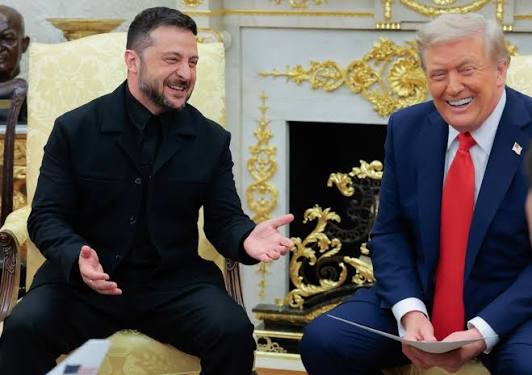
The clearest sign of renewed diplomatic momentum came this week with confirmation that Zelensky and Trump will meet at the White House on Tuesday, July 28. The visit coincides with a memorial service in Washington for Sen. Lindsey Graham, the South Carolina Republican and vocal Ukraine supporter who died July 11 at age 71; two senior officials say the exact format of the Trump-Zelensky encounter is still being worked out, and could take the form of a brief sideline conversation at the funeral, a separate private meeting, or a full official White House visit. Israeli Prime Minister Benjamin Netanyahu is also expected in Washington around the same period, setting up a rare stretch of back-to-back high-profile talks for Trump.
Ahead of the meeting, Ukrainian and American officials have been discussing a proposal for what both sides are calling an "air truce" — a mutual halt to long-range missile and drone strikes on each other's territory, even as ground combat continues along the front line. According to Reuters reporting cited by multiple outlets, U.S. officials increasingly believe Russia may be more receptive to an air ceasefire now than it was a few months ago, though the specific parameters of such a proposal — including verification mechanisms, geographic scope and duration — have not been publicly disclosed.
The idea itself is not new: a version of an air truce was discussed roughly a year ago without result, and Kyiv now appears to be trying to persuade Trump to formally adopt the concept and present it as an official U.S.-backed peace proposal to Moscow. The push follows an inconclusive meeting on July 23 between Secretary of State Marco Rubio and Russian Foreign Minister Sergey Lavrov on the sidelines of the ASEAN Regional Forum in Manila — their fourth meeting since 2025 — in which the two diplomats spent roughly 35 minutes discussing the war and the state of U.S.-Russia relations without announcing any breakthrough. A State Department readout said only that the two "discussed the U.S.-Russia relationship and the need to end the Russia-Ukraine war," while Lavrov reiterated Russia's stated readiness for a "political and diplomatic settlement."

Reactions
The Kremlin's public posture has been cautiously noncommittal. Spokesman Dmitry Peskov said earlier in July that the idea of "closing the sky" was a new proposal that had not previously been discussed in depth, and more recently reiterated only that Moscow "remains open to the negotiation process" without directly endorsing the air-truce concept. That ambiguity mirrors a broader pattern this year: Russian officials have periodically voiced openness to talks while continuing near-daily missile and drone strikes on Ukrainian cities and energy infrastructure.
In Washington, the timing of the Trump-Zelensky meeting alongside Graham's memorial service has taken on symbolic weight. Graham, one of the most hawkish pro-Ukraine voices in the Senate, made ten wartime visits to Kyiv and was a persistent advocate for additional Patriot air-defense batteries and tougher sanctions on Russia; his death removed an influential congressional champion for continued U.S. support at a delicate moment in the diplomacy. Kyiv has not yet formally confirmed whether Zelensky will attend the memorial service itself in addition to meeting Trump, and Ukrainian officials have been notably tight-lipped about the substance of the emerging air-truce proposal — a reticence that reflects both the sensitivity of pre-negotiation diplomacy and Kyiv's wariness of repeating earlier truces that Russia was accused of violating within days.
European governments, which have grown increasingly central to sustaining Ukraine's war effort as U.S. support has become more conditional and unpredictable, have not issued detailed public reactions to the specific air-truce idea, though the broader push for a negotiated settlement continues to run alongside separate, slower-moving European-led efforts, including Ukraine's EU accession process and ongoing sanctions packages targeting Russia's drone and missile supply chains.
What's Next
The July 28 Trump-Zelensky meeting will be the most closely watched test yet of whether the air-truce concept can move from informal discussion to a formal proposal presented to Moscow. Ukrainian officials appear to view a limited air ceasefire as a more realistic near-term goal than a comprehensive settlement, given that a full ceasefire would require resolving far more contentious issues, including territorial control in the east and the future size and posture of Ukraine's armed forces.
Much will depend on whether Trump personally embraces the proposal and is willing to press it directly on Vladimir Putin, and on how the two leaders' meeting is ultimately structured given the competing logistics of Graham's funeral and, potentially, parallel talks with Netanyahu. On the ground, the war shows no sign of pausing in the meantime: Russian forces continue to press in the Pokrovsk-Kostiantynivka sector, the most active part of the front, while Ukraine continues its own long-range strikes against Russian energy and military infrastructure.
Analysts will also be watching whether the Rubio-Lavrov channel, revived for a fourth time this year in Manila without a breakthrough, produces any follow-up before or after the Washington meeting. If Russia rejects or slow-walks the air-truce idea, it would mark yet another instance in a now-familiar pattern of periodic diplomatic openings in the war that fail to translate into a durable de-escalation.
There is also a domestic American dimension to watch. Congress has grown increasingly divided over the scale and conditions of continued U.S. support for Ukraine, a divide sharpened by the Trump administration's parallel military commitments in the Iran war and by Graham's death, which removed one of the Senate's most consistent voices for sustained Ukraine funding. Whether the White House frames a limited air truce as a step toward broader U.S. disengagement from the conflict, or as the opening move in a more ambitious peace push that could eventually involve new security guarantees for Kyiv, will shape how the proposal is received not only in Moscow but in Washington and European capitals as well.
Published By | News Editor